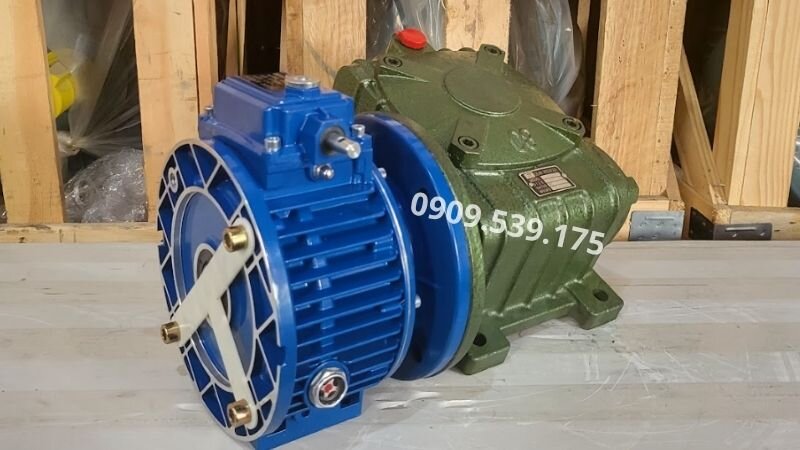
The 2-Stage Mechanical Speed Variator, also known as a 2-stage speed regulating device, is a mechanical transmission device used to flexibly change the output rotation speed of an electric motor, similar to a gearbox. When combined with an electric motor, this device forms a gear motor, allowing the selection of two different operating speeds to suit specific working conditions.
2-Stage Mechanical Speed Variator at Thanh Thai Motor.
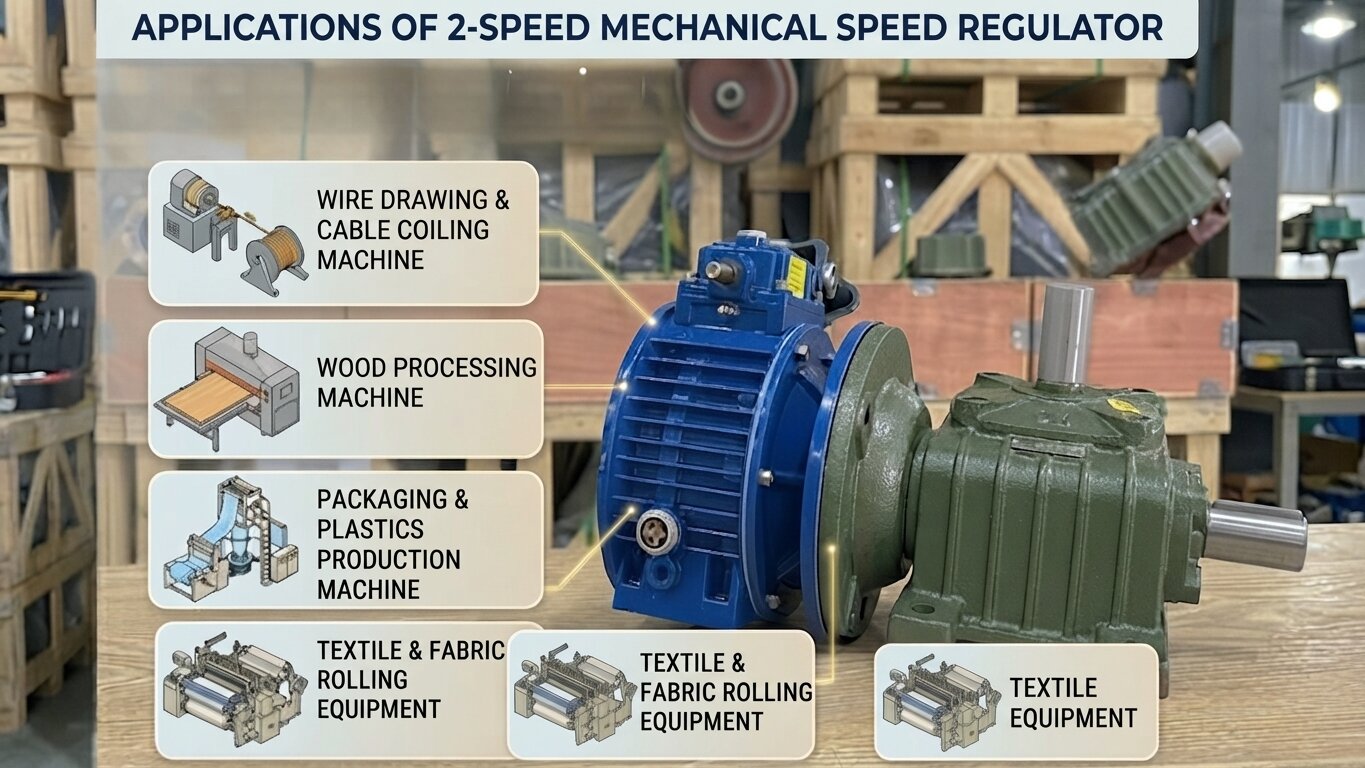
Applications of 2-Stage Mechanical Speed Variator
Production lines requiring a wide speed range: The 2-stage mechanical speed variator provides two transmission stages, allowing for more flexible speed adjustments compared to the 1-stage type, making it suitable for systems with multiple operating modes.
Wire drawing and cable coiling machines: Helps adjust the wire retrieval or payout speed according to each production stage.
Woodworking machinery: Commonly installed on sanding, polishing, or material-feeding equipment that requires changing working speeds depending on the product type.
Packaging and plastics manufacturing machinery: Supports stable control of film drawing, film winding, or feeding speeds.
Industrial material mixing machines: Allows adjustment of mixing speeds for each material processing stage.
Textile and fabric rolling equipment: Easily adjusts operating speeds to suit various material types and production requirements.
Applications of 2-Stage Mechanical Speed Variator.
Advantages of 2-Stage Mechanical Speed Variator
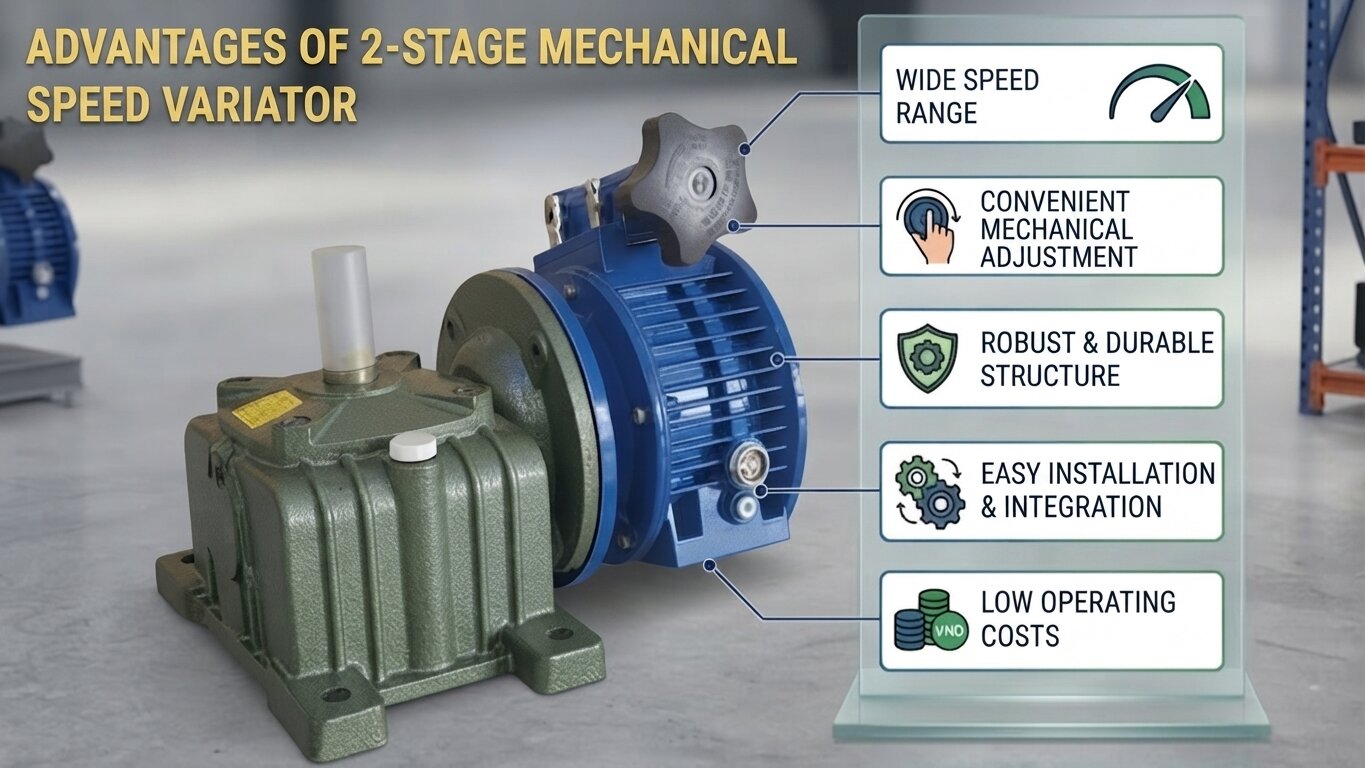
Wider speed adjustment range: By combining two transmission stages, the device can meet various speed levels within the same system.
Convenient speed adjustment: Operators can mechanically change speeds without using complex electronic controllers.
Sturdy construction: The variator housing is typically made of cast iron or aluminum alloy, enhancing rigidity and vibration resistance.
High-durability transmission components: Friction surfaces and power transmission parts are typically machined from wear-resistant alloy steel, suitable for continuous working conditions.
Easy combination with motors and gearboxes: Convenient for installation on various types of industrial machinery.
Low operating cost: Does not require complex control systems, and maintenance and component replacement are relatively simple.
Advantages of 2-Stage Mechanical Speed Variator.
Latest 2-Stage Mechanical Speed Variator Price List at Thanh Thai Motor
Below is the latest reference price list for the 2-Stage Mechanical Speed Variator at Thanh Thai Motor. Products are classified by power, speed adjustment range, and mounting type, making it easy for customers to select the right model for their machine’s operating requirements.
Criteria for Choosing a 2-Stage Mechanical Speed Variator
Determine the required speed range: This is the most important factor for selecting the correct variator model to fit the machinery.
Check the paired motor power: The mechanical speed variator must be compatible with the motor power to ensure stable transmission capability.
Evaluate actual operating loads: Heavy-load or continuous-duty applications require selecting a model with appropriate load-bearing capacity.
Pay attention to manufacturing materials: Prioritize lines with sturdy cast iron housings and alloy steel transmission details to increase equipment lifespan.
Check installation dimensions: Includes shaft diameter, flange, and actual installation space before ordering.
Choose a reputable supplier: This ensures greater convenience during warranty, maintenance, and component replacement when needed.
Additionally, customers can refer to more compilation videos at Thanh Thai Motor. These gearbox videos share practical coupling schemes, methods for selecting gear ratios, appropriate motor power, installation guides, and operational experience across various industrial applications.
Frequently Asked Questions
I am using a 3HP motor combined with a 2-Stage Mechanical Speed Variator for a film winding machine. When the film roll is nearly full, the speed drops noticeably. What is the cause?
This is a quite common phenomenon. As the film roll diameter increases, the load torque also increases. If the mechanical speed variator was chosen too close to the load limit or the motor lacks sufficient torque margin, the output speed will drop when the roll is nearly full. In this case, you need to recheck the actual load or increase the size of the variator unit.
A 2-Stage Mechanical Speed Variator installed on a 20m long conveyor often slips during loaded startup. How should this be handled?
For long conveyors or heavy loads, starting torque should be calculated instead of relying solely on motor power. In many cases, it is necessary to increase the variator size or change the gearbox gear ratio to reduce pressure on the friction mechanism.
I want to reduce the pellet press speed from 70 rpm to 40 rpm. Should I adjust across the entire speed range?
It is not recommended to operate frequently at the lowest limit of the adjustment range. The practical solution is to recalculate the gearbox gear ratio so that the main working speed lies near the middle of the adjustment travel.