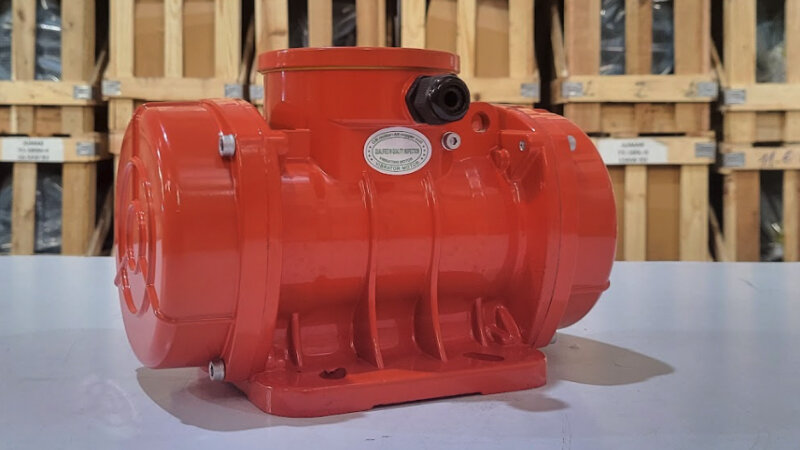
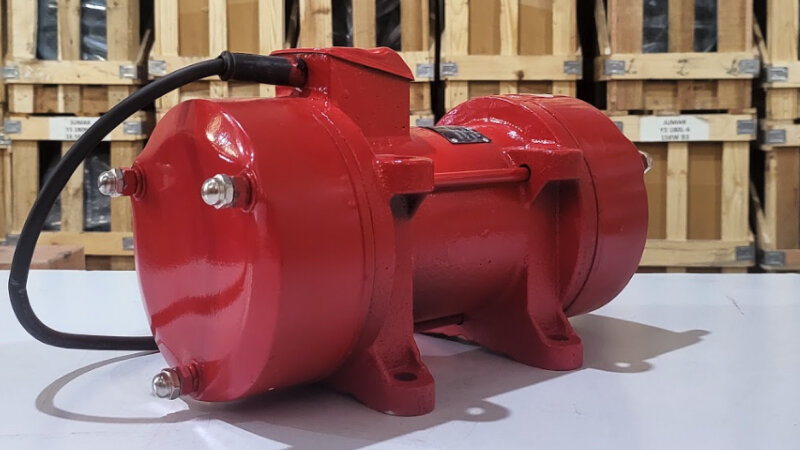
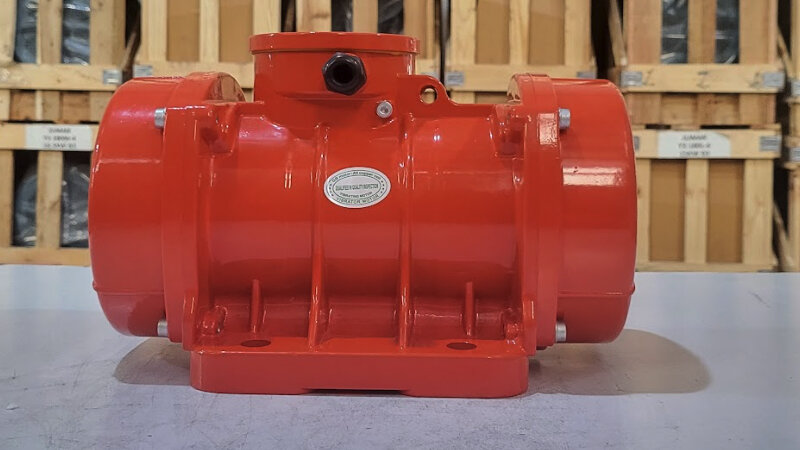
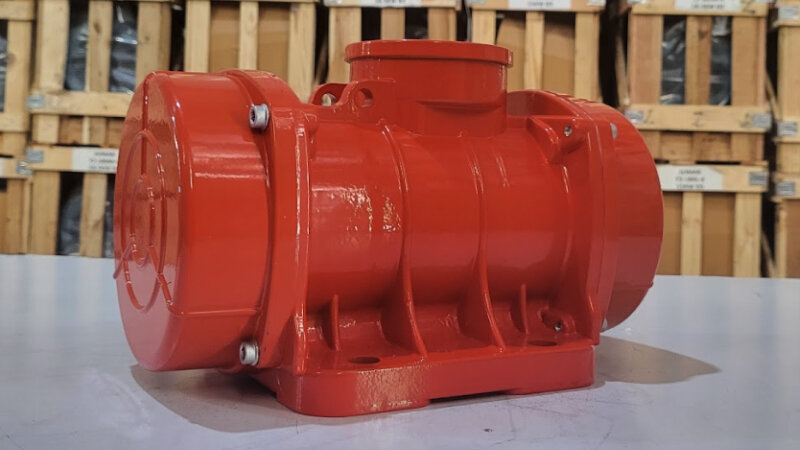
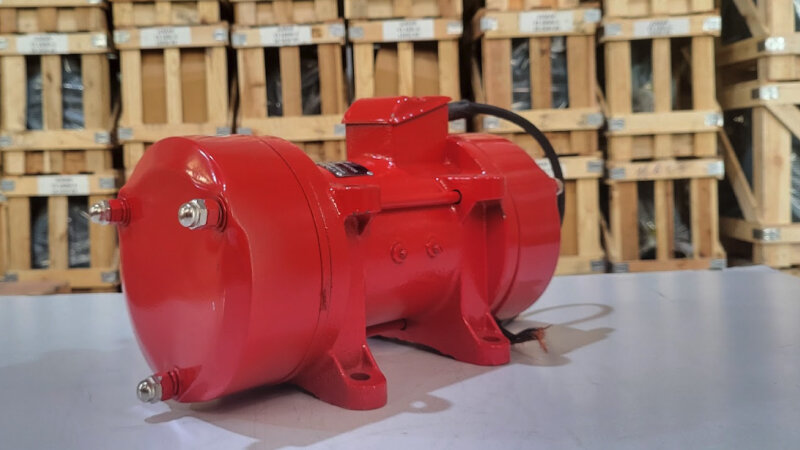
Vibratory equipment (also known as vibrating motors or vibratory compactors) is an electromechanical device that converts electrical energy into mechanical energy in the form of continuous vibration or oscillating force. Unlike conventional motors in fans or water pumps that rotate steadily to transmit power, vibratory equipment is intentionally designed to be “unbalanced,” generating vibration.
Vibratory equipment is an electromechanical device that generates vibratory force
Structure of vibratory equipment
Vibratory equipment consists of two main parts:
Electric Motor: This part generates rotational motion and can be a 1-Phase Electric Motor or a 3-Phase Electric Motor.
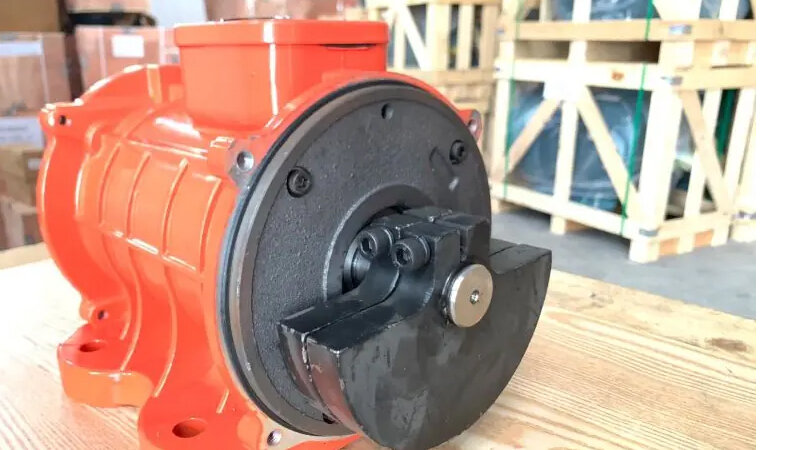
Eccentric weights: This is the most crucial component, located at both ends of the motor shaft, with an asymmetrical shape (often semi-circular or fan-shaped).
Structure of vibratory equipment
Operating principle of vibratory equipment
The operating principle of vibratory equipment is based on the centrifugal force generated by an unbalanced rotating mass.
When power is supplied, the electric motor begins to rotate, causing the motor shaft and the eccentric weights attached to it to spin at high speed.
Because these weights are eccentrically mounted (their center of gravity is not on the axis of rotation), they generate a very large centrifugal force outwards when rotating.
As the weights continuously rotate around the axis, the direction of this centrifugal force also continuously changes 360 degrees with each rotation. This continuous and rapid change in force direction acts on the motor casing and base, creating vibratory motion.
Classification of vibratory equipment
Vibratory equipment is classified as follows, according to the voltage used and the vibratory force adjustment mechanism:
Classification by voltage
1-Phase vibratory equipment
1-Phase vibratory equipment 0.5kW
1-Phase vibratory equipment uses a 220V power supply. It is typically used in compact systems such as vibrating screens for sorting grains, sand, or stones, suitable for household and small-scale industrial applications.
3-Phase vibratory equipment
3-Phase vibratory equipment 0.95kW
3-Phase vibratory equipment uses a 3-phase power supply (220/380V or 380/660V). This type of motor is popular and applied in large industries, agriculture, and even residential settings due to its powerful operation and high efficiency.
Classification by control mechanism
Vibratory equipment with adjustable vibration amplitude
Vibratory equipment with adjustable vibration amplitude
Allows users to flexibly adjust the vibration level to suit specific work requirements. Suitable for applications requiring high precision or frequent changes in vibration mode.
Vibratory equipment with non-adjustable vibration amplitude
Vibratory equipment with non-adjustable vibration amplitude
Operates in a fixed mode, not allowing users to interfere with the vibration intensity. An optimal choice for applications requiring stable vibration without changes during use.
Latest price list for vibratory equipment 10/2026 at Thanh Thai Motor
Price list for 1-Phase vibratory equipment
The price of vibratory equipment using a 220V mains supply is determined based on the vibratory force (measured in kg or kN) and the casing material. Costs typically focus on small power models, suitable for food vibrating screens, packaging machines, or equipment requiring moderate impact force in domestic applications.
The pricing for 3-Phase vibratory equipment is based on the centrifugal force (vibratory force) and the adjustability to change the vibration amplitude. Prices depend on the ability to withstand large acceleration forces, preventing loosening or breakage due to high-frequency vibration in industrial screening and compaction environments.
Vibratory equipment price quote video 10/2026 - Thanh Thai Motor
rn
Notes when purchasing vibratory equipment
Prioritize vibratory force over power: The vibratory force must be compatible with the weight of the screen and the material.
Choose the correct rotational speed: Select the appropriate rotational speed or motor poles for the intended use to achieve optimal efficiency.
Adjustability of eccentric weights: This allows for actively changing the vibratory force from 0% – 100% according to actual needs.
Bearing quality: Due to continuous impact, vibratory equipment requires bearings capable of withstanding high acceleration and temperature.
Sealing and protection: Prioritize IP55 or IP65 standards to prevent dust and moisture from entering the windings.
Base structure and wiring: The base must be thick-cast and free of cracks or pitting. The electrical wires at the connection point to the machine should have a spring or protective sleeve to prevent hidden breaks due to prolonged vibration.
Customers can access the vibratory equipment video compilation page to see a practical overview of the vibratory equipment products currently offered by Thanh Thai Motor, select suitable power, and optimize costs.
Frequently Asked Questions (FAQ)
How to adjust the vibratory force of the vibratory equipment according to actual needs?
The vibratory force of the vibratory equipment does not depend on the current but on the opening of the eccentric weights at both ends of the shaft. To adjust, simply remove the two protective covers at the motor ends, loosen the locking screws, and rotate the eccentric steel plates according to the available scale marks. The closer the two eccentric weights are rotated to each other, the greater the centrifugal force, and vice versa.
Important note: You must adjust both ends of the vibratory equipment to exactly the same angle to avoid uneven shaking, which could lead to shaft breakage or winding burnout.
Why does vibratory equipment tend to heat up quickly and burn out more easily than conventional motors?
Due to the nature of operating in an environment of continuous high-intensity vibration, vibratory equipment experiences extremely high mechanical stress on its bearings and windings. The main reasons are often:
Loose base bolts: When the base is loose, the vibratory force resonates back into the motor body, causing thermal resonance and destroying the bearings.
Phase loss or voltage drop: Unstable current prevents the vibratory equipment from achieving sufficient torque to overcome the starting force of the eccentric weights.
When should one vibratory equipment be installed, and when is it mandatory to install a pair of two vibratory equipment?
Installing one vibratory equipment typically creates a swirling vibratory force, suitable for anti-clogging material hoppers or concrete vibrators. However, for screening systems or vibrating machinery that require materials to move in a specific direction, installing a pair of two counter-rotating vibratory equipment is mandatory.