HB-Series Helical Gearbox and T-Series Right-Angle Bevel Gearbox are two specialized drive equipment lines designed to meet operating requirements in harsh industrial environments. With a sturdy structure, high load capacity, and great durability, both types of gearboxes, when combined with electric motors, form gear motors-specifically heavy-duty gear motors-helping machinery operate stably, continuously, and efficiently.
what is an HB-Series helical gearbox
What is an HB-Series Helical Gearbox?
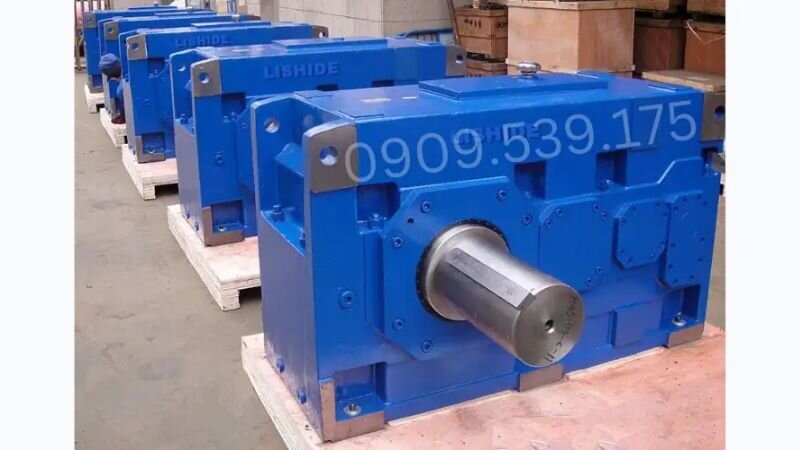
An HB-Series Helical Gearbox is a type of gearbox specifically designed to withstand heavy loads and operate continuously in harsh industrial environments. They are commonly used in applications requiring high durability and powerful power transmission capabilities.
The letters HB are the standardized designation for the combination of two gear series: H (Helical gears) and B (Bevel-Helical gears).
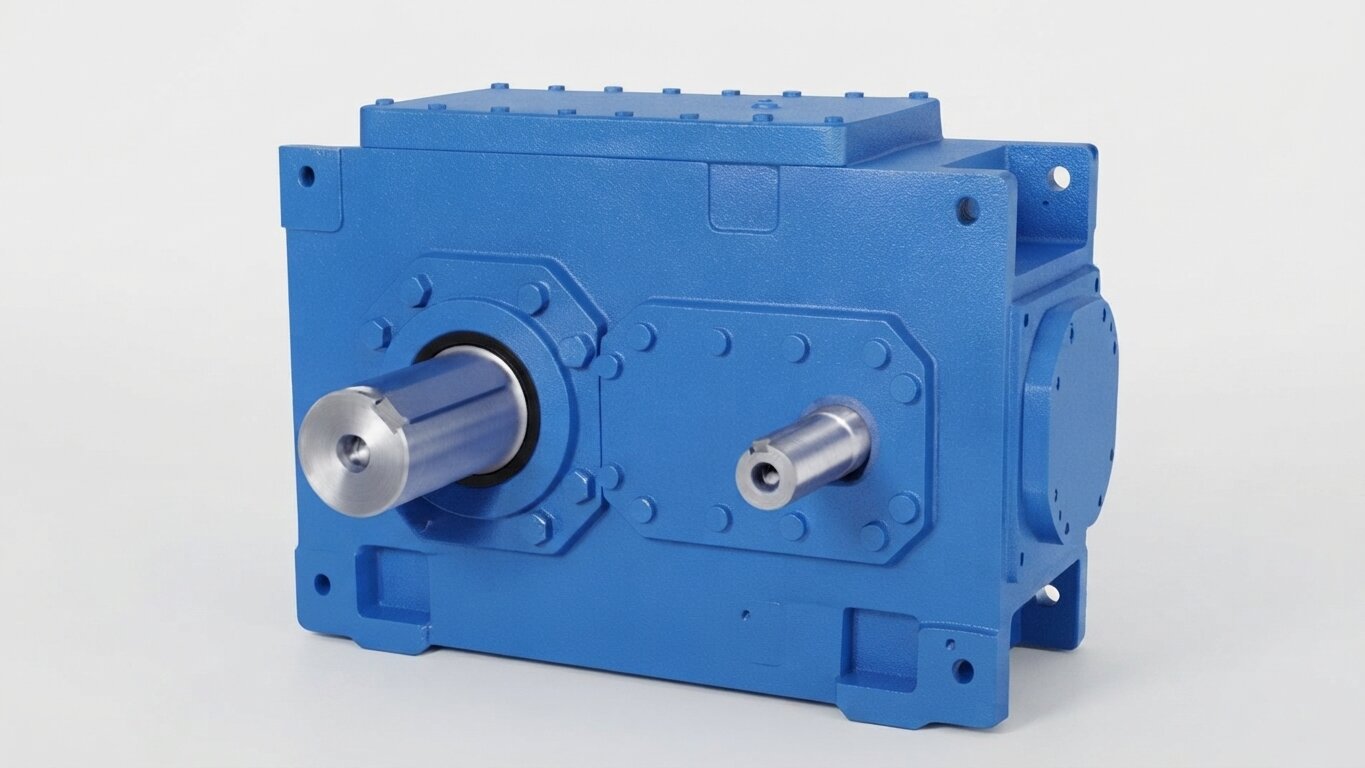
HB-Series Helical Gearbox is a type of gearbox specially designed to withstand heavy loads
Structure of the HB-Series Helical Gearbox
The HB series is divided into two main design types depending on the installation space and drive direction:
H Series (Parallel Shaft): Fully utilizes helical gear pairs. The input and output shafts of the gearbox are parallel to each other.
B Series (Right-Angle Shaft): Uses a bevel gear pair at the initial stage to change the drive direction by 90 degrees, then combines with helical gear pairs. The input and output shafts are perpendicular to each other.
Operating Principle of the HB-Series Helical Gearbox
Basically, the operating principle of the HB-Series Helical Gearbox is based on mechanical transmission via gear meshing. It performs a dual task based on the law of conservation of energy: reducing the rotational speed (RPM) from the input motor to multiply the output torque (pulling force) significantly.
Receiving high speed from the motor → Transmitting through multiple gear stages (from small to large) to reduce speed → Generating enormous torque (pulling force) at the output shaft to drive heavy machinery.
Advantages That Make the HB-Series Ideal for Heavy-Duty Applications
Excellent shock load capacity: The gearbox housing is cast from high-quality gray iron or sturdy welded steel with thick stiffening ribs, helping to absorb vibrations well when machinery starts or suddenly reverses.
High transmission efficiency: The efficiency of helical and bevel gear pairs reaches 94% to 98% per stage, helping save energy and reduce heat generation.
Flexible modular design: Cooling accessories (cooling fans, water-cooling copper tubes), backstops to prevent reverse rotation during power outages, or combinations with fluid couplings can be easily integrated.
The HB-Series Helical Gearbox has high durability, long service life, and minimizes maintenance and replacement costs
Things to Consider When Purchasing an HB-Series Gearbox
Calculate the service factor: This is the most important note. Heavy loads always experience impulses, shocks, or run 24/7. You must not select strictly based on the motor power, but multiply by a service factor (typically 1.5 to 2.5 depending on applications such as conveyors, crushers, or bucket elevators) to choose a gearbox size with excess load capacity.
Check thermal capacity: HB-Series Helical Gearboxes generate significant heat when running continuously. If the thermal capacity of the housing is less than the motor power, the gearbox will overheat, damaging the lubricating oil and seals. In this case, additional accessories must be ordered: cooling fans or water-cooling copper tubes.
Precisely determine shaft direction and output shaft type:
Do you need parallel shafts (H series) or right-angle shafts (B series)?
Is the output shaft a keyed solid shaft or a hollow shaft using a shrink disc to prevent torsional slip?
Backstop (One-way clutch): If used for inclined conveyors or bucket elevators, you must choose a version with an integrated backstop to prevent the system from running in reverse or material slippage during a sudden power outage.
Brand and after-sales service: The HB series requires extremely high mechanical precision. You should choose reputable brands with readily available replacement accessories (such as oil seals, bearings) and on-site maintenance capabilities, as moving a gearbox weighing several tons is extremely difficult.
what is a T-Series right-angle bevel gearbox
What is a T-Series Right-Angle Bevel Gearbox?
A T-series right-angle bevel gearbox (also known as a 90-degree directional gearbox or T-series mechanical speed variator) is a mechanical device used to change the torque transmission direction (usually at a 90-degree right angle) from a power source (such as a motor) to other industrial equipment.
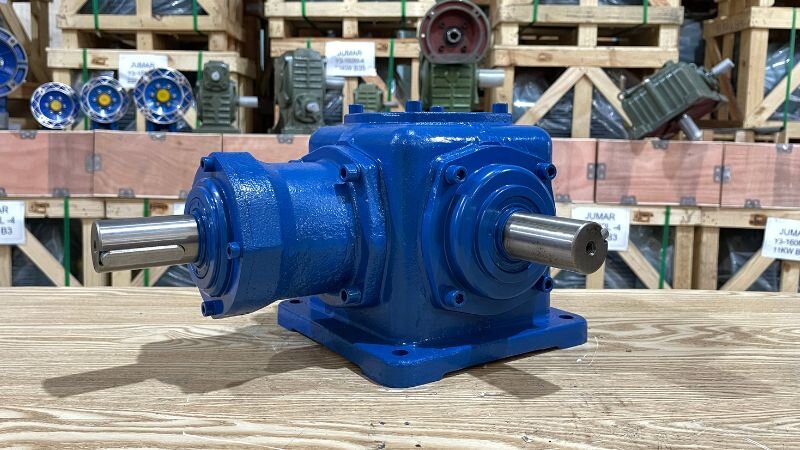
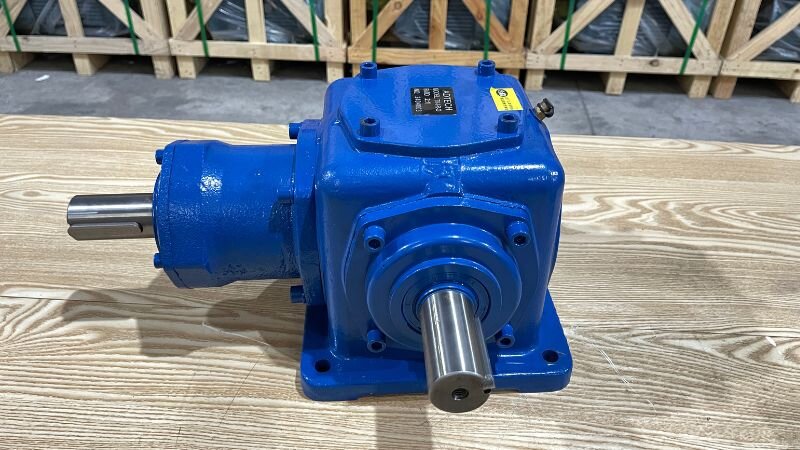
A T-Series Right-Angle Bevel Gearbox is a mechanical device used to change the transmission direction
Structure of the T-Series Right-Angle Bevel Gearbox
The T-series right-angle bevel gearbox operates based on a system of meshing bevel gears (cone gears).
Input shaft: Receives driving force from the motor. A bevel gear is mounted on this shaft.
Output shaft: Perpendicular to the input shaft. Depending on requirements, the gearbox can have 1 or 2 output shaft ends. The bevel gear on the output shaft meshes with the gear of the input shaft, thereby changing the transmission force direction by exactly 90 degrees.
Operating Principle of the T-Series Right-Angle Bevel Gearbox
Perpendicular force transmission: Uses a set of meshing bevel gears (cone gears) to bend the transmission flow from the input shaft to the output shaft at an exact 90-degree angle.
Simultaneous power distribution: One rotating input shaft drives two driven gears on both sides, helping distribute force evenly to two output shafts simultaneously.
Rotation direction characteristics: Depending on the internal gear arrangement, the two output shafts can rotate in opposite directions (most common) or in the same direction to synchronize the system.
Common Shaft Configurations
Depending on the system design, you will encounter the following basic T-configuration types:
1 input shaft – 2 parallel output shafts gearbox: Force enters from the bottom of the T and transmits in two opposite directions across the horizontal bar of the T. Both output shafts usually rotate in the same or opposite directions depending on the internal gear arrangement.
1 input shaft – 1 right-angle output shaft gearbox: Commonly used when you only need to bend the drive angle by 90 degrees in a confined space (actually looking like an L shape, but still belonging to this directional gearbox series).
Solid or hollow shaft type: The gearbox shaft can be a protruding solid shaft (male shaft / solid shaft) or a keyed bore hole to insert the machine shaft (female shaft / hollow shaft).
Outstanding Advantages
Space optimization: Helps arrange the motor more neatly, especially in tight spaces where the motor cannot be aligned inline with the machinery.
High transmission efficiency: Thanks to precisely machined bevel gears, transmission force incurs minimal loss and operates smoothly.
Versatility: Can both change direction and integrate gear ratios to reduce rotational speed and increase torque (common gear ratios are typically 1:1, 1:2, 1:3…).
The T-Series Right-Angle Bevel Gearbox helps optimize space, provides high efficiency, and is versatile
Important Notes When Purchasing
Gear ratio: Do you need pure directional change (1:1 ratio) or both directional change and speed reduction (1:2, 1:3, 1:4…)? Choosing the wrong gear ratio will distort the output speed of the entire system.
Shaft rotation direction: As mentioned in the operating principle, T-series gearboxes have types where two output shafts rotate in the same or opposite directions. You must precisely determine the machinery’s requirements to choose the correct internal gear layout scheme.
Shaft type and dimensions: Choose hollow shaft (bore) or solid shaft? The shaft diameter (mm) and keyway dimensions must match the motor shaft and production machine shaft perfectly.
Power and load-bearing torque: The gearbox must withstand the power and torque of the input motor. You should choose a gearbox with a safety factor 1.2 to 1.5 times greater than the actual load to prevent gear breakage during overload or sudden startup.
Mounting position and oil filling location: Is the gearbox mounted horizontally, vertically, or inverted? The mounting position determines the location of the breather plug and oil drain plug to avoid oil overflow or lack of lubricating oil in upper gear stages.
HB-Series helical gearbox price and T-Series right-angle bevel gearbox price
Applications of HB-Series Helical Gearboxes and T-Series Right-Angle Bevel Gearboxes
HB-Series Helical Gearbox
Commonly used in heavy industries such as mining, metallurgy, cement production, and steel plants. The equipment is suitable for crushers, heavy-duty conveyors, concrete batching plants, and high-capacity winding systems.
T-Series Right-Angle Bevel Gearbox
This gearbox series appears extensively in industrial conveyor systems, packaging lines, chemical/liquid agitators, or synchronous lifting systems (where a motor needs to transmit force evenly to two shafts on both sides).
Frequently Asked Questions
Can a T-series gearbox be used to increase rotational speed?
Yes, but it is rarely used. If you apply power to the larger shaft and take power from the smaller shaft (reversing the gear ratio, for example to 2:1), the output speed will double. However, at this time, the pulling force (torque) will be halved, causing the motor to be heavily loaded and prone to overheating.
Why does a newly purchased gearbox heat up and make loud noises after running for a while?
There are 2 main reasons:
Not filled with oil or wrong oil type: Bevel gearboxes require heavy-duty load oils (typically viscosity 220 or 320). Lack of oil will cause extreme friction.
Misaligned installation: The motor shaft and gearbox shaft are not perfectly aligned, causing the bevel gears to be jammed, generating heat quickly and producing a howling noise.
When is it mandatory to use a hollow shaft with a shrink disc instead of a solid shaft with a keyway?
When machinery runs under extremely heavy loads with continuous shock vibrations. The shrink disc provides absolute friction-based clamping, prevents looseness, and protects the shaft from deformation or keyway tearing.