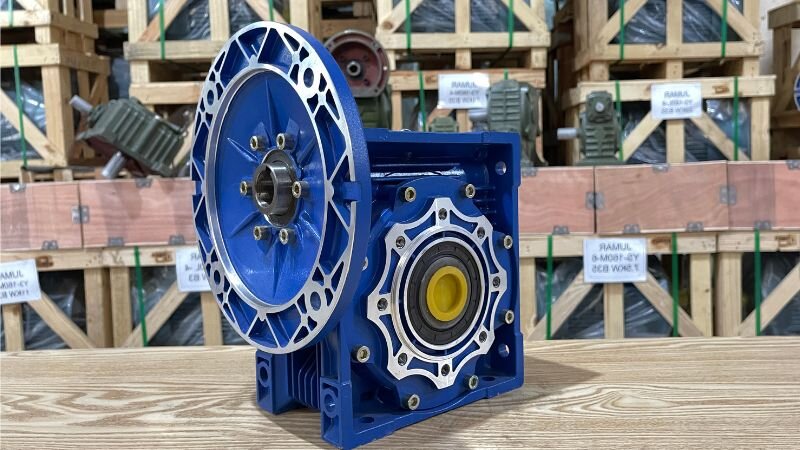
NMRV Gearboxes are rectangular-shaped gearboxes widely used in industry due to their high durability and stable working performance. When combined with an electric motor, these gearboxes form a gear motor, effectively reducing speed and increasing torque while providing a compact and easy-to-install transmission solution for various machinery and equipment.NMRV Gearboxes overview
Structure of NMRV Gearboxes
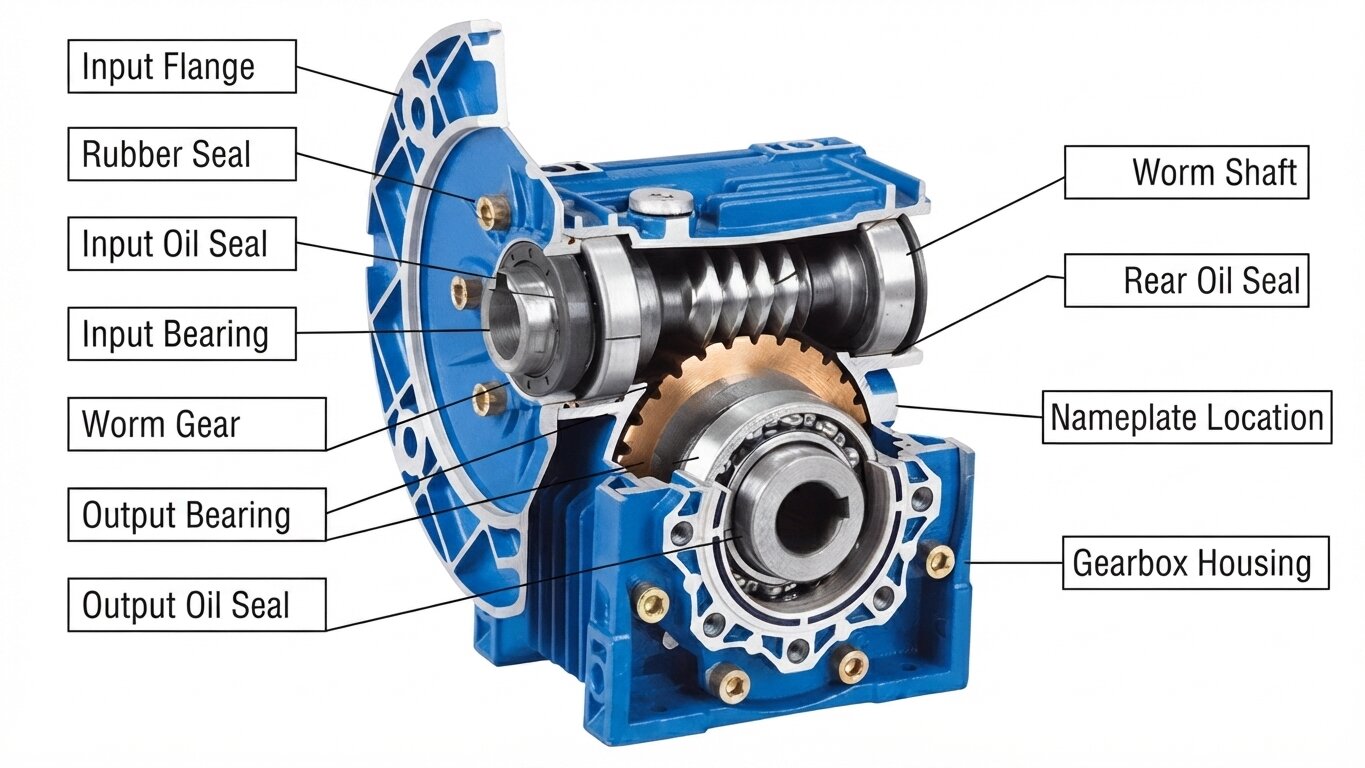
NMRV gearboxes (also known as worm gearbox NMRV) are a popular line of gearboxes thanks to their compact structure, flexible installation, and simple maintenance. Below is a complete description of the components and structural features of NMRV gearboxes:
Worm and Wormwheel Assembly
Worm shaft: Usually made of hardened alloy steel, precision-machined to ensure smooth meshing and good wear resistance.
Wormwheel: Usually made of copper alloy or bronze/bronze alloy to reduce friction and increase lifespan when meshing with the worm shaft. The steel-copper combination helps optimize the friction coefficient and torque transmission capacity.
Housing
Small sizes (30, 40, 50, 63, 75, 90): The housing is usually made of die-cast aluminum, offering advantages such as lightweight, good heat dissipation, and convenient installation at high elevations or on mobile frames.
Large sizes (110, 130, 150): The housing is reinforced with cast iron, enhancing durability, rigidity, and load-bearing capacity for heavy industrial applications.
The housing usually features cooling fins, inspection covers, oil filling holes, flanges, and bolt holes for easy installation and maintenance.
Dimensions and Standards (Size)
NMRV sizes are determined by the center distance from the output shaft center to the input shaft center.
Popular sizes: 30, 40, 50, 63, 75, 90, 110, 130, 150 – each size corresponds to a different power and torque range, suitable for motors from 0.18 kW to 7.5 kW depending on the type.
Input and Output Shafts & Motor Connection
Input shaft: Usually a hollow shaft or a straight keyed shaft, connected to the motor via a standard flange or coupling.
Output shaft: Can be a solid shaft or a hollow shaft with a keyway, adapting to various applications (pulleys, gears, couplings).
NMRV gearboxes usually feature standard flanges to easily mount standard/IEC motors from 0.18 kW to 3 kW (aluminum housing) or 4-7.5 kW (cast iron housing).
Bearings and Shaft Support System
Uses quality ball bearings to withstand radial and axial loads, helping the shaft operate smoothly, reducing vibration, and increasing lifespan.
Supports are properly arranged to ensure concentricity between the worm shaft and wormwheel, reducing wear and mechanical losses.
Seals, Gaskets, and Oil Recovery
Equipped with oil seals and rubber gaskets to prevent leakage, retain lubricating oil, and keep out dust and water.
The gearbox features oil filling holes, oil drain holes, and inspection covers for easy oil replacement, oil level check, and lubrication status monitoring.
Lubrication System
NMRVs use specialized oil or grease for worm gearboxes to reduce friction and dissipate heat.
Some large models feature a circulating lubrication system or oil pump locations to serve heavy-duty/continuous operation.
Structure of NMRV Gearboxes
Operating Principle of NMRV Gearboxes
When the electric motor rotates, motion is transmitted to the worm shaft of the NMRV gearbox. This worm shaft acts as an “infinite gear”, tasked with converting the high-speed rotational motion of the motor into slower rotational motion at the wormwheel.During this process, the worm threads slide along the grooves of the wormwheel, creating sliding friction motion rather than direct meshing like cylindrical or bevel gears. This characteristic helps NMRV gearboxes operate smoothly, dampen shocks, and reduce vibration effectively, although there may be slight energy loss due to high friction.When the wormwheel rotates, torque is amplified and transmitted to the output shaft, helping heavy-duty equipment operate more stably and powerfully even with a small motor capacity.
Classification of NMRV Gearboxes
Classification by Housing Material
Aluminum housing NMRV gearboxes: Includes small sizes such as NMRV 30, 40, 50, 63, 75, 90.
Cast iron housing NMRV gearboxes: Includes large sizes such as NMRV 110, 130, 150.
Classification by Reduction Stage
1-Stage NMRV gearboxes: Features one worm shaft and one wormwheel. Provides a transmission ratio from 1/10 to 1/60, sufficient for systems requiring moderate speed reduction.
2-Stage NMRV gearboxes (combination of NMRV + NMRV or NMRV + Helical): Larger transmission ratio, up to 1/100 – 1/3600, suitable for applications requiring deep reduction and large torque.
Classification by Output Shaft Type
Solid output shaft: The most common type, a solid shaft integrated with the wormwheel, transmitting load directly to gears or couplings.
Hollow output shaft: Allows direct mounting onto the machine shaft or load equipment, saving space and reducing shaft misalignment.
Right-angle output shaft: For applications requiring a 90° change in rotation direction, providing flexibility in machine layout design.
Classification by Installation Method
Foot-mounted type (B3): Used for floor-mounted machines, fixed with bolts.
Flange-mounted type (B5, B14): Mounted directly to the electric motor, saving space and easy to assemble/disassemble.
Hanging type: Applied to conveyor systems or equipment with suspended shafts, saving installation area.
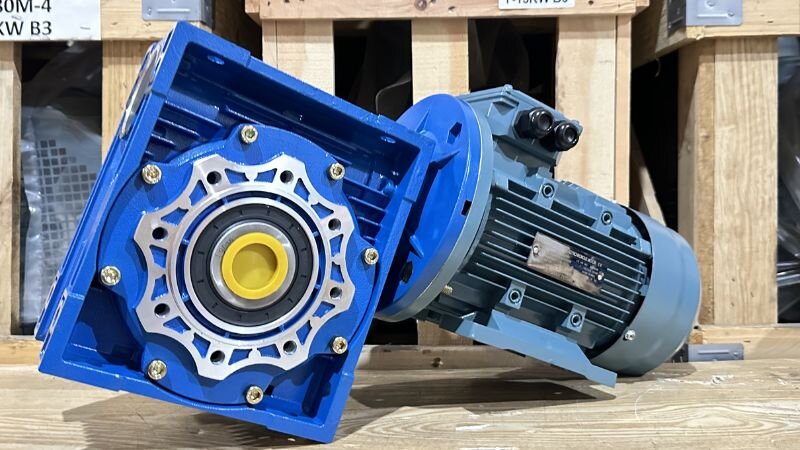
NMRV gearbox assembled with a 2.2kW electric motor via a flange
Prices for NMRV Gearboxes at Thanh Thai Motor
To help customers easily choose products that suit their needs, Thanh Thai Motor would like to send you the latest price list for NMRV gearboxes. This price list includes popular NMRV gearboxes on the market, complete with technical specifications and competitive pricing.
Video on Latest Prices for NMRV Gearboxes at Thanh Thai Motor
Notes When Purchasing NMRV Gearboxes
Calculate self-locking force: NMRV gearboxes have a self-locking capability (when the motor stops, the output shaft will be locked rigidly, preventing backward sliding under load). However, the self-locking ability is only truly good when the transmission ratio i ≥ 30 (the worm shaft has a small lead angle). If you use it for lifting or winch applications and choose a small transmission ratio (i = 5, 10, 15), the gearbox will not be able to self-lock safely, and it is mandatory to use an additional motor with a brake.
Accurately determine the size according to center distance: The name NMRV always comes with the center distance dimension from the input shaft to the output shaft (in mm). The larger the size, the higher the load-bearing capacity and torque (Nm). You need to consult the torque parameter table to select the appropriate size, avoiding choosing solely based on motor capacity which leads to shaft overload.
Check the input shaft type: NMRV gearboxes are usually mounted directly to the electric motor via a flange. You must accurately measure 2 parameters: Flange diameter and input shaft diameter (motor shaft).
Note on transmission efficiency: Due to the sliding friction transmission mechanism between the worm (steel) and the wormwheel (bronze), the efficiency of NMRV gearboxes is lower than that of heavy-duty gear series (such as R, K, F series). The larger the transmission ratio, the lower the efficiency (can drop below 70%). Therefore, when choosing the driving motor capacity, you should calculate a safety margin of 1.2 to 1.5 to compensate for this frictional energy loss.
Choose accompanying installation accessories: The original NMRV gearbox has a hollow shaft. Depending on the machine design, you need to clearly determine whether to purchase additional accessories:
Solid shaft (Single or double shaft): To convert a hollow shaft into a solid output shaft.
Torque arm: To fix the gearbox to the machine frame, reducing reaction force upon startup.
Output flange: To bolt the gearbox directly to the machine wall.
Quality of the bronze gear: This is the deciding factor for the gearbox’s lifespan but is hard to see with the naked eye. The internal gear must be made of high-quality bronze alloy (usually phosphor bronze) to withstand friction well.
Customers can visit the gearbox video collection category page on the Thanh Thai Motor website to view the product overview, installation instructions, and price quotes in practice.
Frequently Asked Questions
Why do newly installed NMRV gearboxes heat up very quickly during operation?
Due to the specific transmission mechanism of sliding friction between the steel worm shaft and the bronze wormwheel, NMRV gearboxes always generate very high heat during the first 50 – 100 running-in hours until the tooth surfaces achieve optimal smoothness. This is a completely normal physical phenomenon. However, if after this period the gearbox is still hot above 90ºC, you need to check immediately for motor amp overload, lack of lubricating oil, or shaft misalignment.
When is it necessary to change the oil for NMRV gearboxes and what specialized oil do these aluminum housing lines use?
Small sizes from NMRV 25 to NMRV 90 (aluminum housing) are typically pre-filled with high-grade synthetic oil by the manufacturer and are completely sealed, running continuously throughout the machine’s lifespan without needing oil changes. As for large sizes from NMRV 110 to NMRV 150 (cast iron housing), customers are required to change the oil for the first time after 500 running-in hours, and periodically every 2500 – 3000 operating hours thereafter. The specialized standard oil must have an ISO VG 320 or VG 460 viscosity to protect the bronze gear from scratching.
Why does the output shaft of NMRV gearboxes always have a certain amount of backlash when shaken by hand?
Unlike spur gear transmissions, worm gear transmissions must have a standard mechanical clearance (backlash) for thermal expansion when friction generates heat and to allow the lubricating film to enter between the teeth. The typical manual backlash ranges from about 0.5º to 1º. If you deliberately tighten or choose a gearbox without backlash for applications requiring absolute precision such as CNC cutting machines or robotic arms, the bronze gear will bind tightly, causing jamming and crumbling wear after just a few days of use.