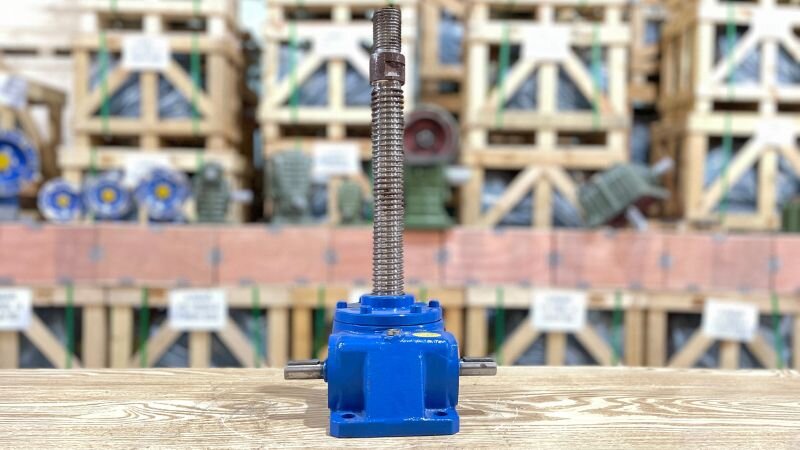
A screw jack, also known as a lifting gearbox, is a mechanically specialized device used to convert rotational motion into linear motion, commonly used in basic lifting systems. When combined with an electric motor, this gearbox forms a gear motor specialized for applications requiring precise, stable, and safe lifting in industries such as mechanical engineering, automation, stage equipment, or industrial door opening systems.What is a lifting screw?
Structure of the screw jack
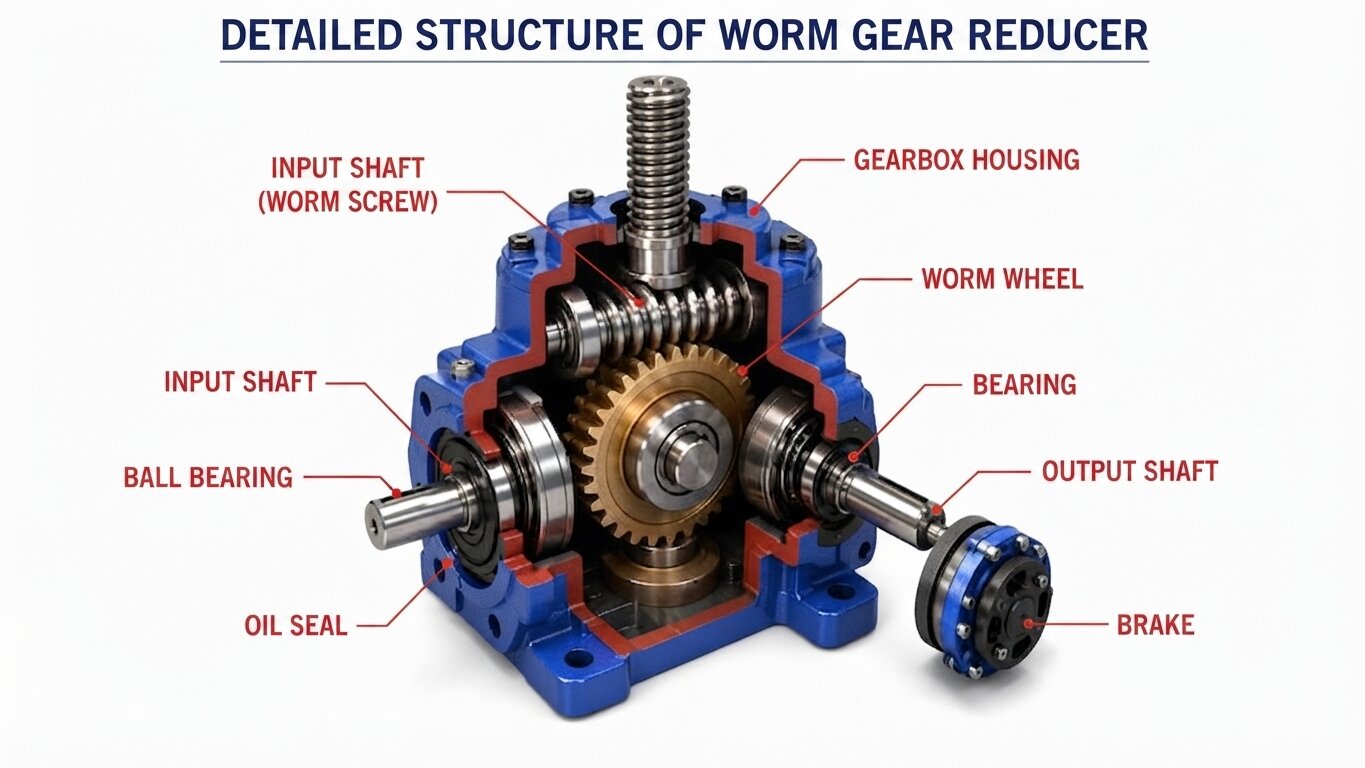
A typical screw jack includes the following main components:
Housing: Made of sturdy cast iron, steel, or aluminum alloy to protect internal parts.
Input shaft: Receives power from the lifting motor.
Output shaft: Connects to the winding drum or lifting cable.
Gear system: Usually bevel gears, cylindrical gears, or worm gears to generate high torque.
Bearings – oil seals: Support the rotating shaft and protect the inside of the gearbox.
Brake mechanism: Holds the load in a fixed position, ensuring safety during sudden stops.
Detailed structure of the screw jack
Operating principle of the screw jack
The operating principle of the lifting gearbox is based on power transmission between gears of different sizes. When the motor rotates, energy is transmitted through the input shaft, then through the gear system. Here, the speed is reduced while the torque is increased. Finally, energy is transmitted to the output shaft to wind/unwind cables or pull loads.During load lowering, the braking system or reverse gears prevent the load from free-falling, ensuring absolute safety. Some types of screw jacks also integrate stroke limiters or safety sensors to enhance system control and protection.
Classification of screw jacks
Lifting screw jacks only come in a 1-stage type, a popular gearbox series due to its simple design and stable performance. With a compact structure, easy installation, and maintenance, the 1-stage screw jack is especially suitable for lifting systems with small and medium loads. The product helps optimize installation space and provides smooth, efficient operation, reducing maintenance costs and saving time during operation.
Latest Screw Jack Price at Thanh Thai Motor
Below is the reference price list for the screw jack at Thanh Thai Motor. For detailed information and the best quotation, please contact us directly.
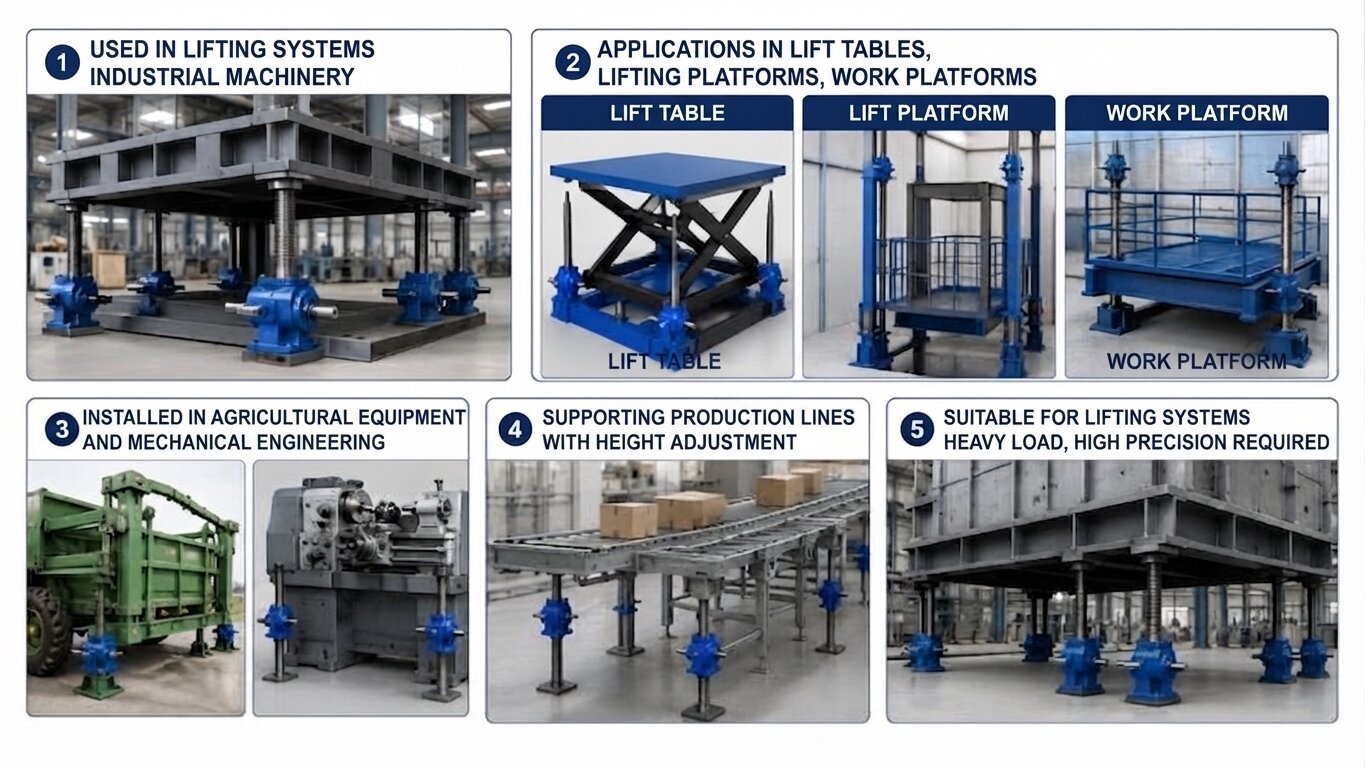
Applied in lifting tables, elevators, and lifting platforms
Installed in agricultural equipment and mechanical manufacturing
Supports production lines requiring height adjustment
Suitable for heavy-load lifting systems requiring high precision
Applications of the lifting screw
Criteria for choosing a suitable screw jack
To select a suitable screw jack, you need to consider the following factors:
Lifting load: The load mass affects the required torque.
Lifting speed: Choose the transmission ratio that matches the speed requirements.
Mounting type: Hanging, vertical mounting, or horizontal mounting depending on the system.
Power source: 1-phase, 3-phase, or hydraulic system.
Safety factors: Whether load-holding brakes or stroke limiters are required.
Installation space: Consider the gearbox dimensions and output shaft orientation.
Customers can visit the comprehensive video page for the gearbox video category, a video-focused system built by the Thanh Thai Motor team to provide customers with a practical view of products, monthly public price quotes, and technical instructions ranging from basic to advanced.
Frequently Asked Questions
What is the biggest difference between a ball screw and a standard lifting screw?
Standard lifting screw (Trapezoidal thread screw): Operates via sliding friction, resulting in lower efficiency (about 30% – 40%), generating more heat but featuring excellent self-locking capabilities. When power is cut off, heavy loads remain in place without slipping back down.
Ball screw: Operates via rolling friction through recirculating balls, resulting in extremely high efficiency (over 90%), running smoother and faster. However, this type does not have self-locking features. If lifting heavy loads, when power is cut off, the load will drive the screw backward and fall freely, so it is mandatory to use a motor with an electromagnetic brake for fixed holding.
How to recognize when the bronze nut of the screw jack has worn down to a dangerous level requiring replacement?
When the system operates continuously, the threads of the bronze nut gradually wear thin due to friction with the steel screw. The most accurate technical inspection method is to measure the axial backlash. Please turn off the machine, use your hand or a jig to shake/push the screw vertically. If the backlash exceeds 1/4 of the screw pitch, it indicates that the bronze threads are too thin, risking thread stripping (load drop) and causing serious accidents. You need to replace the nut immediately.
Why do screw jack systems often experience bending or jamming of the screw when lifting heavy loads?
This phenomenon is usually caused by eccentric load errors or forces not parallel to the screw’s center. Screw systems are designed to withstand perfect axial lifting forces. If the mechanical structure of the lifting table is tilted, the pushing force will turn into radial bending force, pressing the nut tightly against one side of the screw thread teeth, causing jamming, heat generation, and bending of the screw shaft. During installation, it is mandatory to use a spirit level or laser to achieve absolute leveling for the lifting table surface.