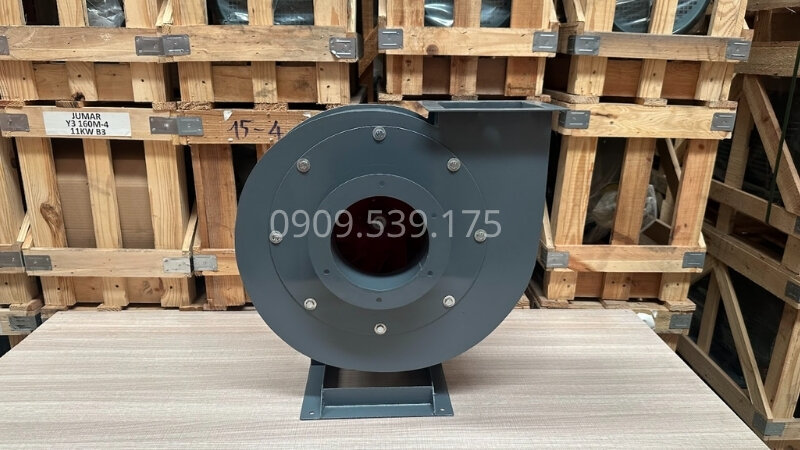
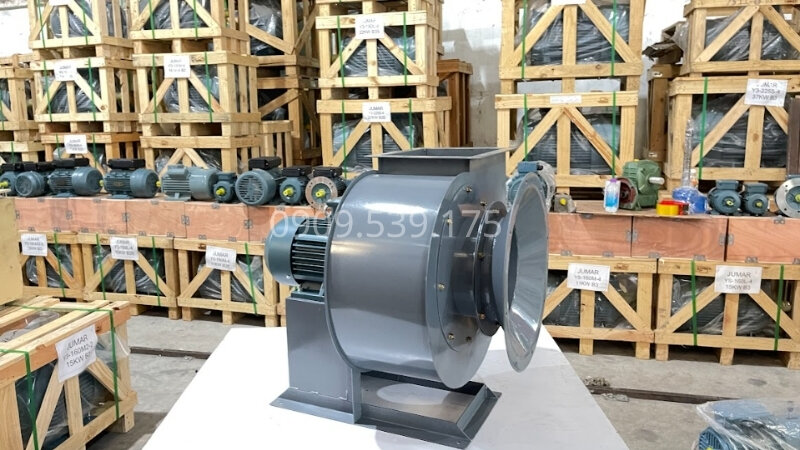
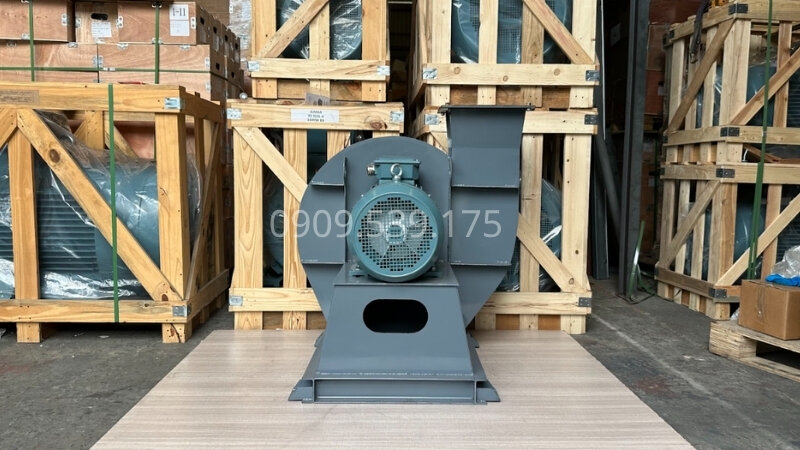
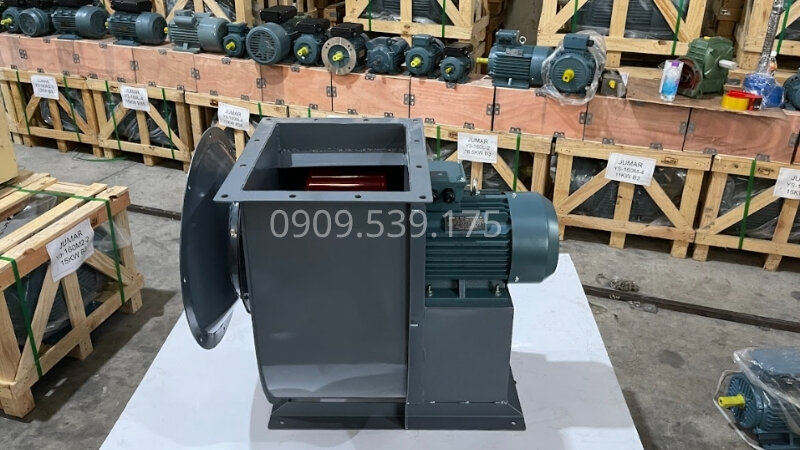
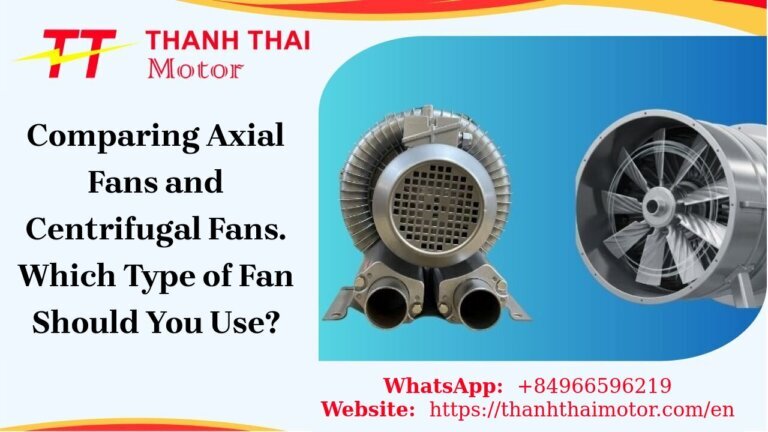
Air Blowers (centrifugal fans) are essential mechanical devices that generate a moving stream of air through the rotation of an impeller. This process creates pressure, assisting in pushing air in a specific direction or suctioning and exhausting air out.
Air Blowers are optimized for performance and durability, operating reliably in continuous and harsh environments. They are vital equipment in various sectors such as manufacturing, mechanical engineering, food processing, chemicals, and environmental treatment.
What are Air Blowers?
Structure of Air Blowers
Air Blowers, particularly centrifugal fan models, typically consist of the following components:
Fan casing: Designed in a spiral or cylindrical shape, it serves to protect internal components and direct the airflow outward.
Centrifugal impeller: The primary wind-generating part, operating on the centrifugal principle to push air out at high pressure.
Drive system (belt): Connects the motor to the impeller, ensuring stable and efficient motion transmission.
Electric motor: Provides the energy for the fan to operate, which can be an electric motor or a gasoline engine depending on the application.
Operating Principle of Air Blowers
The operating principle of Air Blowers can be summarized as follows:
Suction – compression – discharge via centrifugal force: When the motor rotates, the impeller creates a low-pressure zone at the center, drawing air in along the axis. Centrifugal force then pushes the air to the edges of the blades, where it is compressed and guided toward the casing.
Redirection and pressure increase: After leaving the impeller, the airflow changes direction from axial to perpendicular to the rotation axis, moving along the casing and exiting. This significantly increases both pressure and air velocity.
Maintaining stable airflow: The pressure differential between the inlet and outlet is maintained continuously, ensuring smooth air circulation and creating a powerful, stable stream suitable for aeration, ventilation, and cooling needs.
Classification of Air Blowers
Air Blowers under 3.7kW
Air Blowers under 3.7kW are suitable for small-scale applications such as cooling and ventilation in households or small construction projects.
Air Blowers under 3.7kW
Air Blowers over 3.7kW
Air Blowers over 3.7kW are used for larger applications in factories, industrial zones, or high-capacity air treatment systems.
Air Blowers over 3.7kW
Price List for Air Blowers in 10/2026 at Thanh Thai Motor
Centrifugal Fan Price Quote
Centrifugal fan lines offer advantages such as high airflow, high pressure, stable operation, and high durability, making them suitable for many industrial ventilation and gas treatment systems.
Ha Thanh Motor provides Air Blowers under 3.7kW with benefits including stable operation, energy efficiency, low noise, and high durability, suitable for various practical applications.
High-capacity Air Blowers (>3.7kW) are often selected based on airflow, pressure, and operational durability, as these factors determine efficiency in large-scale industrial systems.
Air blower price quote video 10/2026 - Thanh Thai Motor
Criteria for Choosing Air Blowers
When selecting centrifugal fans, you only need to focus on a few core factors:
Power capacity: This is the most important factor. You must choose a fan with a power rating and flow rate (m³/h) that matches actual needs to ensure ventilation efficiency and avoid power shortages or energy waste.
Installation suitability: The fan must fit the space and not cause difficulties during installation. If used in environments requiring quiet, priority should be given to low-noise models to avoid affecting living or working conditions.
Durability and cost: Choose fans made from durable, corrosion-resistant materials for long-term use. Additionally, prioritize energy-saving products to reduce future operating costs.
Ease of long-term use: Select fans that are easy to disassemble and maintain to save on repair efforts. Furthermore, reputable brands with clear warranties will provide peace of mind during use.
Criteria for choosing Air Blowers
Customers can visit the comprehensive video gallery section for Air Blowers to update more useful knowledge, from installation and operation guides to how to choose the right equipment for specific practical needs.
Frequently Asked Questions
Why do Air Blowers experience a decrease in airflow and pressure after some time?
Clogged air filtration system: Thick dust buildup on the inlet filter restricts intake air volume, forcing the fan to work harder while output performance remains low.
Increased lobe (impeller) clearance: After long periods, wear between lobes or between the lobe and the casing increases clearances, causing air to leak back into the fan chamber.
How to handle Air Blowers with squealing sounds or strong vibrations?
High-pitched squealing: Usually caused by a loose or hardened V-belt slipping on the pulley. The tension should be adjusted or the belt replaced.
Vibration with impact sounds: This may be due to loose or damaged bearings, causing the lobes to collide with each other.
Pipe blockage: If the discharge pipe pressure is too high compared to the rating, the fan will experience back pressure, causing the entire body to vibrate.
Why does the temperature of the fan body and discharge air rise abnormally?
Lack of gear lubrication oil: Increases friction in the gearbox.
Installation in enclosed spaces: Lack of air circulation to dissipate heat from the fan body.
Overpressure operation: Forcing the fan to run at pressure levels higher than the design for an extended period.
Note: Excessive temperatures will cause the lobes to expand and jam the fan. Customers should install a pressure gauge and a safety valve to protect Air Blowers from thermal overload.