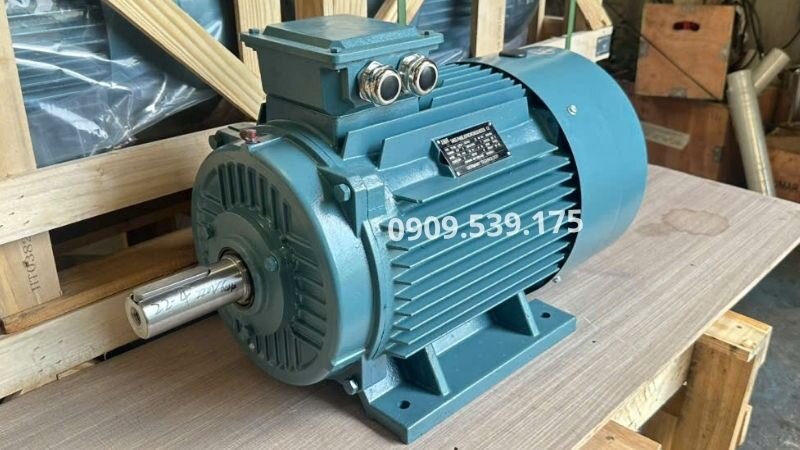
1-Phase Electric Motors above 3.7kW are high-power electric motors designed to meet drive requirements demanding strong pulling force and continuous operation. Single-Phase Motors exceeding 3.7kW are constructed with a stator, rotor, capacitor, and cooling system, ensuring stable operation and high efficiency.
1-Phase Electric Motors above 3.7kW at Thanh Thai Motor.
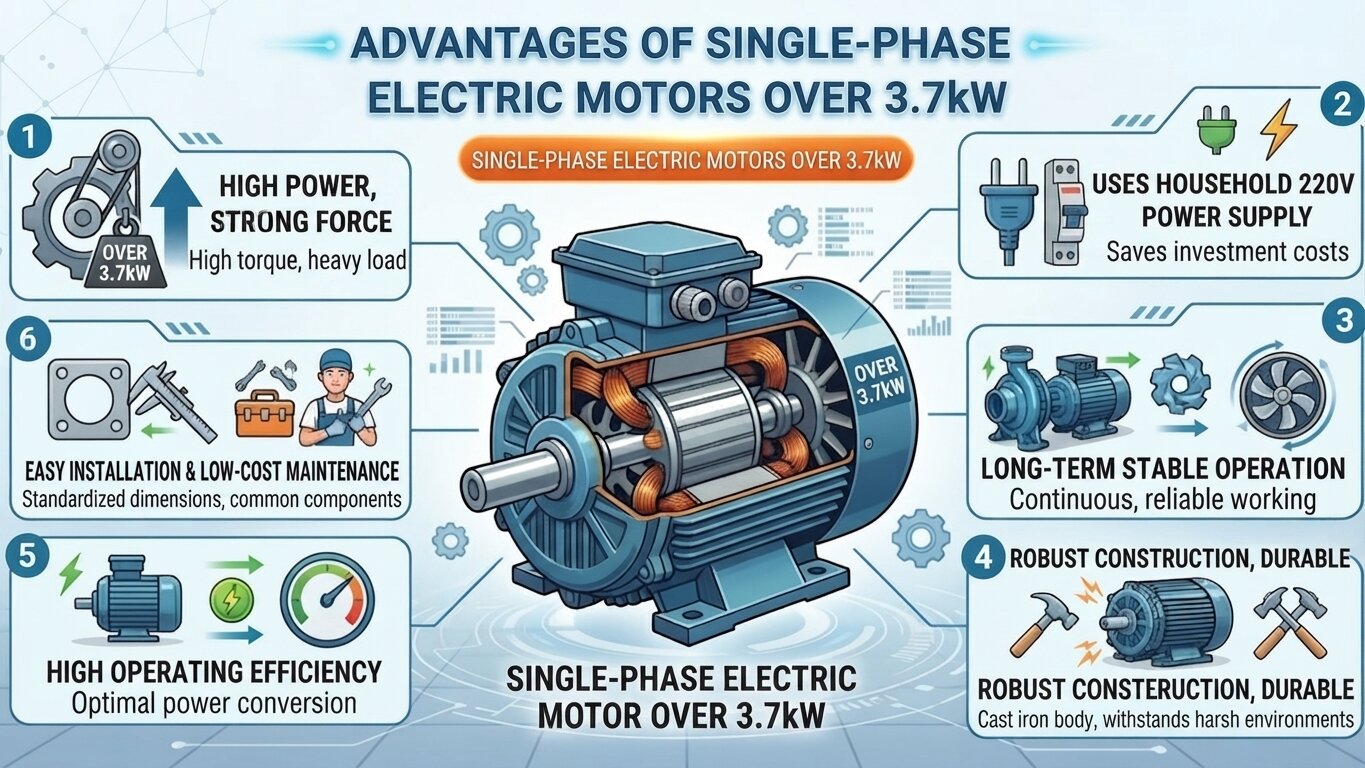
Advantages of 1-Phase Electric Motors above 3.7kW
High power, strong pulling force: 1-Phase Electric Motors above 3.7kW excel in applications requiring high torque and heavy loads, such as high-capacity water pumps, air compressors, mixers, and specialized production equipment.
Uses residential 220V power supply: Eliminates the need to install a 3-phase electrical system, saving initial investment costs and providing convenience for areas with only 1-phase power.
Stable operation over long periods: The motors are designed for continuous duty, well-suited for manufacturing facilities, mechanical workshops, and agricultural farms.
Sturdy structure, high durability: The motor frame is typically made of high-rigidity cast iron, protecting internal components and enhancing performance in harsh environments.
Good working efficiency: Efficient conversion of electrical energy into mechanical energy ensures powerful motor operation and reduces energy waste during use.
Easy installation and low maintenance cost: Installation dimensions are manufactured to standards, making it convenient to replace or upgrade existing systems. Low maintenance costs with common, easy-to-find components make servicing and repairs fast and cost-effective.
Advantages of 1-Phase Electric Motors above 3.7kW.
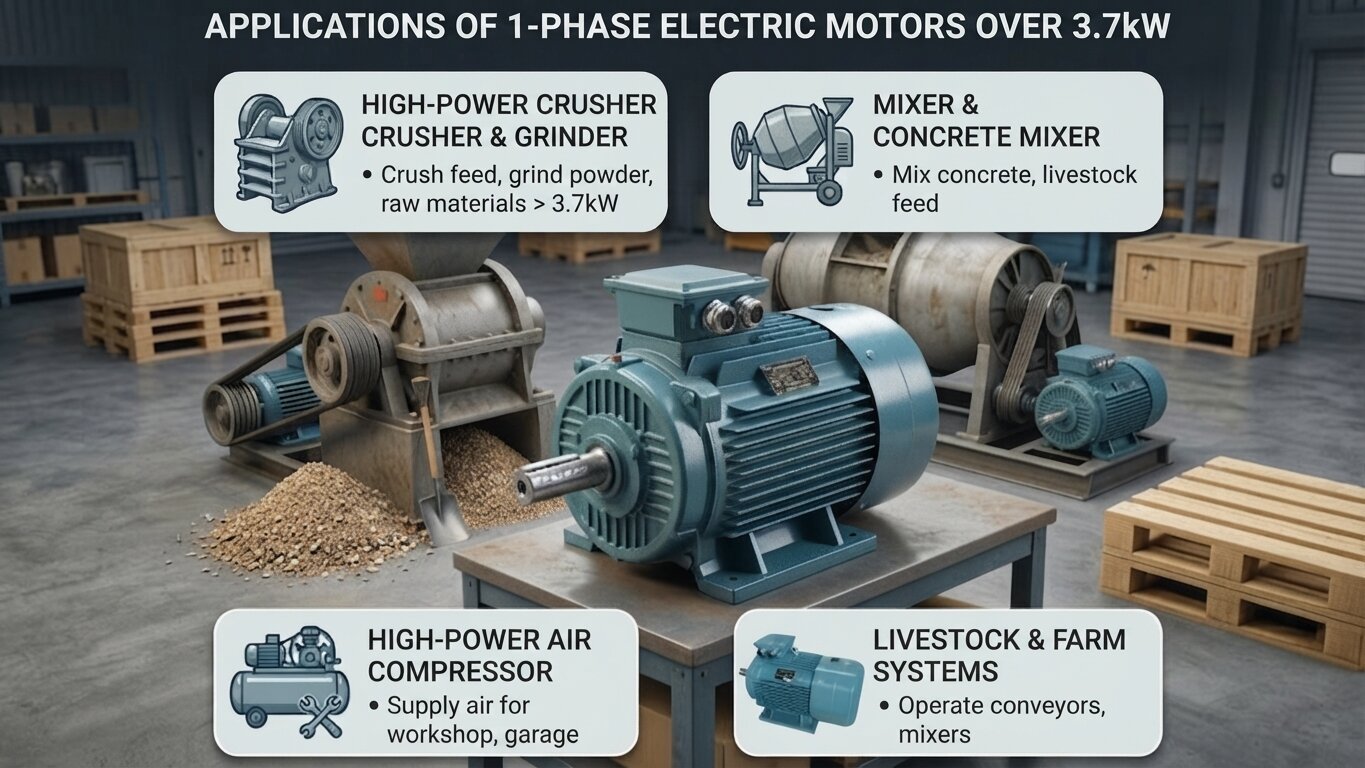
Applications of 1-Phase Electric Motors above 3.7kW
Grinders and mills: The motors are suitable for operating livestock feed grinders, flour mills, raw material grinders, and various other processing equipment.
Industrial mixers and concrete mixers: With strong pulling power, 1-Phase Electric Motors above 3.7kW effectively meet the mixing material needs in construction, manufacturing, and animal husbandry.
High-capacity air compressors: Installed on air compressor lines serving mechanical workshops, repair garages, or small-to-medium-scale production facilities.
Civil mechanical equipment: The motors can be combined with various machinery requiring strong pulling force such as cutting machines, polishing machines, wire winding machines, or other drive systems.
Livestock and farm systems: Used to operate feed mixers, mini conveyors, bran grinders, and various agricultural production equipment.
Applications of 1-Phase Electric Motors above 3.7kW.
Prices of 1-Phase Electric Motors above 3.7kW at Thanh Thai Motor
Below is the latest reference price list for 1-Phase Electric Motors above 3.7kW at Thanh Thai Motor, helping customers easily review and select products that match their usage needs.
Notes When Buying 1-Phase Electric Motors above 3.7kW
Choose the appropriate power for the load: Avoid choosing a motor that is too small for your usage needs, as this easily leads to overloading, overheating, and reduced operating lifespan.
Select the mounting style: Before purchasing 1-Phase Electric Motors above 3.7kW, check the base dimensions, flange sizes, and shaft diameter to ensure the motor fits properly with other equipment.
Pay attention to motor rotation speed: Each type of machinery requires a different speed, such as 1,400 rpm or 2,800 rpm. Choosing the wrong speed can affect the operating efficiency of the equipment.
Check the material: Cast iron frame motors are typically suitable for heavy and continuous working environments, while aluminum frame motors offer the advantages of lightweight and good heat dissipation.
Choose a reputable supplier: You should purchase products from Thanh Thai Motor because the products come with complete technical information, clear warranty policies, and necessary technical support to ensure long-term usage efficiency.
For a more intuitive look at the product, customers can refer to the electric motor video category produced by the Thanh Thai Motor team. These comprehensive videos provide plenty of practical information on installation guides and how to choose the right motor power. This is a useful reference source helping customers better understand the product before purchasing.
Frequently Asked Questions
Why do 1-Phase Electric Motors above 3.7kW typically require larger wires and circuit breakers compared to low-power motors?
As motor power increases, operating current and starting current also increase. If wires with too small a cross-section or unsuitable circuit breakers are used, the system may experience voltage drops, tripped circuit breakers, or overheated wires during operation.
Can 1-Phase Electric Motors above 3.7kW start directly or do they need additional supporting devices?
Most high-power 1-phase motors are designed to start directly via starting and running capacitors. However, for loads with high inertia such as grinders, air compressors, or mixers, it is necessary to ensure a sufficiently strong power supply to avoid weak starting or failure to reach full speed.
Why do 1-Phase Electric Motors above 3.7kW usually require larger capacitor capacitance, and what happens when choosing the wrong capacitor?
For high-power 1-phase motors, capacitors play a role in creating starting torque and maintaining stable operating capability. If the capacitor capacitance is lower than standard, the motor will start slowly, struggle under load, or fail to reach rated speed. Conversely, if an excessively large capacitor is used, current through the auxiliary winding will increase rapidly, causing the motor to heat up quickly and potentially damaging the winding after prolonged use.
Why do 1-Phase Electric Motors above 3.7kW installed 50-100m away from the power source often experience weak load capacity even though the measured voltage is still close to 220V?
When the distance from the electrical panel to the motor is too far, the conductors will incur voltage drop under load. Although the no-load measured voltage still reaches nearly 220V, when the motor starts or works with heavy loads, the actual terminal voltage can drop significantly. Therefore, when installing high-power motors at a distance, appropriate wire cross-sections must be calculated to limit voltage losses.