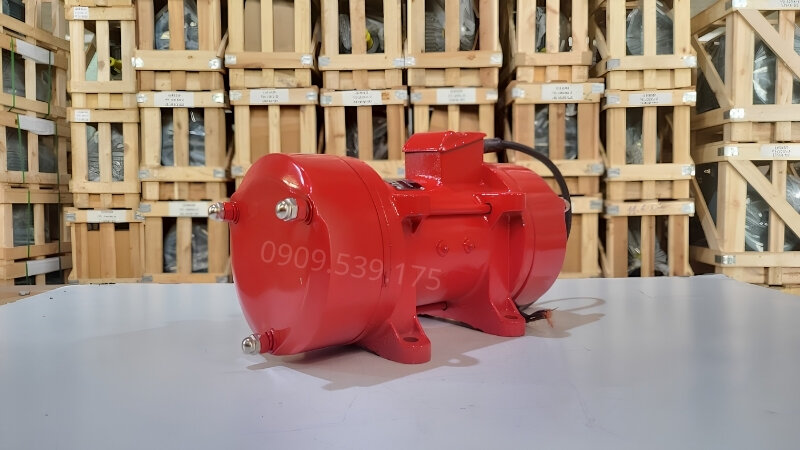
The 1-Phase Vibration Motor, also known as a 1-phase concrete vibrator, is an electric motor using a 220V power supply, specifically designed to generate vibration force for various industrial and civil applications. The device operates based on the eccentric rotation principle, helping to generate strong and stable oscillations during operation. This type of motor is widely used in systems such as vibrating screens, sand screening machines, concrete vibrating tables, material feeding hoppers, or material separation equipment in manufacturing. Thanks to its simple design, ease of installation, and use of the common 1-phase power supply, the 1-phase vibration motor becomes a suitable choice for small and medium-scale systems, especially in places without available 3-phase power.
In addition, the equipment is also highly appreciated for its stable operation, good durability, and reasonable investment cost, helping to optimize production efficiency in many different fields.
Overview of the 1-phase vibration motor
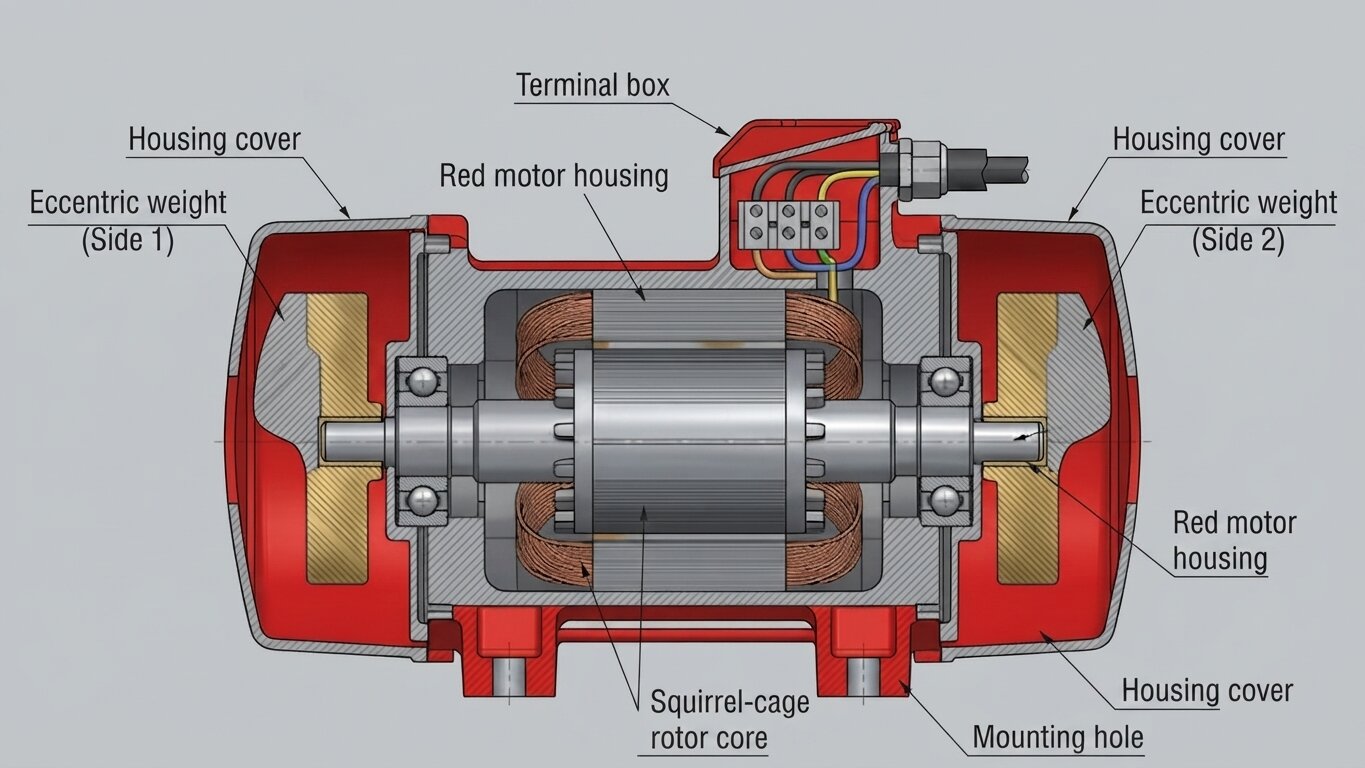
Structure of the 1-Phase Vibration Motor
The 1-phase vibration motor is designed with a sturdy structure to generate stable vibration force and operate durably in various environments. The device consists of many components combined together to create vibration oscillations serving industrial and civil applications.
1-Phase electric motor: The main component generating rotational motion, using a common 220V power supply, suitable for small and medium-scale systems.
Eccentric weights: Installed at both ends of the motor shaft, responsible for generating vibration force when rotating. This is a crucial component determining the amplitude and vibration intensity of the device.
Motor shaft: Directly connected to the motor and eccentric weights, helping transmit stable rotational motion during operation.
Motor housing: Usually manufactured from cast iron or sturdy alloy to protect internal components while supporting effective heat dissipation.
Bearing system: Helps reduce friction and keeps the 1-phase vibration motor running smoother, increasing equipment lifespan during continuous operation.
Terminal box: The place connecting the power source to the motor, designed safely and conveniently for installation and maintenance.
Structure of the 1-phase vibration motor
Operating Principle of the 1-Phase Vibration Motor
The 1-Phase Vibrator Motor operates by converting the rotational motion of the motor into vibration force through an eccentric weight system mounted at both ends of the motor shaft. When supplying a 220V power source, the motor begins to rotate at high speed and drives the weights to move continuously.
During rotation, due to the uneven distribution of the weight mass, centrifugal force is generated, causing vibration oscillations. Depending on the adjustment angle of the eccentric weights, the vibration force can be adjusted to be strong or light, making the 1-phase vibrator motor suitable for various applications such as vibrating screens, feeders, concrete vibrating tables, and other industrial vibration systems.
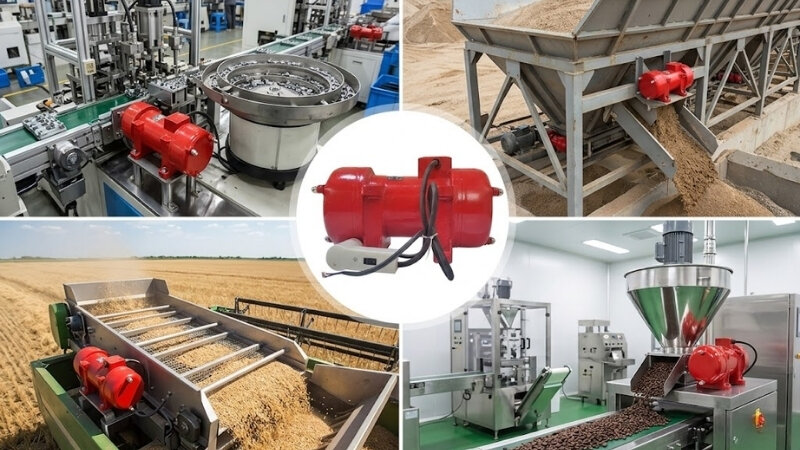
Applications of the 1-Phase Vibration Motor
The 1-phase vibration motor is commonly used in small and medium-scale systems thanks to its advantages of easy installation, use of 220V household power supply, and reasonable investment cost.
Material Production and Transportation
The 1-phase vibration motor is often installed in production lines to support the transportation, screening, and classification of materials. Thanks to stable vibration force, the device helps raw materials move evenly, minimizes clogging, and enhances operational efficiency.
Agriculture and Harvesting
In the agricultural sector, the vibration motor is used to shake seeds, fruits, or post-harvest agricultural products. The vibration mechanism helps separate materials, clean them, and support rapid collection processes, saving labor.
Packaging and Food Processing
The 1-phase vibration motor is applied in packaging machines, screening machines, and food processing equipment to ensure materials are accurately classified before entering the production process. This helps improve finished product quality and reduce packaging errors.
Applications of the 1-phase vibration motor
Product Price List of the 1-Phase Vibration Motor at Thanh Thai Motor
Below is the 1-Phase Vibration Motor Price table at Thanh Thai Motor for customers to easily reference and choose according to their usage needs. If you are looking for a competitive 1-Phase Vibrator Motor Price, please review our detailed listing below.
To choose the right 1-phase vibration motor and ensure long-term operating efficiency, customers should note the following important criteria:
Determine the correct usage needs: Clearly understand practical applications such as vibrating screens, concrete vibrating tables, feeders, or material separation to choose the appropriate vibration force and power.
Choose compatible power: Avoid choosing a motor that is too small, which easily causes overload, or too large, which wastes energy and investment costs.
Check the motor vibration force: Each 1-phase vibration motor line has a different vibration amplitude, so it is necessary to choose according to the load and system size.
Suitable power source: The equipment uses 220V electricity, so a stable power source must be ensured for the motor to operate more efficiently.
Durability and component quality: Prioritize motor lines with sturdy housings, good quality bearings, and continuous vibration resistance.
Working environment conditions: If used in dusty, humid, or high-temperature environments, customers should choose a motor with good protection and heat dissipation capabilities.
Customers can also watch the summary video of the vibration motor category to practically reference various models, thereby easily selecting equipment suitable for usage needs.
Frequently Asked Questions [FAQ]
Can the 1-Phase Vibration Motor adjust its vibration force?
Yes. Users can change the angle of the eccentric weights to adjust the vibration force according to usage needs.
Does the 1-phase vibration motor cause loud noise?
There is a certain level of vibration and noise during operation, but if installed correctly according to technical standards, the machine still operates stably.
Can the 1-phase vibration motor run continuously?
Yes. If used with the correct load and installed securely, the motor can operate continuously for a long time.