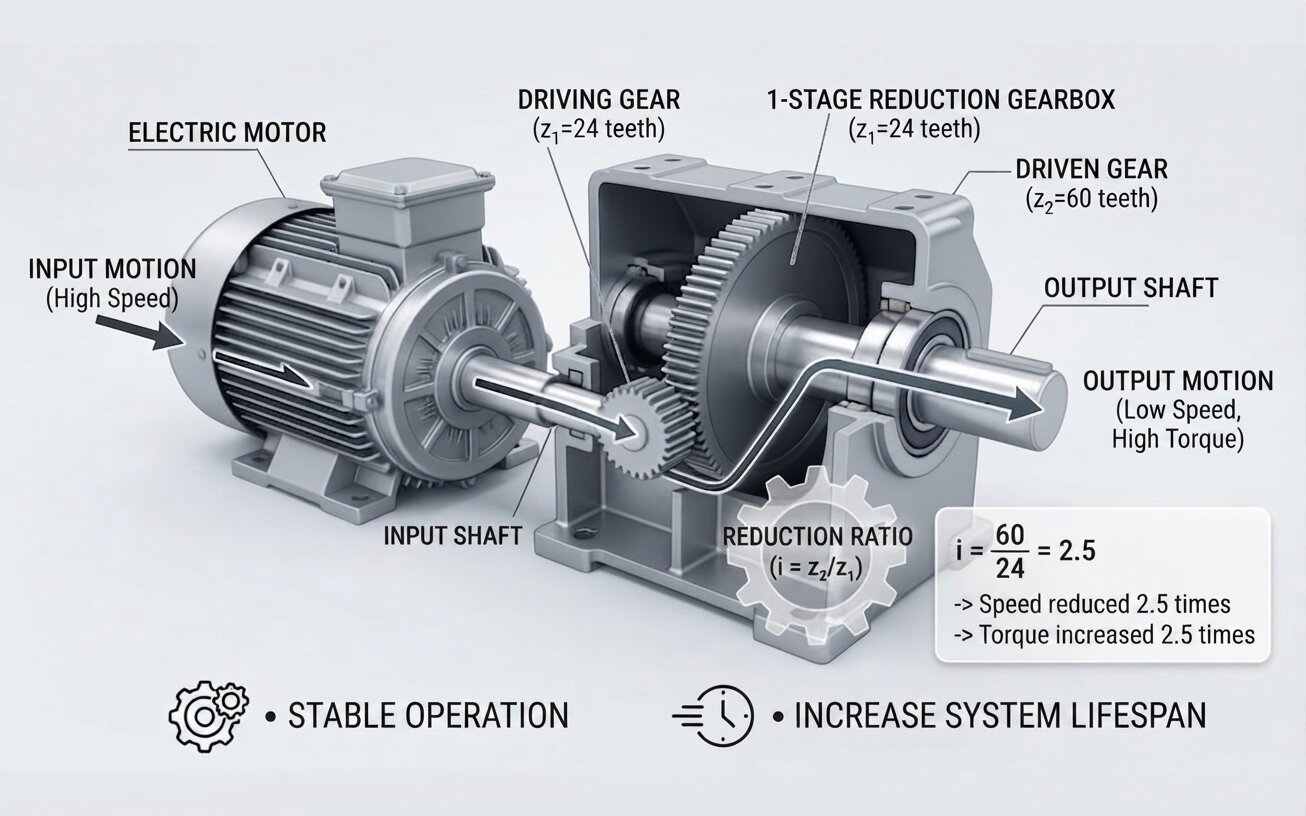
A 1-Stage Gearbox, also known as a single-stage reduction gearbox, is a type of gearbox used to reduce motor rotation speed in industrial and automation applications. It operates by changing the transmission ratio between the motor and the load, helping to increase output torque while reducing speed. In practice, this device is often combined with an electric motor to create a gear motor, optimizing transmission efficiency and ensuring long-term operational durability.
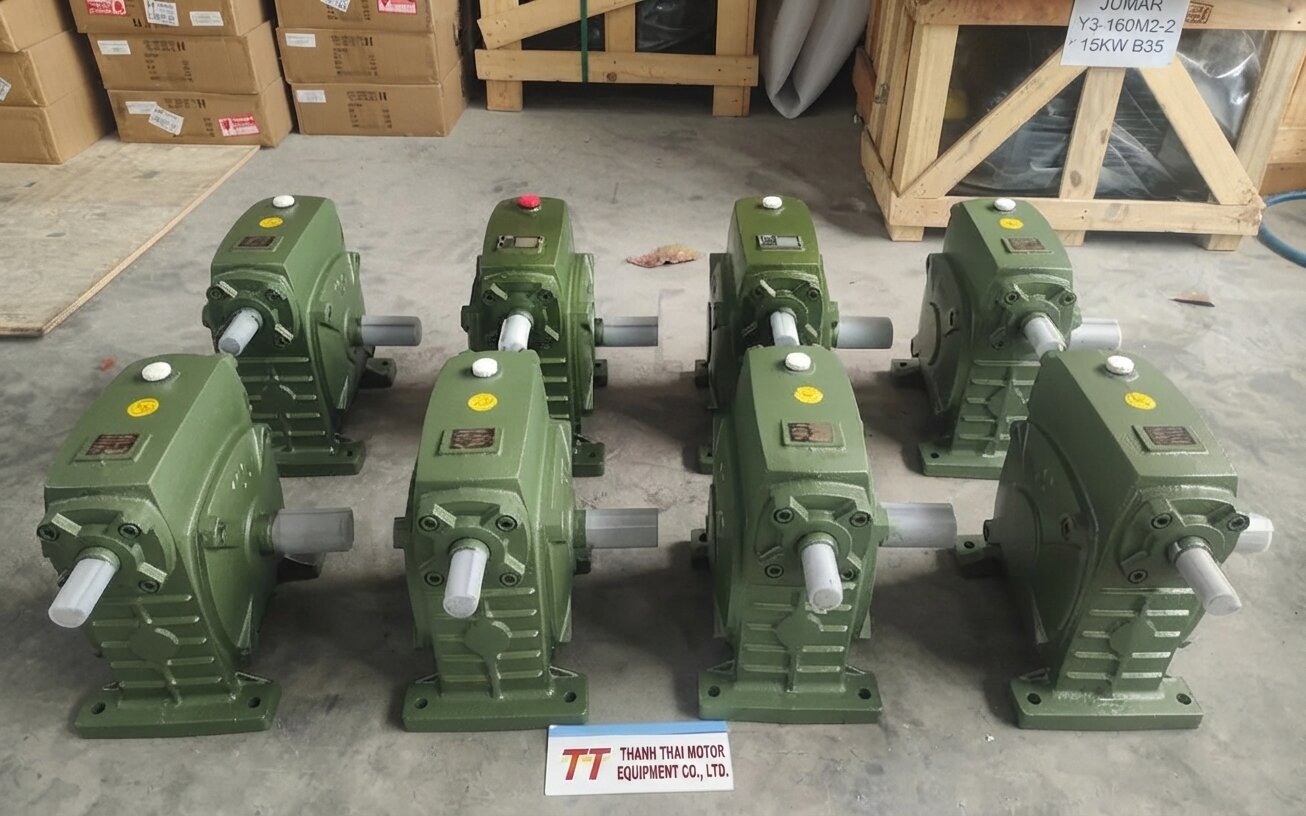
General design of the worm gearbox
Characteristics of a 1-Stage Gearbox
Simple structure, consisting of only 1 input shaft, 1 output shaft, and 1 transmission gear pair.
Small transmission ratio (usually from 3:1 to 10:1), suitable for systems requiring light speed reduction.
High transmission efficiency, low energy loss due to fewer transmission stages.
Easy maintenance, low investment cost, and high durability when operated correctly.
Structure of a Single-Stage Gearbox
Gearbox housing:
Made of cast iron or aluminum alloy, responsible for protecting all internal components from impacts, dust, and oil leakage.
Sealed design helps reduce noise and increases equipment durability.
Input shaft (primary shaft): Connected directly to the electric motor, serving as the point to transmit initial torque into the gearbox.
Output shaft (secondary shaft): Connected to the load device or transmission mechanism, receiving higher torque after speed reduction.
Transmission gear pair:
Consists of 1 driving gear (mounted on the input shaft) and 1 driven gear (mounted on the output shaft).
These two gears have a specific transmission ratio, determining the reduction level of the gearbox.
Bearings and oil seals:
Bearings help the shafts rotate smoothly and reduce friction.
Oil seals prevent lubricating oil leakage and block dust infiltration.
Lubricating oil: Used to reduce friction between gears, limit wear, and provide cooling during operation.
Operating principle of a 1-Stage Gearbox
Operating principle of a 1-Stage Gearbox
The operating principle of a 1-Stage Gearbox is based on the direct meshing gear transmission mechanism to reduce rotation speed and increase torque.
When the electric motor transmits rotational movement to the input shaft of the gearbox, the driving gear mounted on this shaft rotates.
The driving gear meshes with the driven gear mounted on the output shaft.
Because the two gears have a different number of teeth, the rotation speed at the output shaft is slower than at the input shaft, but the torque (rotational force) is correspondingly increased.
The transmission ratio (also known as the reduction ratio) of a 1-Stage Gearbox is determined by the formula:
i = Z₂ / Z₁
Where:
Z₁ is the number of teeth on the driving gear
Z₂ is the number of teeth on the driven gear
Thanks to this principle, a 1-Stage Gearbox helps machinery operate stably, increases pulling force while ensuring energy savings and extending the lifespan of the transmission system.
Classification of 1-Stage Gearboxes
Common types of 1-stage gearboxes
1-Stage Gearboxes are classified primarily by their transmission mechanism, including spur gear gearboxes, cycloidal gearboxes, and screw jacks. Each type has its own characteristics and applications, with prices varying depending on design and operational requirements.
1-Stage NMRV Gearbox
A popular NMRV gearbox thanks to its compact design and stable performance. The 1-stage NMRV gearbox is suitable for packaging machines, food processing machines, and conveyor belts. With a reasonable price, it is a common choice in light industries.
1-Stage Worm Gearbox
Featuring a simple structure and good load-bearing capacity, the 1-stage worm gearbox operates smoothly and durably. This device is very well-suited for lifting systems and heavy industrial machinery, thanks to its effective self-braking capability and stable transmission.
1-Stage Screw Jack
A specialized transmission device that converts rotational motion into linear motion. Widely applied in lifting systems, the 1-stage screw jack is an ideal choice for lifting tables, automatic lifting equipment, and industrial production lines.
1-Stage Cycloidal Gearbox
With the cycloidal meshing principle, the cycloidal gearbox provides high reduction efficiency and superior shock load capacity. This product is typically used in industrial mixers, crushers, and equipment requiring high torque.
1-Stage ZQ Gearbox
A series of equipment using spur gears, the ZQ gearbox is suitable for applications requiring heavy loads and continuous operation. The 1-stage ZQ gearbox is commonly used in steel rolling mills, industrial tractors, and heavy industrial equipment.
1-Stage Mechanical Speed Variator
The mechanical speed variator is an ideal solution for adjusting motor rotation speed, especially in machine tools and automated production lines. This 1-stage mechanical speed variator helps change the transmission ratio within the gearbox, offering flexible speed adjustment and ease of use.
1-Stage HB-Series Helical Gearbox
Specially designed for heavy industry, the HB-Series Helical Gearbox features high load capacity and outstanding durability. Commonly used in stone crushers, concrete mixers, and high-power transmission systems.
1-Stage F-Series Parallel Shaft Helical Gearbox
With parallel input and output shafts, the F-series parallel shaft helical gearbox optimizes installation space. The 1-stage F-series parallel shaft helical gearbox is used in conveyor systems, packaging machines, and mechanical equipment requiring compactness and efficiency.
1-Stage K-Series Helical Bevel Gearbox
Possessing a right-angle design, the K-series helical bevel gearbox saves space and is easy to install in lifting machine systems and steering systems. The 1-stage K-series helical bevel gearbox is an ideal choice for applications needing to change transmission direction.
1-Stage S-Series Helical Worm Gearbox
Also featuring a right-angle design, the structure of the S-series helical worm gearbox is adjusted to suit specific technical requirements. The 1-stage S-series helical worm gearbox is a popular product in textile machinery, printing machines, and other specialized equipment.
Latest 1-Stage Gearbox Prices at Thanh Thai Motor
To help customers easily choose the right product, Thanh Thai Motor provides the prices for popular 1-stage gearboxes currently on the market.
With inline input and output shafts, the 1-stage R-series inline helical gearbox provides precise and stable transmission. This type of 1-stage R-series inline helical gearbox is well-suited for machine tools, CNC machines, and mechanical systems requiring high precision and long-term durability.
Advantages of a 1-Stage Gearbox
Advantages of a 1-Stage Gearbox
The advantages of a 1-stage gearbox include many prominent features that make it widely used in industrial transmission systems:
Simple structure, easy maintenance: A 1-stage gearbox consists of only a driving and driven gear pair, resulting in fewer parts and making installation, disassembly, and maintenance easy.
High transmission efficiency: Due to going through only one transmission stage, energy loss is low, and transmission efficiency typically reaches 95-98%, helping save electricity.
Stable power transmission, smooth operation: Precisely designed gears ensure the gearbox operates smoothly, reducing vibration and noise.
Compact size, space-saving: The 1-stage gearbox features a compact design, easily integrating with motors and other machinery equipment.
Reasonable price: Compared to multi-stage gearboxes, the single-stage type is more affordable, suitable for medium-load applications or moderate speed reduction requirements.
Applications of a 1-Stage Gearbox
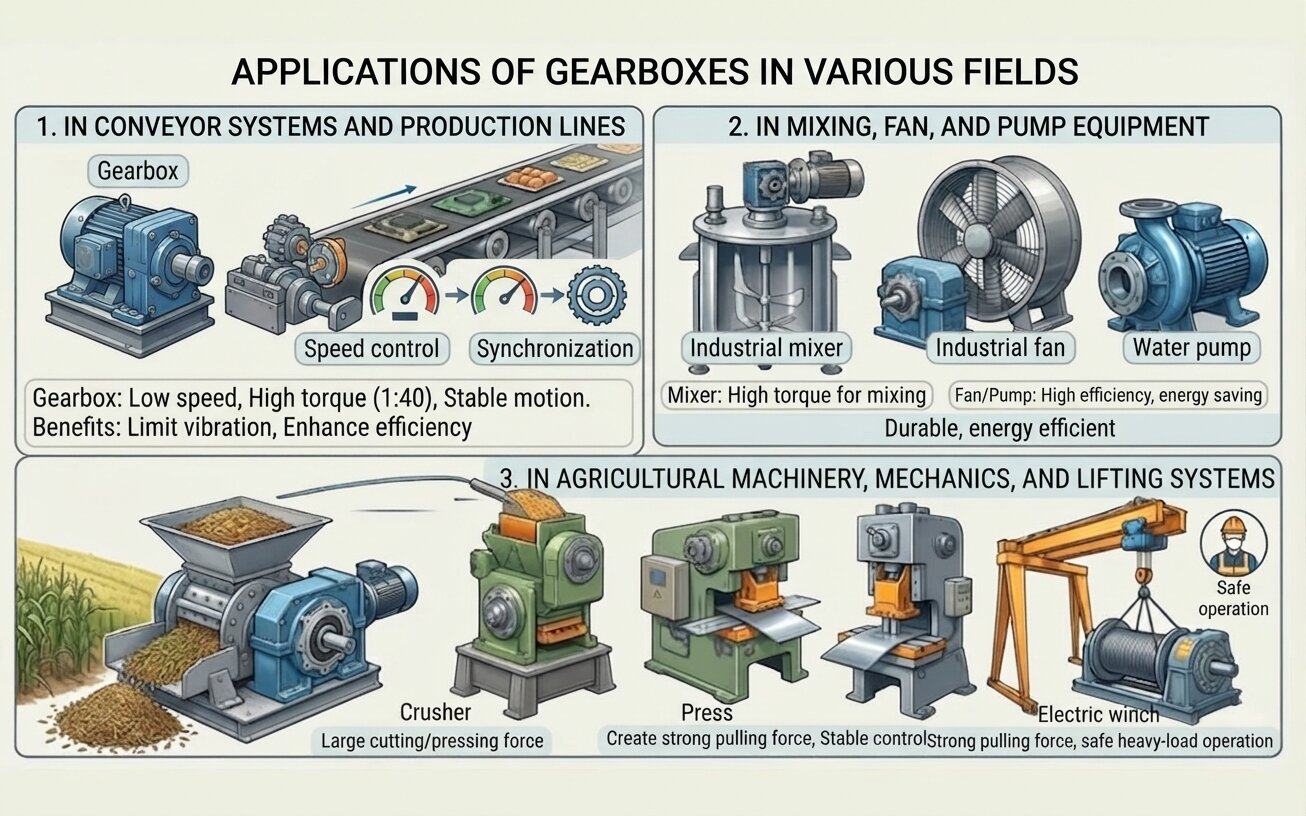
Applications of a 1-stage gearbox are diverse in industrial and civil sectors thanks to its compact design, easy installation, and high efficiency. Below are the most common applications:
In conveyor systems and production lines: Applied to adjust conveyor speed and synchronize with each stage in the production line. The gearbox helps goods move stably, limits vibration, and enhances operational efficiency.
In mixing equipment, fans, and pumps: Used in agitators, mixers, industrial fans, and water pumps. The device helps reduce motor rotation speed, increase torque, and ensure durable operation with energy savings.
In agricultural machinery, mechanical engineering, and lifting systems: Applied in crushers, presses, lawn mowers, as well as electric winches and lifting systems. The gearbox helps generate strong pulling force at low speeds, control stable movement, and ensure safety when operating heavy loads.
Applications of a 1-Stage Gearbox
Notes when buying a 1-Stage Gearbox
Limitations on transmission ratio: Because it only reduces speed once, the transmission ratio of a 1-stage gearbox is usually limited to a range from i = 3 to i = 100 (depending on the technology line). If your application requires extremely slow output speeds (under 10 rpm), forcing a 1-stage gearbox to run is not feasible or will severely reduce machine lifespan. In this case, you must switch to a 2-stage or 3-stage series.
Significant efficiency differences between technology lines:
If choosing the 1-stage inline/helical gear series (such as R-series, mini inline series): Very high efficiency, reaching 95% to 98%, the machine runs cool and saves electricity.
If choosing the 1-stage worm gear series (such as WP, NMRV): Much lower efficiency, reaching only about 60% to 85% due to large sliding friction losses, and the machine will generate heat quickly during operation.
Determine shaft orientation (inline or right-angle): You need to base your choice on the actual installation space of the workshop to select the structural style:
Inline / Parallel shaft: The input and output shafts lie on a straight line or are parallel to each other (gear series).
Right-angle shaft: The output shaft is at a 90º angle to the motor input shaft (worm gear or bevel gear series).
Pay special attention to connection flange dimensions: If you buy a standalone 1-stage gearbox to install yourself with an existing electric motor, you must accurately measure the input shaft diameter (female shaft) and the flange diameter. Just a deviation of a few millimeters will make it impossible to fit the motor into the gearbox.
Check the manufacturer’s lubrication method:
Small-sized aluminum housing 1-stage gearboxes are usually pre-filled with sealed synthetic grease/oil for the lifetime of the machine.
Large heavy-duty cast iron housing series usually leave the oil chamber empty upon factory release. When purchased, you must fill it with the correct industrial lubricating oil (usually ISO VG 220 or 320 for gears, ISO VG 460 for worms) before turning on the power to avoid shattering the internal gear system.
Frequently Asked Questions
Why does a 1-stage gear gearbox run cooler and stronger than a 1-stage worm gear series?
Because the gear series operates by a rolling friction mechanism (95% – 98% efficiency), wasting little energy. Meanwhile, the worm gear series operates by sliding friction (only 60% – 85% efficiency), transforming energy into large thermal energy that makes the machine hotter and reduces pulling force.
Can we modify it ourselves to increase or decrease the transmission ratio of an existing 1-stage gearbox?
No. The transmission ratio of a 1-stage gearbox depends entirely on the number of teeth of the internal gear pair and the fixed shaft center distance of the cast iron housing. If you want to change the speed, you can only replace the gearbox with a new one, replace the motor with a different pole count, or install a variable frequency drive to adjust it.
Is it a problem if a newly purchased 1-stage gearbox is accidentally powered on and test-run for a few minutes without being filled with oil?
Extremely dangerous. Even if run unloaded for just 1 – 2 minutes, the lack of a lubricating oil film will cause the metal gear tips to rub directly against each other at high speed (1450 rpm from the motor), causing oil seal failure, chipped teeth, or immediate bearing seizure.