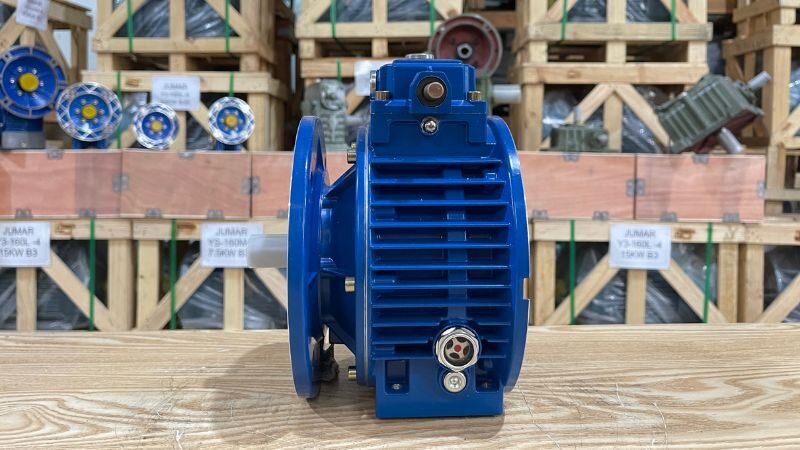
A mechanical speed variator, also known as a motor speed variator or motor controller, is a mechanical device designed to reduce the rotational speed of an electric motor while adjusting torque in transmission systems. When a gearbox is combined with an electric motor, they form a gear motor, helping to flexibly adjust and optimize operating performance. This type of speed variator is widely used in various industrial fields.What is a mechanical speed variator?
Structure of mechanical speed variator
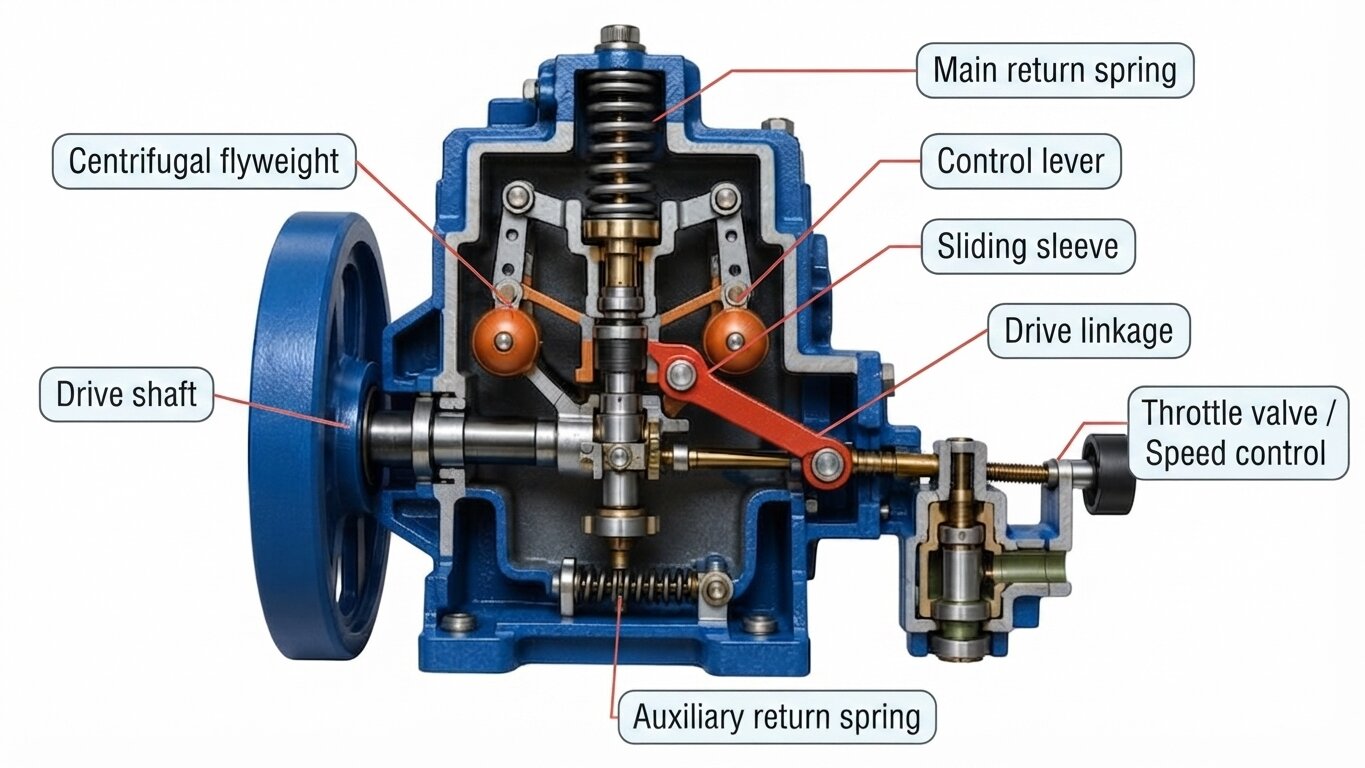
A mechanical speed variator is a device that helps stabilize the rotational speed of an engine by automatically adjusting the amount of fuel or energy transmitted into the system. The structure of a mechanical speed variator consists of the following main components:
Centrifugal weights: Consists of two or more weights mounted on a control arm rotating around the main axis. When the shaft speed increases, centrifugal force causes the weights to fly outward, generating control movement for the throttle linkage.
Rotating shaft: The component that transmits motion from the motor to the centrifugal weight system, converting rotational speed into centrifugal movement.
Control arm and transmission mechanism: Connects the centrifugal weights and the control valve, transmitting mechanical motion to open/close the valve according to speed changes.
Return spring: Creates a counterforce against the centrifugal force of the weights, helping to balance and maintain the desired stable speed.
Control valve or throttle mechanism: Controls the flow of fuel or energy entering the engine. When speed increases, the valve automatically reduces fuel; when speed decreases, the valve opens wider.
Detailed structure of the mechanical speed variator
Operating principle of mechanical speed variator
A mechanical speed variator operates based on the principle of balancing centrifugal force and spring elastic force to automatically adjust engine speed.
When the engine speed increases, the shaft rotates faster → centrifugal force acting on the weights increases → the weights fly outward, pulling the control arm up → the fuel control valve (or throttle valve) narrows → the amount of fuel entering the engine decreases → the speed drops back to a stable level.
Conversely, when the engine speed decreases, centrifugal force weakens → the return spring pulls the weights closer to the shaft → the control arm lowers → the control valve opens wider → increases fuel input → engine speed increases again.
Classification of mechanical speed variator
According to the number of reduction stages
1-Stage mechanical speed variator: The 1-stage mechanical speed variator is the simplest form among speed control devices, suitable for applications that do not require high-precision speed control. The main advantages are low cost, easy installation, and maintenance. This type of device is often used in simple machinery or common household appliances.
2-Stage mechanical speed variator: The 2-stage mechanical speed variator has the ability to operate at two different speeds, making it easy for users to choose the appropriate mode according to needs. This device is commonly found in machines requiring flexible speed changes such as grinders and drills. The strength of this line is its good adaptability to various uses.
3-Stage mechanical speed variator: With three operating speed levels, the 3-stage mechanical speed variator provides maximum adjustability for users. This is an ideal choice for complex industrial machinery systems where continuous and precise speed changes are required. The outstanding advantage of the 3-stage type is optimizing working performance and meeting diverse production requirements.
Common types of mechanical speed variators
According to installation position
Directly motor shaft-mounted speed variator: Receives direct motion from the crankshaft or output shaft of the engine, fast response, used in generators and agricultural machinery.
External (detached) speed variator: Installed via belt or intermediate transmission, suitable for large machinery systems, gearboxes, or industrial motors requiring flexible adjustment.
Latest mechanical speed variator price 10/2026 at Thanh Thai Motor
Mechanical speed variator price video 10/2026 at Thanh Thai Motor
Advantages of mechanical speed variator
A mechanical speed variator is widely used in many fields thanks to the following outstanding advantages:
Simple structure, easy to use: Purely mechanical design, no complex electronic system needed, making operation and maintenance easy.
High reliability: Operating on mechanical principles (centrifugal, inertia…), the mechanical speed variator is less affected by environmental conditions such as dust, temperature, or high humidity.
Fast and stable response: When engine speed changes, the system automatically adjusts to maintain stable speed, especially useful in generators, agricultural machinery, and industrial machines.
Low investment cost: Compared to electronic or hydraulic speed variators, mechanical speed variators are cheaper, suitable for various production scales.
Long lifespan, easy component replacement: With durable mechanical materials and good load-bearing capacity, the mechanical speed variator has a long service life, and components are easy to find and repair.
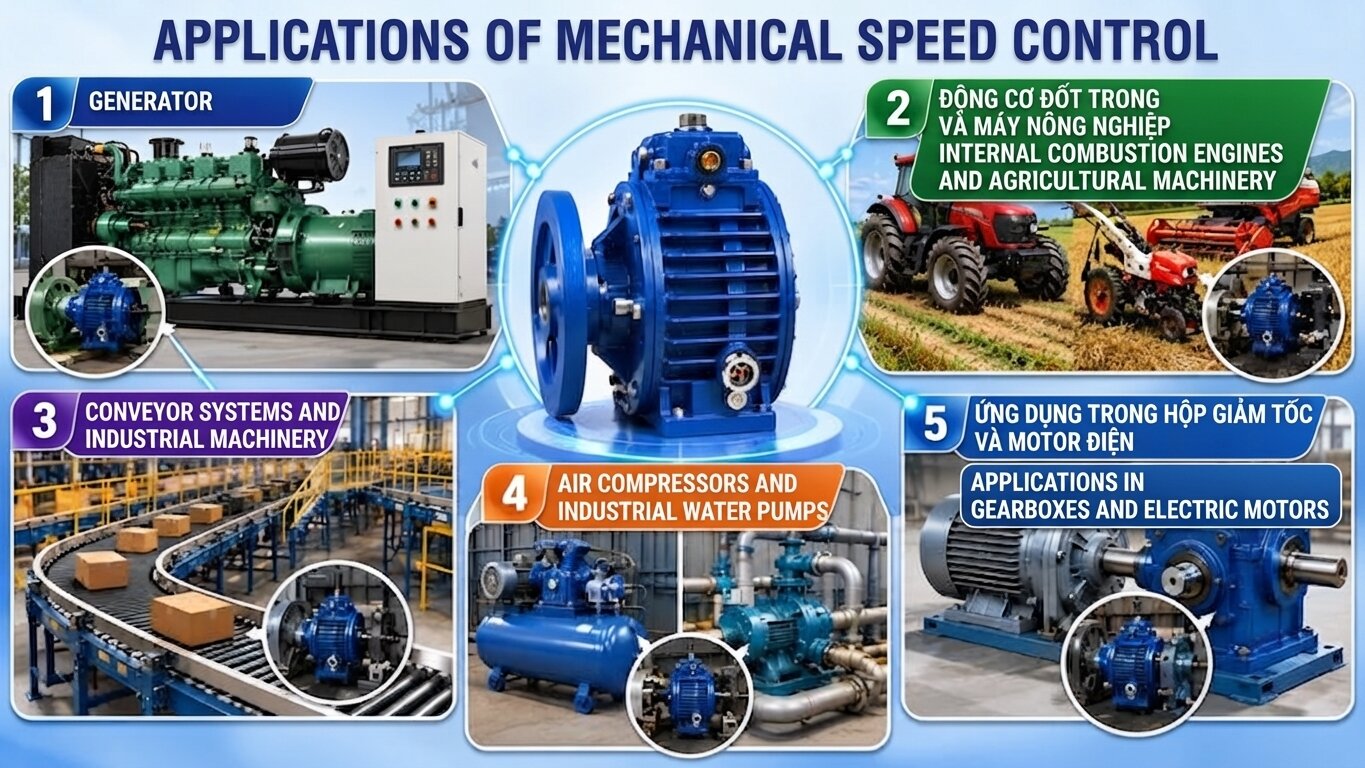
Applications of mechanical speed variator
The mechanical speed variator is widely used in many fields thanks to its accurate speed control and stabilization capabilities. Here are the most common applications:
Generators: The mechanical speed variator helps keep the engine rotational speed stable, ensuring that the output electrical frequency does not fluctuate, helping the generator operate efficiently and safely.
Internal combustion engines and agricultural machinery: Applied on tractors, cultivators, harvesters… to automatically adjust engine speed according to load, helping save fuel and increase equipment durability.
Conveyor systems and industrial machinery: Helps maintain stable operating speed, avoiding overload or sudden speed changes that affect the production line.
Air compressors and industrial water pumps: The mechanical speed variator helps control stable flow, saves energy, and limits wear and tear on rotating parts.
Applications in gearboxes and electric motors: When combined with a gearbox, the mechanical speed variator helps fine-tune the output speed to suit operating requirements, increasing working efficiency and lifespan for the entire system.
Applications of the mechanical speed variator
Notes when buying a mechanical speed variator
Determine the speed adjustment range: Clearly understand the RPM range of the variator (usually from 200 – 1000 RPM when paired with a 4-pole motor) to ensure the speed range of the production line is within this safe interval.
Carefully check the connecting flange code: Accurately measure the input/output shaft diameter and flange dimensions (PAM 71, 80, 90…) to ensure the mechanical speed variator assembles perfectly between the motor and gearbox.
Special attention to lubricating oil: The device operates entirely by metal disc friction mechanics, thus generating very high heat. It is mandatory to use specialized heat-resistant hydraulic/gear oil and check the oil sight glass periodically to prevent oil dryness and disc wear.
Choose cast iron or aluminum housing: Aluminum housing lines (like UDL) are compact, dissipate heat quickly, suitable for small capacities. Cast iron housing lines (like MB) are heavier but better withstand centrifugal force and impacts for heavy-duty applications.
Customers can access the gearbox video compilation category for a comprehensive overview, detailed reviews of gearbox products currently sold at Thanh Thai Motor, and pricing.
Frequently asked questions
Why does turning the adjustment knob while the motor is off completely ruin the mechanical speed variator?
The mechanical speed variator changes speed by shifting the contact position of the planetary friction discs along the axis. When the motor is running, these discs constantly roll and move smoothly to the new position. But when the motor stops, the metal surfaces are tightly pressed together in a fixed position; if you deliberately use force to twist the adjustment knob, the internal screw mechanism and gear structure will suffer mechanical overload resulting in immediate deformation, bending, or shattering.
How to handle a mechanical speed variator experiencing load slippage (motor still rotates but output shaft stands still or rotates very weakly)?
This phenomenon occurs due to 2 technical causes: First, the disc spring (compression spring) after years of use gets tired, reducing the clamping force and causing the friction discs to slip against each other when pulling heavy loads. Second, using the wrong type of lubricating oil or degraded oil (too thin, lost oil film), failing to create sufficient fluid friction adhesion between metal surfaces. To handle this, you need to disassemble and readjust the spring clamping force or replace it with the manufacturer’s specialized gear oil.
Why cannot an independent mechanical speed variator be used for extremely slow running applications?
A mechanical speed variator paired with a 4-pole motor (1450 RPM) only has a safe speed adjustment range within 200 – 1000 RPM (maximum reduction ratio of about 1/5 or 1/7). If you try to force the adjustment knob below the designed range, the friction disc will run close to the edge margin, increasing local friction and causing burn wear on the disc. Moreover, the slower it runs, the weaker the pulling force. Therefore, to achieve speeds below 10 RPM while keeping the machine strong, it is mandatory to install according to the combo scheme: Electric motor + Mechanical speed variator + Gearbox (such as NMRV or helical) at the rear.