A 2-Stage Gearbox (also known as a 2-stage gear unit) is a special drive gearbox that uses a mechanism of two pairs of gears meshing consecutively. This design helps reduce rotational speed to a very low level (slow speed) while doubling the torque, creating extremely strong pulling force that 1-stage types cannot achieve.
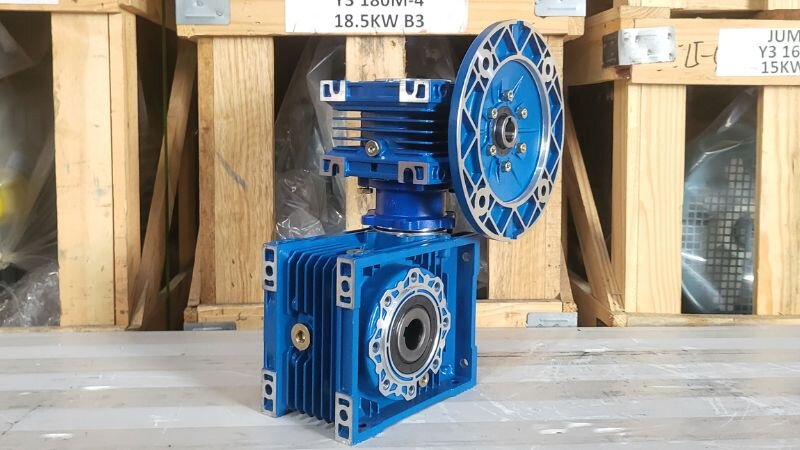
2-Stage NMRV Gear Motor
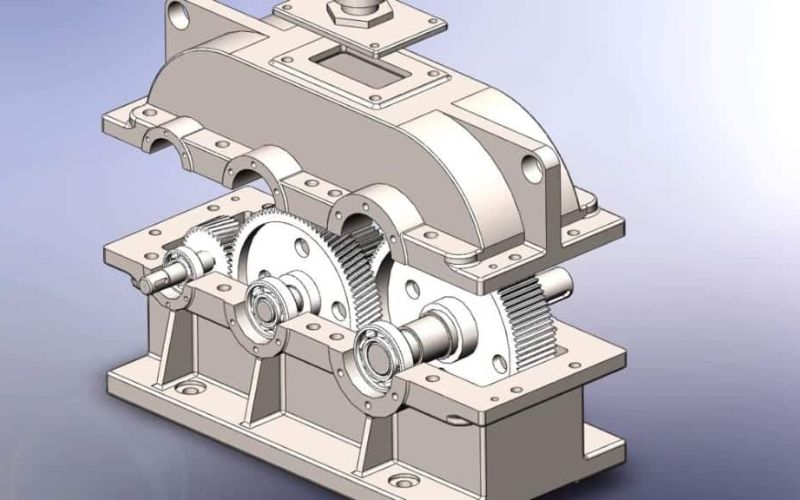
2-Stage Gearbox Construction
Gearbox Housing
The housing is usually made of cast iron or aluminum alloy, functioning to protect internal components such as gears and worms from external environmental impacts like dust and moisture. At the same time, the housing also serves as the load-bearing frame for the entire gearbox.
Gear System
This is the heart of the 2-stage gearbox construction. The system consists of two meshing gear pairs:
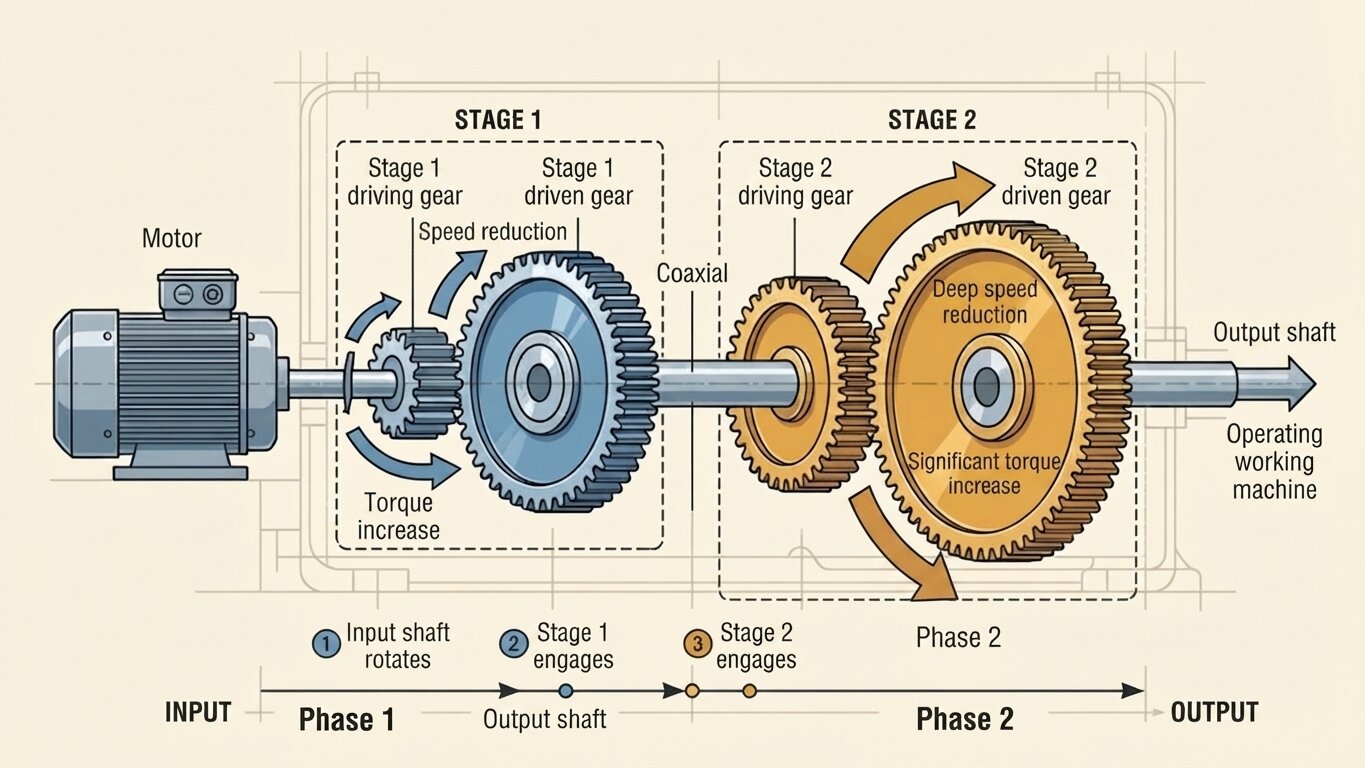
1-Stage (fast stage): Consists of a small driving gear receiving direct drive from the input shaft and a larger driven gear.
2-Stage (slow stage): The driving gear of this stage is coaxially connected to the driven gear of the 1st stage, and it meshes with the largest driven gear of the gearbox, which is connected to the output shaft.
The material for manufacturing gears is usually alloy steel that is thoroughly hardened to increase hardness and wear resistance.
Input and Output Shafts
The shafts are made of high-quality steel, possessing high strength and rigidity to withstand large torque. The input shaft connects to the motor, while the output shaft connects to the driven machine. The construction of the 2-stage gearbox determines whether the output shaft type is inline or right-angle.
Lubrication and Bearing System
Lubricating oil is contained inside the housing, serving to cool, reduce friction, and prevent wear for the gears and bearings. Bearings are installed on the shafts to support them, reduce friction, and ensure precise gear meshing. This is an indispensable part of the 2-stage gearbox construction to ensure the service life of the gear motor.2-Stage gearbox construction includes gear system, gearbox housing, input shaft, output shaftThis 2-stage gearbox construction operates effectively in adjusting the motor rotational speed while providing the necessary torque increase for various industrial applications. Choosing the appropriate gear type will depend on the specific requirements of each drive system.
Operating Principle of 2-Stage Gearbox
The operating principle of a 2-stage gearbox is quite simple yet extremely effective. The transmission process takes place in a closed cycle, based on the meshing of gear pairs with different numbers of teeth. Understanding this principle helps you know why the gear motor is so important.The operating process of a gear motor reducer can be described as follows:
Stage 1 (1-Stage Reduction): The motor transmits rotational movement to the input shaft of the gearbox. This shaft rotates the small driving gear of the 1st stage. This gear meshes with and rotates the larger driven gear, causing the rotational speed to decrease and torque to increase for the first time.
Stage 2 (2-Stage Reduction): The driven gear of the 1st stage is coaxially connected to the driving gear of the 2nd stage. Therefore, when the 1st-stage gear rotates, it also rotates the 2nd-stage driving gear. This gear continues to mesh with the largest driven gear of the gearbox, performing the second reduction process. The rotational speed decreases further, while the torque increases significantly.
Output: The rotational movement with reduced speed and increased torque is transmitted to the output shaft to operate the driven machine.
Operating principle of 2-stage gearbox
Classification of 2-Stage Gearboxes
2-Stage ZQ Gearbox
The 2-stage ZQ gearbox uses deployed cylindrical gears, increasing transmission ratio and bearing loads well. ZQ has a simple structure, easy maintenance, and reasonable cost. Used in agitators, mixers, small conveyors.
2-Stage Mechanical Speed Variator
The 2-stage mechanical speed variator allows flexible adjustment of output speed through changing the transmission ratio. Used in rolling mills, drawing machines, and systems requiring continuous speed changes.
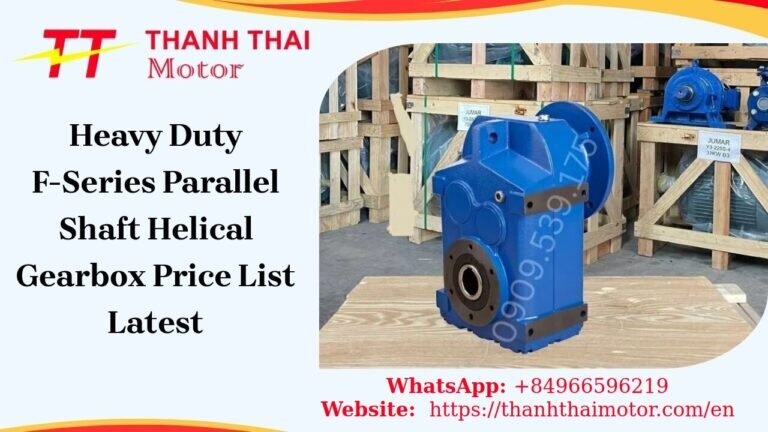
2-Stage F-Series Parallel Shaft Helical Gearbox
The 2-stage F-series parallel shaft helical gearbox features a parallel input-output shaft design, space-saving, high efficiency, and smooth operation. Used in conveyor systems and lifting machines.
2-Stage K-Series Helical Bevel Gearbox
The 2-stage K-series helical bevel gearbox features a right-angle input-output shaft design, changing transmission direction, high load capacity, and stability. Used in construction machinery and concrete mixers.
2-Stage S-Series Helical Worm Gearbox
The 2-stage S-series helical worm gearbox has a design similar to the K type but adds an intermediate shaft to increase torque and transmission ratio. Used in heavy industrial machinery requiring high performance.
2-Stage R-Series Inline Helical Gearbox
The 2-stage R-series inline helical gearbox is equipped with an intermediate shaft to increase transmission ratio and output torque. Designed with an inline shaft, compact size, easy installation, and stable transmission. Used for continuous heavy loads in restricted spaces.
2-Stage Cycloidal Gearbox
Using the cycloidal drive principle, it provides a large transmission ratio and effective deceleration. Compact size, high load capacity, and superior durability. Applied in industrial machinery requiring high precision and stable operation. However, the disadvantage of the 2-stage cycloidal gearbox is that production costs may be higher than other types of gearboxes and it also requires regular maintenance.
Latest 2-Stage Gearbox Price at Thanh Thai Motor
If you are looking to buy a 2-stage gearbox with stable performance and high durability, the 2-stage gearbox price list below will help you easily choose according to your needs. Thanh Thai Motor updates the latest prices in 10/2026 for a variety of models and capacities.
A 2-stage gearbox is an important mechanical device widely used in many industrial applications. This gear motor plays a role in reducing rotational speed and increasing motor torque, meeting the requirements of various machinery. To better understand your choice, let’s explore the advantages and disadvantages of the 2-stage gearbox.
Advantages
Large transmission ratio: Capable of creating a high transmission ratio, meeting very slow speed requirements.
High torque: Significantly increases pulling force at the output shaft, suitable for heavy-duty applications.
Stable operation: The staged gear structure helps the gearbox operate durably and withstand good loads.
Variety of types: There are many types such as coaxial gearboxes and right-angle gearboxes to suit various installation spaces.
Disadvantages
Complex construction: Compared to the 1-stage type, the construction of a 2-stage gearbox is more complex, requiring high precision in manufacturing and assembly.
Higher cost: Due to more components and higher technical requirements, the price of a 2-stage gearbox is usually higher than that of a 1-stage type. Many users look for cheap gearboxes but need to carefully consider quality.
Larger size: Usually has a larger size and weight than a 1-stage type with the same power.
Things to Keep in Mind When Buying a 2-Stage Gearbox
When deciding to buy a 2-stage gearbox, there are several important factors you need to consider to ensure the equipment fits your usage needs and operates effectively. Here are things to keep in mind:
Determine the required power and transmission ratio suitable for your application. The gearbox must be able to meet the necessary load and rotational speed.
For the 2-stage gearbox construction, choose between spur gears and helical gears, depending on requirements for noise, efficiency, and load capacity.
Check the material of the gearbox. Durable and corrosion-resistant materials will help increase the device’s lifespan.
Ensure the gearbox has a size suitable for the installation space and a weight that does not affect the machinery’s structure.
Compare prices among different products, but also consider quality and performance instead of relying solely on low prices.
Check the product’s warranty policy. A long-term and clear warranty will give you more peace of mind during use.
Factors to note when buying a 2-stage gearbox
Guide to Choosing the Right 2-Stage Gearbox
To choose an optimal 2-stage gearbox, you need to pay attention to the following factors:
Motor power (kW or HP): Choose a gearbox with a power suitable for the motor to ensure synchronized and efficient operation.
Transmission ratio (Ratio): Determine the desired output speed to calculate the necessary transmission ratio.
Output shaft type: Choose an inline or right-angle shaft (hollow or solid shaft) depending on the space and installation design.
Working environment: Consider factors such as temperature, humidity, and dust to choose a gearbox with an appropriate protection class.
Reputable supplier: Choose a reputable gearbox supplier like Thanh Thai Motor to ensure product quality, good warranty policy, and available high-quality Chinese gearboxes.
Frequently Asked Questions (FAQ)
Is the ZQ gearbox a 1-stage or 2-stage type?
Most ZQ gearboxes (such as ZQ 200, ZQ 350…) on the market are 2-stage cylindrical gear types. However, there are still 1-stage or 3-stage variants depending on ordering requirements. Please check the specification label for accuracy.
When should you use a 2-stage gearbox instead of a 1-stage?
You must use a 2-stage gearbox when:
Very slow output speed is required (under 50 rpm);
Extremely large pulling force (torque) is needed to pull heavy objects such as marine winches or presses. The 1-stage type will not have enough force and is prone to gear breakage in this case.