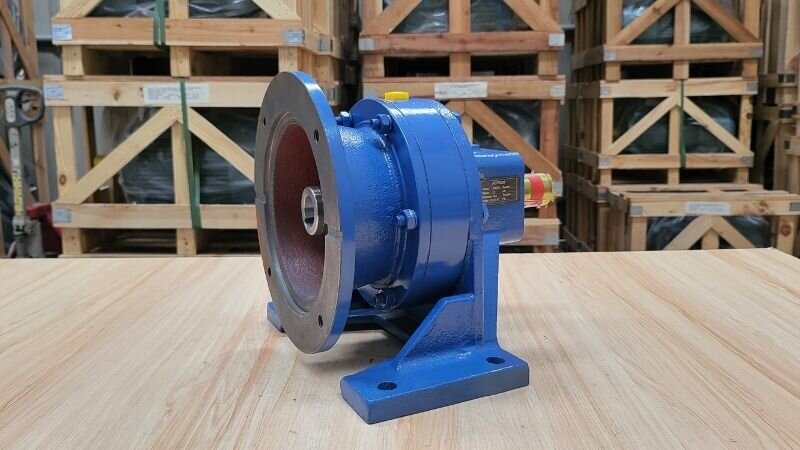
A cycloidal gearbox, also known as a cycloidal speed reducer, is one of the most widely used transmission devices in industry due to its high load capacity and high efficiency. When combined with an electric motor, this gearbox forms a gear motor, specifically heavy duty gear motor lines, which effectively increases torque and reduces output speed. With a special design and optimal operating principle, this device is suitable for many applications requiring high durability and precision.What is a cycloidal gearbox?
Cycloidal gearbox structure
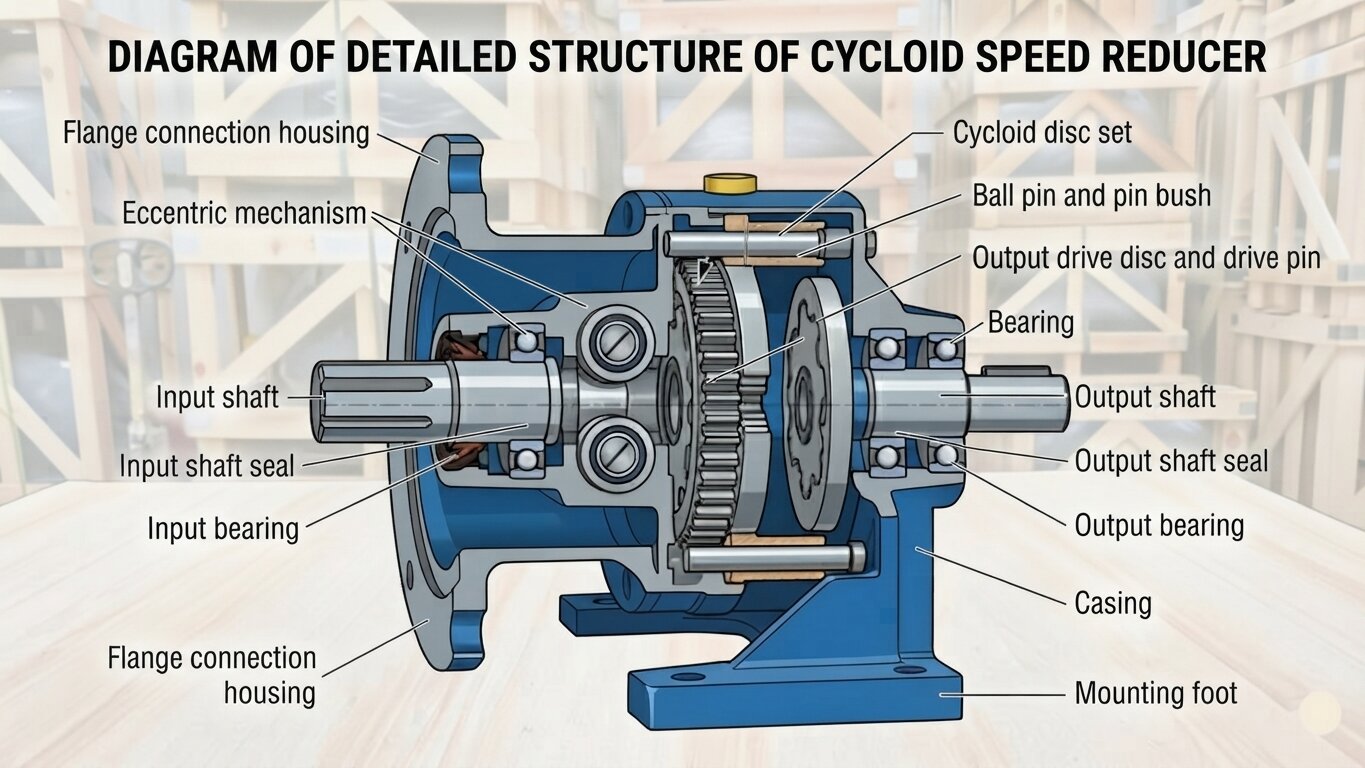
A cycloidal gearbox (also known as an eccentric shaft gearbox) has a more special structure than conventional gearboxes. The product is designed based on the drive principle of the pin and cycloidal disc mechanism, which effectively reduces rotational speed and increases torque. The main components include:
Input Shaft: Directly connected to the electric motor, usually designed with an eccentric structure to transmit motion to the cycloidal disc.
Cycloidal Disc: A characteristic component of the gearbox, featuring a special shape that helps create slow and stable rotational motion.
Pin or Needle Bearing: Arranged around the cycloidal disc, responsible for converting eccentric motion into the rotational motion of the output shaft.
Output Shaft: Receives rotational motion from the pin and cycloidal disc system and transmits it to the external load.
Gearbox Housing: Made of cast iron or cast aluminum alloy, protecting the entire transmission mechanism while helping reduce vibration and noise.
Bearings and Oil Seals: Help reduce friction, increase durability, and prevent oil leakage during operation.
Detailed structure of the cycloidal gearbox
Cycloidal gearbox operating principle
A cycloidal gearbox operates based on the eccentric transmission principle between the input shaft and the cycloidal disc. When the input shaft rotates, it transmits motion to the eccentric shaft, causing the cycloidal disc to rotate and oscillate around the center of the pin ring.During this process, the holes on the cycloidal disc mesh with the surrounding fixed pins or needle bearings, creating a rotational speed difference between the input shaft and the output shaft. This difference helps effectively reduce the output rotational speed while significantly increasing torque.Thanks to this principle, the cycloidal gearbox achieves a large transmission ratio in a compact size, operates smoothly and stably, and has high shock load resistance – making it ideal for mechanical systems requiring high precision and efficiency.
Classification of cycloidal gearboxes
Classification by number of stages
1-Stage cycloidal gearbox: A simple transmission gearbox consisting of only a single reduction stage. The 1-stage cycloidal model stands out for its compact design, easy installation, and high working efficiency. The product has a reasonable price and is suitable for transmission systems requiring moderate speed reduction, limited installation space, and long-term stable operation.
2-stage cycloidal gearbox: Designed with two consecutive reduction stages, this type provides a large transmission ratio and higher torque. Thanks to its good load capacity and durable operation, the 2-stage cycloidal gearbox is often used in industrial production lines, heavy machinery, long conveyor systems, or equipment requiring continuous operation under heavy loads.
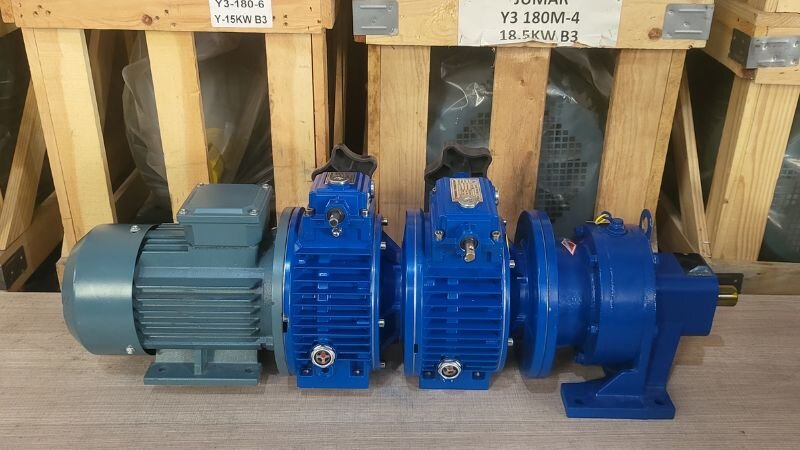
Cycloidal gearbox assembled with 2 mechanical speed variators and an electric motor
By mounting type
Horizontal type: Input and output shafts are parallel, easy to mount on machine bases or fixed frames.
Vertical type: Input and output shafts are perpendicular, suitable for narrow spaces or vertical conveyor systems.
Flange-mounted type: Compact design, often used for direct connection to electric motors.
Latest cycloidal gearbox price list at Thanh Thai Motor
Latest cycloidal gearbox price quote video 10/2026 at Thanh Thai Motor
Advantages of cycloidal gearboxes
The cycloidal gearbox is highly rated thanks to its special structure and superior transmission capabilities, offering many outstanding benefits compared to traditional gearboxes:
High transmission efficiency: reaches 90 – 95%, thanks to the continuous power transmission mechanism through multiple contact points, helping reduce energy loss.
Compact size – high load capacity: with a unique cycloidal design, the gearbox can withstand 3-5 times the load compared to units of the same capacity, while maintaining a small size and light weight.
Smooth operation, low noise: the sliding-rolling structure of the cycloidal disc helps reduce vibration and noise during operation, suitable for low-noise environments such as robots, packaging machines, and automated lines.
Long lifespan, low maintenance: thanks to precisely hardened components and continuous operation in a load-balanced state, cycloidal gearboxes have a durable lifespan and require minimal maintenance.
High precision: stable speed control capability without jolting or deviation, highly suitable for servo systems, industrial robots, and CNC machines.
Diverse mounting types and transmission ratios: easily combined with various electric motors and variable frequency drives, suitable for various spaces and technical requirements.
Applications of cycloidal gearboxes
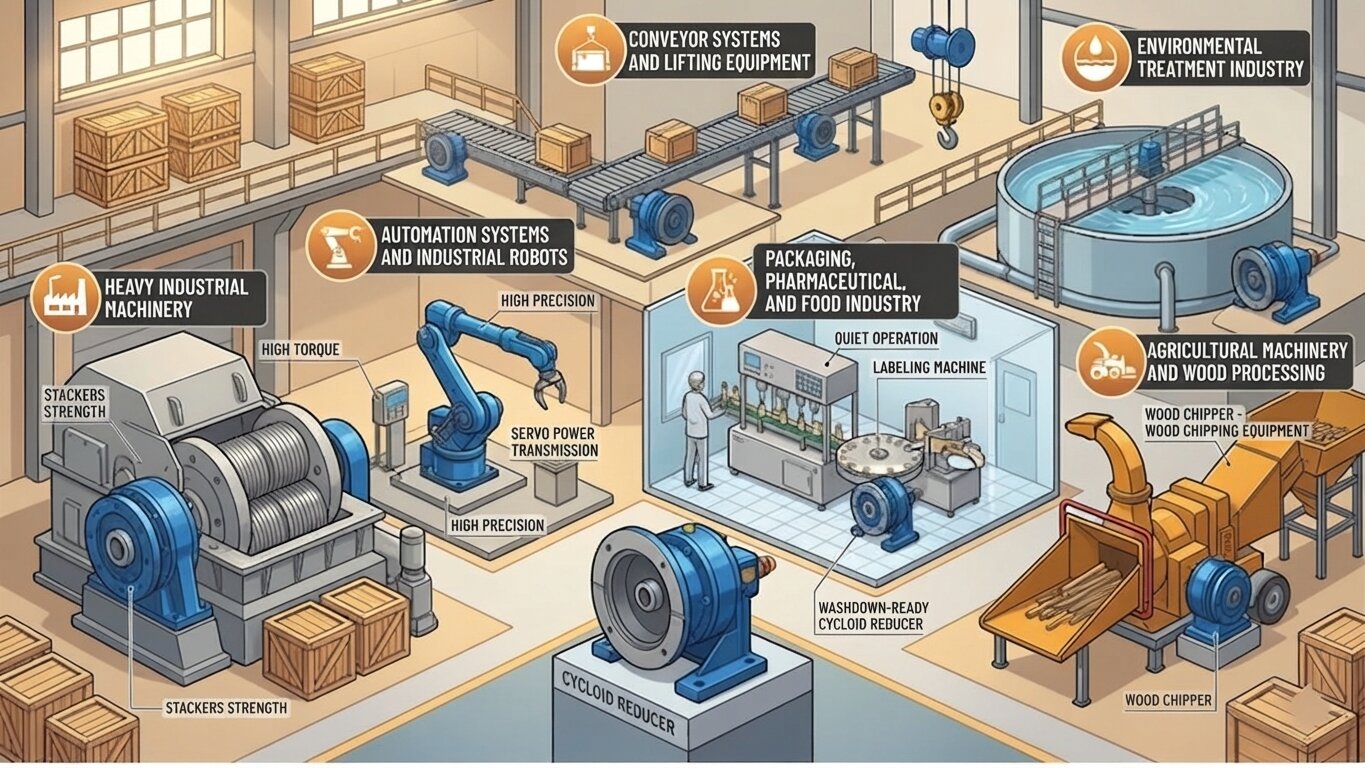
Cycloidal gearboxes (BWD, XWD, XWED, XLED…) are widely used in many industrial fields thanks to their stable transmission, heavy load capacity, and high precision. Some common applications include:
Heavy industrial machinery: such as presses, steel rolling mills, crushers, and heavy-duty conveyor belts – where high torque and stable operation are required.
Automation systems and industrial robotics: thanks to high precision and low backlash, cycloidal gearboxes are ideal for pick-and-place robots, welding robots, or precision servo control equipment.
Packaging, pharmaceutical, and food industries: used in filling machines, packaging machines, mixers, labeling machines… with advantages of smooth, stable operation and easy hygiene.
Environmental and wastewater treatment industry: installed in agitators, aerators, and sludge dewatering presses, helping transmit powerful force and save energy.
Lifting equipment, conveyors, freight elevators: cycloidal gearboxes ensure smooth, safe movement and continuous load-bearing over long periods.
Agricultural and woodworking machinery: used in grinders, crushers, feed mixers, and automatic feeding systems.
Applications of cycloidal gearboxes
Notes when buying a cycloidal gearbox
Determine the mounting type (Foot-mounted or Flange-mounted): This is the first important note to avoid ordering the wrong code. Foot-mounted series (designated as X or B) are used for horizontal applications, connected via couplings or chains. Flange-mounted series (designated as XL or BL) are used for vertical applications such as chemical agitators, submersible agitators, and mixing tanks.
Accurately look up the model/size: Cycloidal gearboxes designate sizes according to housing numbers, for example: X2, X3, X4, X5… or B0, B1, B2, B3… The larger the size, the larger the shaft diameter and the higher the torque (Nm) it can withstand. You need to rely on the catalog table to choose the right size matching the motor power, avoiding discrepancies where an overly powerful motor breaks the gearbox shaft or vice versa.
Select the reduction structure (1-stage or 2-stage):
1-stage: Transmission ratio ranges from 9 to 87. Extremely high transmission efficiency (over 90%).
2-stage: Usually combined from 2 cycloidal stages (designated as X42, X53, B21…), giving a very large transmission ratio from 121 up to 7569. This series specializes in ultra-low speed applications requiring super heavy pulling force.
Input shaft diameter and connection flange: If you buy a separate gearbox to install with an existing motor in your workshop, you must accurately measure the motor shaft diameter and flange dimensions. Even a few millimeters of deviation will prevent the motor shaft from fitting into the eccentric bearing (cam bearing) of the cycloidal gearbox.
Safety service factor: Although cycloidal units withstand impacts well, for particularly heavy and harsh loads such as stone crushers, rice husk briquette presses, and thick sludge agitators… you still need to select a higher gearbox capacity (Sf from 1.5 to 2.0). Selecting right at the load limit will quickly wear out the internal roller bearing system and cycloidal disc.
Check the manufacturer’s lubrication method:
Horizontal foot-mounted series typically use liquid oil (not pre-filled upon delivery). Upon purchase, you must fill it with industrial oil before operating.
Vertical flange-mounted series must use specialized heat-resistant grease to prevent oil leakage downward. Carefully ask the supplier whether the equipment is already pre-filled with grease/oil to avoid burning the gearbox upon powering on.
Customers can access the gearbox video collection page to get more product information, practical reviews, installation guides, and monthly price quotes.
Frequently asked questions
Why do cycloidal gearboxes have much better overload and impact resistance than conventional gearboxes?
In spur or worm gear series, only 1 to 2 teeth bear the load at any single contact point, making them prone to chipping or breaking when subjected to sudden jolts. Meanwhile, the cycloidal gearbox utilizes an eccentric disc rolling mechanism on rollers, allowing up to 30% – 50% of the total number of “teeth” to simultaneously bear the load. Impact force is evenly distributed around, helping the gearbox withstand impact forces up to 500% without fear of breaking internal mechanisms.
What technical error causes a cycloidal gearbox to jam or make clanking noises after disassembly for maintenance?
This is a classic issue caused by installing the cycloidal discs backwards. A standard cycloidal gearbox always has 2 cycloidal discs installed 180º out of phase to balance dynamic forces during rotation. Each disc surface features the manufacturer’s symbol or code. When disassembled for cleaning and reassembly, if the mechanic places both discs in the same direction (in phase) or flips the marked side of the disc inward, the gearbox will lose balance, causing shaft binding or loud mechanical impact noises when powered on.
How does the lubrication mode of foot-mounted cycloidal gearboxes (X/B) differ from flange-mounted series (XL/BL)?
The mounting orientation completely determines the lubrication method for this series:
Horizontal foot-mounted series (X, B, WD): Typically lubricated by oil bath immersion (ISO VG 150/220 industrial oil). Oil helps dissipate heat well for bearings and eccentric discs when rotating at high speeds.
Vertical flange-mounted series (XL, BL, WDL): Due to vertical installation, using liquid oil would easily cause leakage downward through the shaft seal. Therefore, vertical series must use specialized heat-resistant grease for lubrication. Customers should strictly note not to fill liquid oil into vertical series and vice versa to avoid damaging internal bearings.