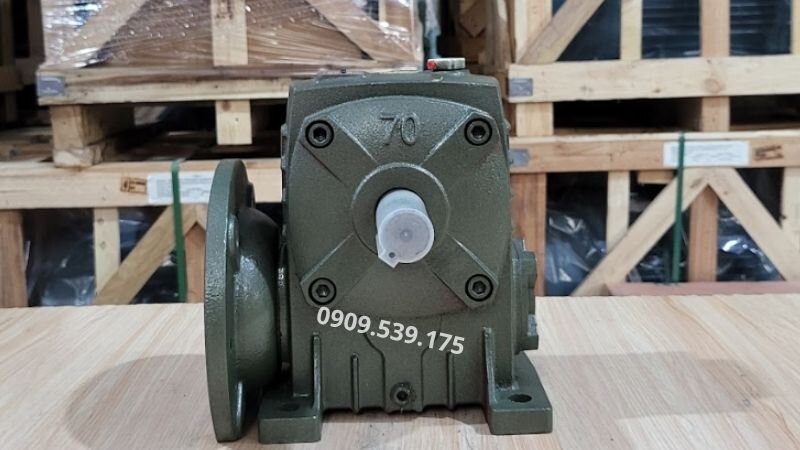
A 1-Stage Worm Gearbox is a mechanical transmission device that uses a worm and worm wheel mechanism to reduce input rotational speed and increase output torque. When combined with an electric motor, this gearbox forms a gear motor, meeting the requirements for performance and strong pulling force for machinery systems.
With a compact design, stable performance, and good self-locking capability, worm gearboxes are widely applied in industrial and civil sectors, helping to adjust speed and pulling force accurately and efficiently.
1-Stage Worm Gearbox.
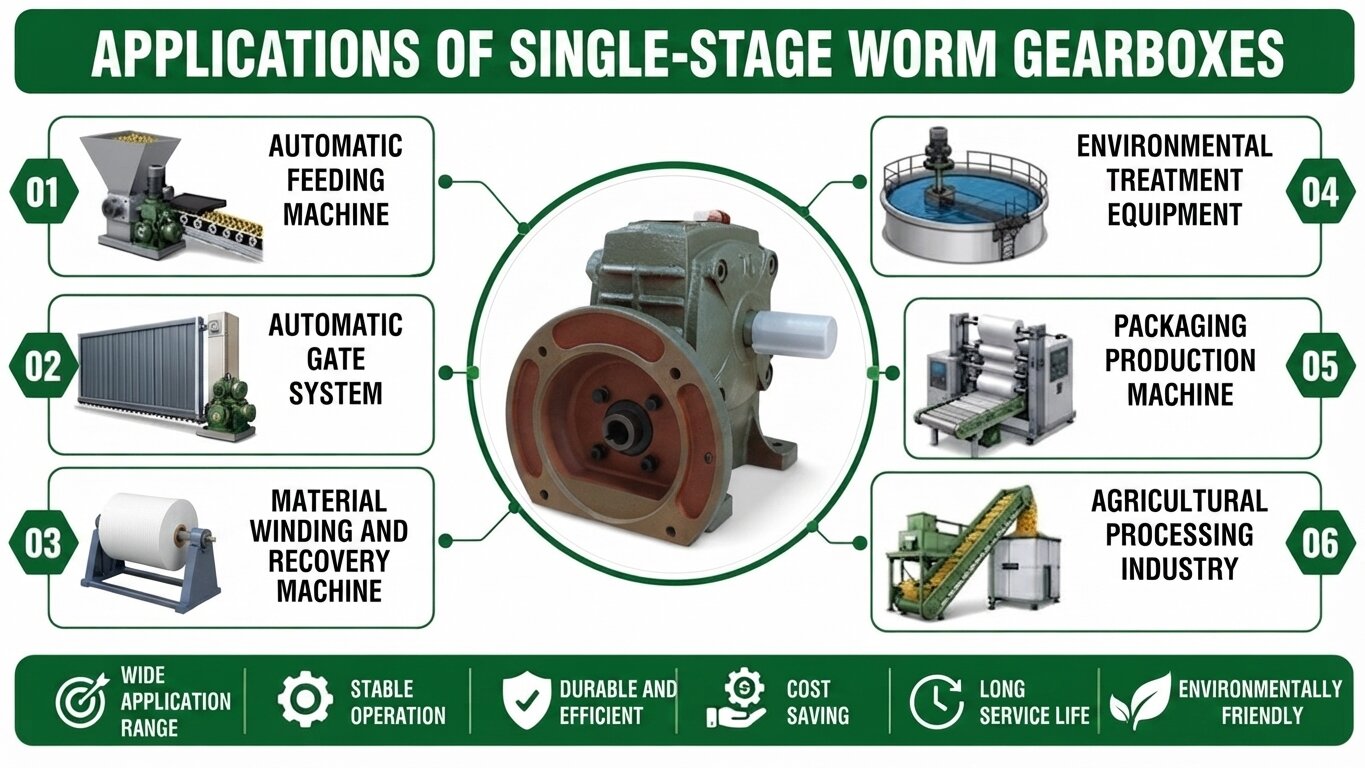
Applications of 1-Stage Worm Gearbox
Automatic material feeding machine: Helps adjust the material feeding speed stably, ensuring the production process takes place continuously and evenly.
Automatic gate system: Used to transmit motion for the door opening and closing mechanism, providing smooth and precise operation.
Material winding and recovery machine: Suitable for equipment winding cables, plastic films, fabrics, or other roll-form materials.
Environmental treatment equipment: Commonly installed on sludge scrapers, slow agitators, or wastewater treatment systems.
Packaging machinery: Supports pulling, rolling, and product positioning mechanisms in industrial packaging production lines.
Agricultural processing industry: Applied on dryers, sorters, or material transport equipment during processing.
Applications of 1-Stage Worm Gearbox.
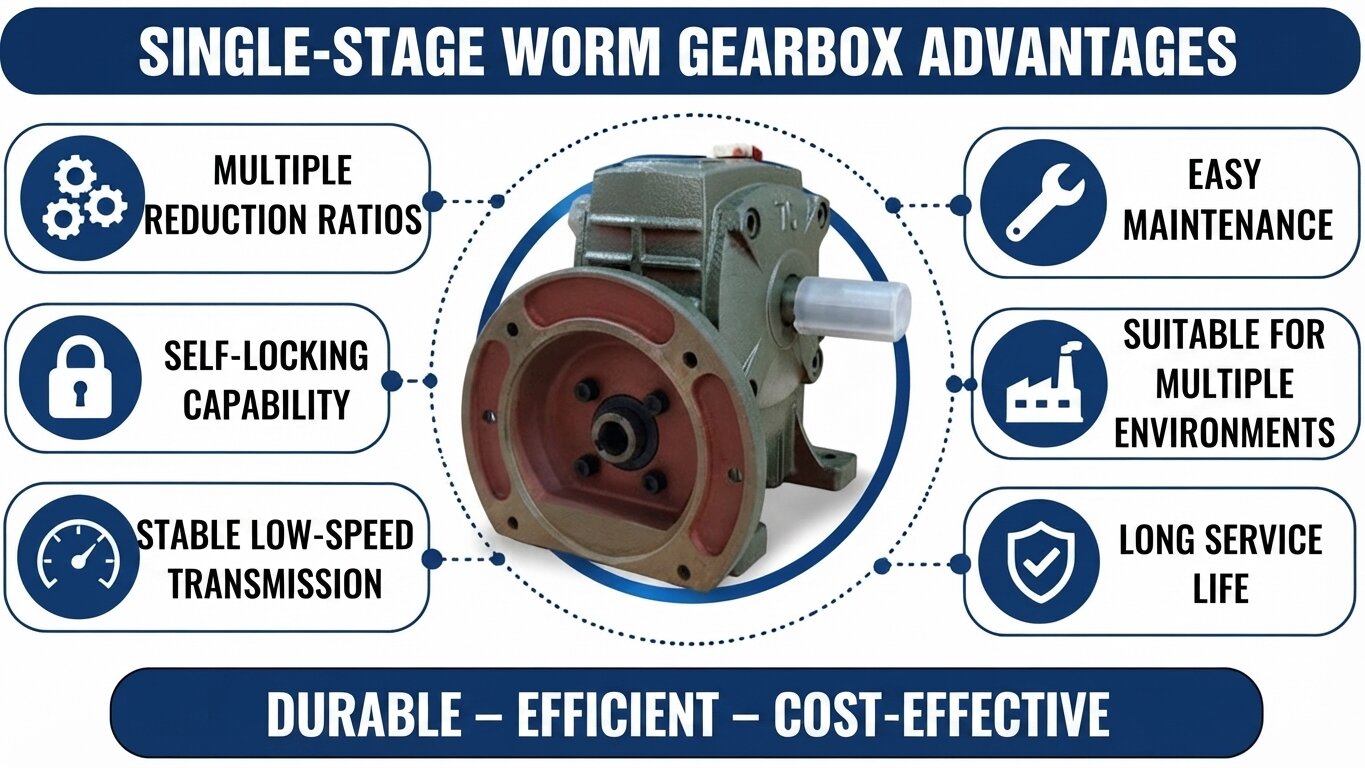
Advantages of 1-Stage Worm Gearbox
Diverse gear ratios: Various gear ratio options are available to meet the speed reduction needs of many types of machinery and equipment.
Self-locking capability: Under certain working conditions, the gearbox can limit the reverse rotation phenomenon from the load to the motor.
Stable low-speed transmission: Maintains continuous operation even when the output requires a low rotational speed.
Easy maintenance: Not too complex in structure, convenient for checking lubricating oil and replacing components when necessary.
Suitable for various working environments: Can be used in workshops, production lines, or industrial and civil mechanical systems.
High service life: When chosen with the correct load capacity and maintained periodically, the gearbox can operate stably for many years.
Advantages of 1-Stage Worm Gearbox.
Featured 1-Stage Worm Gearbox Price List at Thành Thái Motor
Below is the price list for 1-StageWorm Gearbox models chosen by many customers at Thành Thái Motor. You can refer to and compare them based on dimensions, gear ratios, and load capacities to select the product that suits your actual transmission system.
Determine the required output rotational speed: This is an important basis for selecting the appropriate gear ratio, avoiding situations where the working speed does not meet the machinery’s requirements.
Check the load acting on the output shaft: Both continuous load and starting load must be calculated to ensure the gearbox can work stably for a long time.
Match the gearbox size with the motor power: Proper matching between the motor and gearbox will help the system operate efficiently and limit premature damage.
Note the working environment conditions: For dusty environments, high humidity, or continuous operation, priority should be given to gearbox lines with a sturdy structure and good sealing capability.
Warranty policy: Prioritize products with full technical specifications and a warranty policy; this facilitates installation, maintenance, and component replacement when needed.
In addition to referring to the technical specifications, you can view more practical summary videos at Thành Thái Motor. The gearbox videos at Thành Thái Motor share detailed information about the structure, how to identify gear ratios, installation guides, and practical experiences in using worm gearboxes.
Frequently Asked Questions
After changing new oil, why do bubbles and abnormal noises appear in the gearbox?
This condition may occur when using the wrong type of oil, overfilling the oil beyond regulations, or when the oil contains moisture, which reduces the lubrication capacity of the transmission system.
Why does the gearbox leak oil at the housing joint surface even though the shaft seal is still good?
The cause usually comes from aged sealing gaskets, warped mating surfaces, or connection bolts losing sufficient tightening torque after long-term operation.
Why are the worm wheel teeth broken in the gearbox even though the motor has been equipped with overload protection devices?
The cause may stem from sudden shock loads, mechanical jamming at the output, or fatigue cracks that appeared earlier in the transmission but went unnoticed during maintenance.