Centrifugal fans are mechanical devices used to generate airflow by utilizing the centrifugal principle. When air enters the fan, it is rotated around an axis and expelled outward in a direction perpendicular to the rotation axis.
Applications of Centrifugal Fans
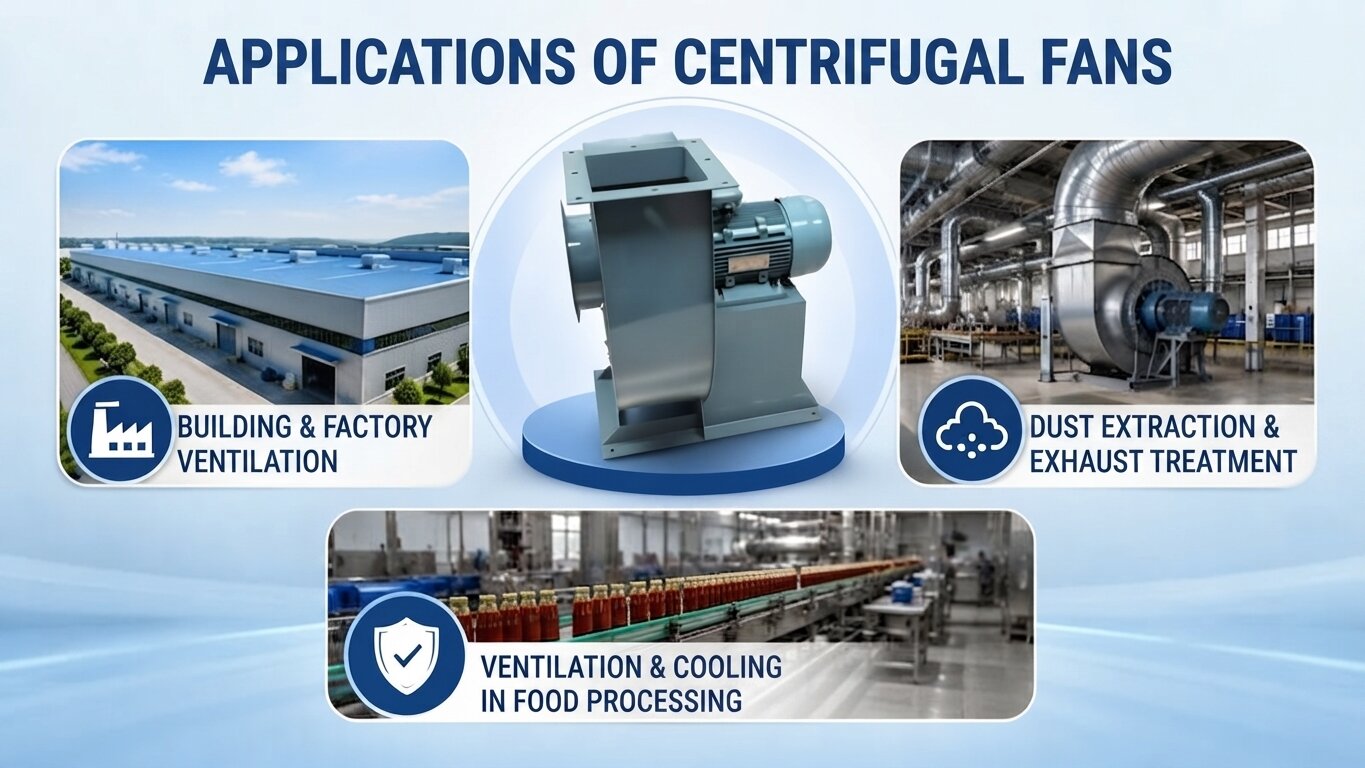
Centrifugal fans operate on the principle of high pressure generation via centrifugal force, making them suitable for systems requiring large air volumes, strong suction and blowing, and stable operation in industrial environments.
Building and factory ventilation: Used in buildings, workshops, and industrial zones for air supply and exhaust, as well as air circulation. Centrifugal fans help improve air quality, reduce temperatures, and create a well-ventilated working environment.
Dust collection and exhaust gas treatment: Applied in factories and production workshops to extract dust, smoke, and pollutants generated during machining processes. Thanks to their high-pressure generation capability, centrifugal fans support dust filtration systems in operating efficiently, contributing to environmental protection and worker health.
Ventilation and cooling in food processing: Installed in food production and processing areas to control temperature, humidity, and odors. Centrifugal fans help maintain stable production conditions, ensuring food quality and safety.
Applications of centrifugal fans
Characteristics of Centrifugal Fans
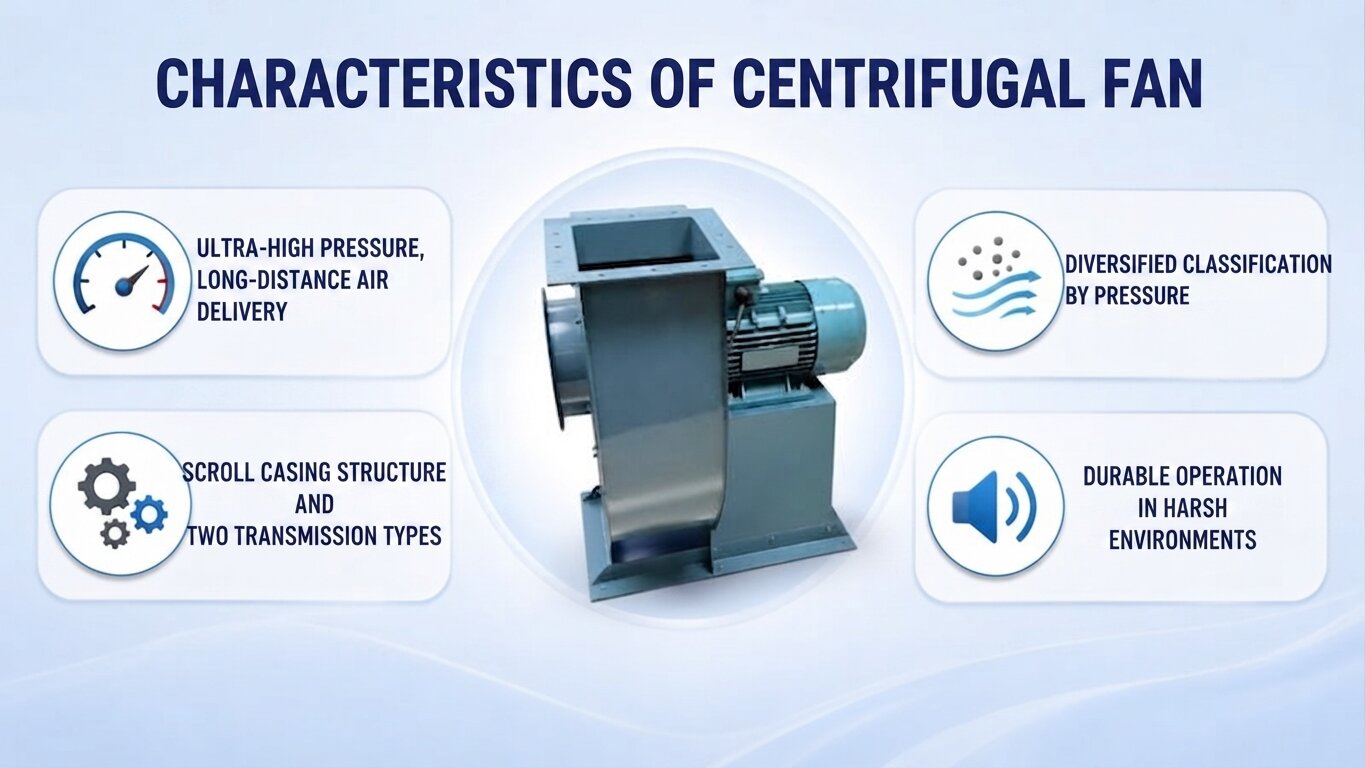
Extremely high head pressure, long-distance air delivery: Due to centrifugal force, centrifugal fans generate very high pressure, helping to compress and push airflow through long piping systems or multiple bends much better than axial fans.
Volute casing structure and 2 drive types: The fan casing is designed in a scroll shape to collect air. The fans are available in direct-drive configuration (impeller mounted directly to the motor shaft) or indirect-drive configuration (via V-belts, protecting the motor from high temperatures and dust).
Diverse classification by pressure: Divided into 3 main lines including low-pressure (ventilation, fresh air supply), medium-pressure (dust collection, workshop smoke extraction), and high-pressure (boiler and combustion chamber air supply).
Durable operation in harsh environments: Withstands hot air, dust, abrasive particles, and corrosive chemicals well; operates smoothly and experiences minimal pressure drop under fluctuating loads.
Disadvantages: Relatively bulky size, with higher investment and installation costs compared to axial fans.
Characteristics of centrifugal fans
Price List for Centrifugal Fans at Thanh Thai Motor
How to know whether a workshop dust collection and ventilation system should use centrifugal fans or axial fans?
Choose centrifugal fans when the system has long piping, many winding curves, or needs to extract heavy air (wood dust, hot smoke, chemical vapors) because this line generates extremely high head pressure to push air over long distances. Conversely, choose axial fans when you only need a large air volume for short, straight ventilation and cost savings.
When should you choose direct-drive centrifugal fans and when should you use indirect-drive (V-belt)?
Choose direct-drive (impeller attached directly to the motor shaft) for clean air at normal temperatures to keep the machine compact and achieve maximum efficiency. Choose indirect-drive (motor located externally, driven via V-belts) when extracting hot air, heavy dust, or corrosive chemicals to protect the motor from damage.
Why do centrifugal fans experience heavy vibration or mechanical squealing noises right upon startup?
This phenomenon is usually caused by 2 reasons: First, the impeller is unevenly fouled or warped, causing dynamic imbalance. Second, the bearings are dry or damaged, or the V-belt (in indirect-drive models) is slack or the pulley is misaligned. You need to clean the impeller, adjust the V-belt, and grease the bearings for maintenance.