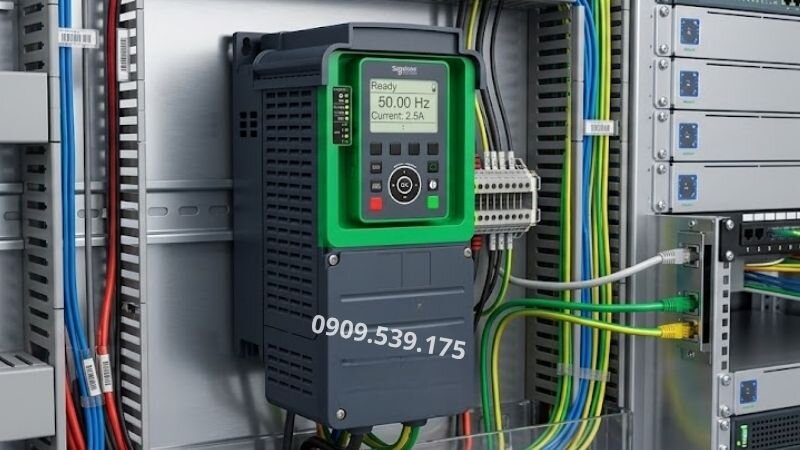
Schneider Variable Frequency Drives above 10kW are electric motor speed control devices specially designed for medium and heavy-duty applications. Developed by Schneider Electric (France), Schneider Variable Frequency Drives above 10kW offer stable operation, meet continuous duty requirements, and support various control modes to optimize performance and save energy for the system.
Schneider Variable Frequency Drives above 10kW.
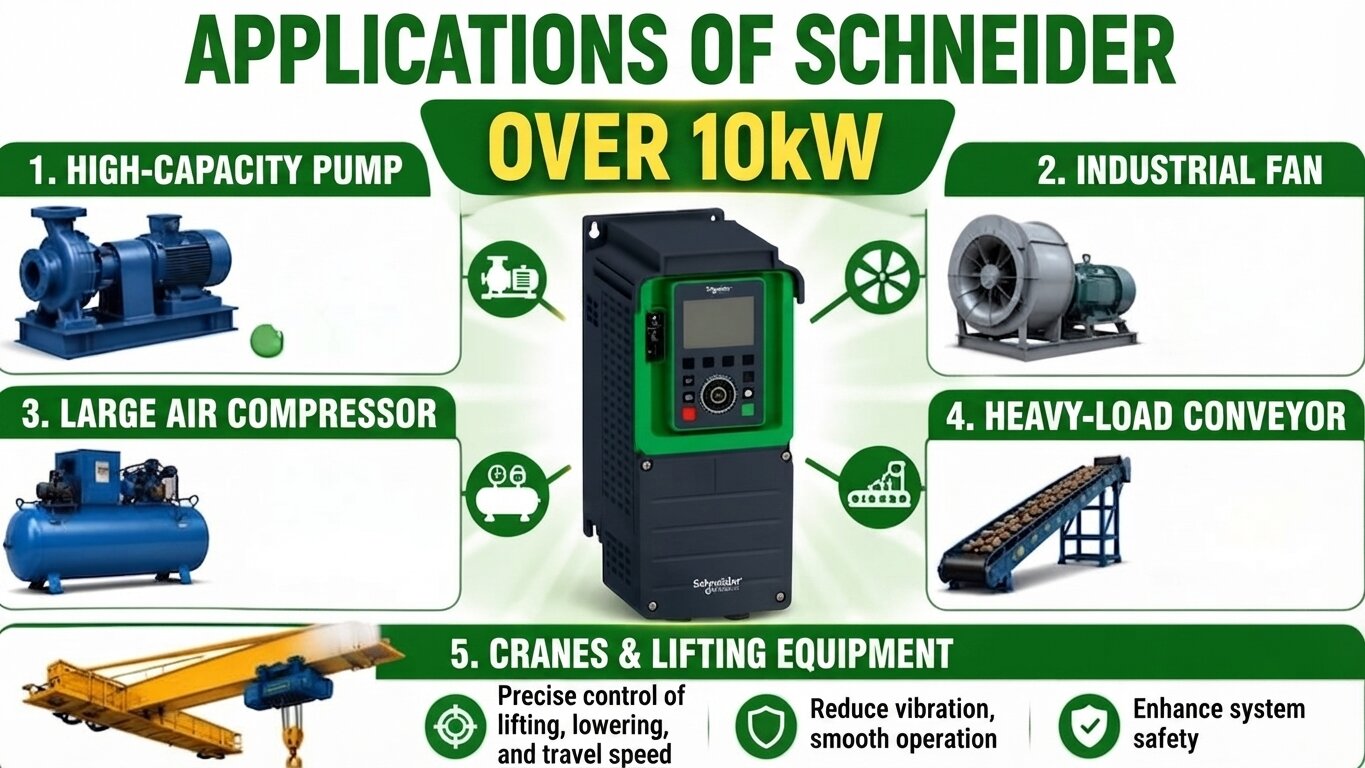
Applications of Schneider Variable Frequency Drives above 10kW
Large-capacity pumping systems: Variable Frequency Drives above 10kW are used to control water supply pump stations, booster pumps, and circulation pumps, helping maintain stable flow, reduce power consumption, and limit pressure shock phenomena.
Industrial fan systems: Suitable for dust collection fans, ventilation fans, and boiler fans in factories. The variable frequency drive allows adjusting fan speed according to actual demands, contributing to energy savings and noise reduction during operation.
Large-capacity air compressors: The device helps control motor speed according to air consumption, maintain stable pressure, and reduce direct starting frequency, thereby extending compressor lifespan.
Heavy-duty conveyor lines: Applied in systems transporting cement, coal, ore, building materials, or heavy bulk goods, helping ensure smooth starting and stable operation under high loads.
Cranes and lifting equipment: Used to control the hoisting, lowering, and traveling speeds of overhead cranes, gantry cranes, or electric hoists, ensuring precise operation, limiting vibration, and increasing system safety.
Applications of Schneider Variable Frequency Drives above 10kW.
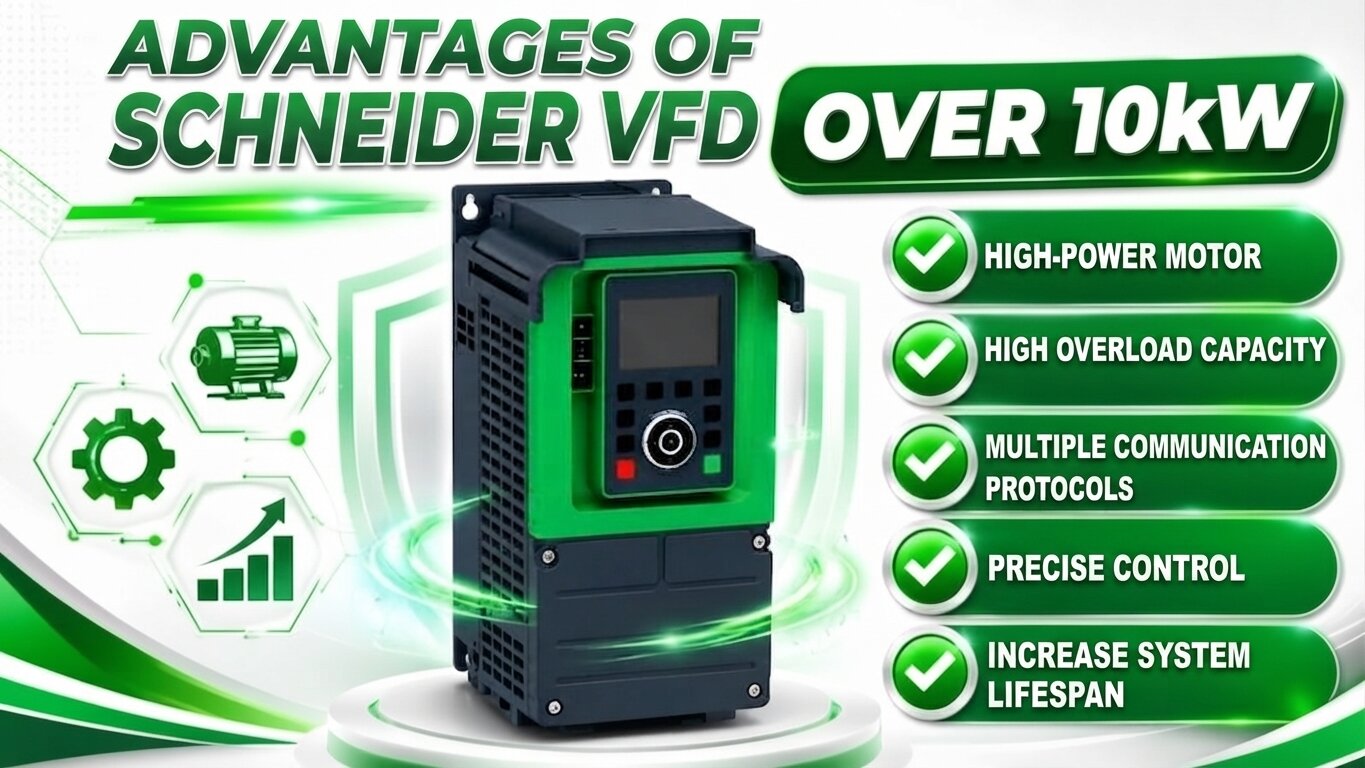
Advantages of Schneider Variable Frequency Drives above 10kW
Well-suited for large-capacity motors: Variable frequency drives above 10kW are designed to control high-capacity motors, suitable for systems requiring heavy loads and continuous operation.
High overload capacity: Supports high starting torque and withstands short-term overloads, well-meeting applications such as conveyors, crushers, mixers, and air compressors.
Support for multiple communication protocols: Integrates industrial communication standards such as Modbus, CANopen, Ethernet/IP, or PROFINET (depending on the model), facilitating convenient connection with PLCs, HMIs, and SCADA systems.
Precise control: Provides multiple motor control modes, helping maintain stable speed and torque even when the load changes, meeting the requirements of modern production lines.
Increased system lifespan: Starts and stops motors with ramp-up and ramp-down acceleration/deceleration, limiting high starting currents, reducing mechanical wear, and extending the lifespan of motors as well as drive equipment.
Advantages of Schneider Variable Frequency Drives above 10kW.
Prices for Schneider Variable Frequency Drives above 10kW at Thanh Thai Motor
Below is the latest pricing table for Schneider Variable Frequency Drives above 10kW in 10/2026 at Thanh Thai Motor. The price list is updated with various power ratings, making it easy for customers to reference and choose the right product for their usage needs.
Notes when purchasing Schneider Variable Frequency Drives above 10kW
Determine the correct motor power: The variable frequency drive power must be compatible with the motor’s power and rated current to ensure stable equipment operation and prevent overloading.
Select the appropriate load mode: It is necessary to determine whether the application belongs to light load (fans, pumps) or heavy load (conveyors, crushers, mixers, air compressors) to select the variable frequency drive line with corresponding load capacity.
Check the power supply voltage: Variable frequency drives above 10kW typically use a 3-phase 380-480V power supply, so the voltage at the installation site must be checked before making a selection.
Pay attention to the cooling method: For high-capacity systems operating continuously, priority should be given to variable frequency drives with good heat dissipation capabilities or support for cooling fan installation, helping increase equipment lifespan.
Select the appropriate communication protocol: If the system needs to connect with PLCs, HMIs, or SCADA, check whether the variable frequency drive supports protocols such as Modbus, CANopen, Ethernet/IP, or PROFINET according to factory requirements.
Installation environment: If the variable frequency drive is used in an environment with high dust, high humidity, or high temperature, an electrical enclosure with a suitable protection rating and proper ventilation should be arranged to ensure stable equipment operation.
Additionally, customers can refer to more variable frequency drive videos and compilation videos at Thanh Thai Motor. The video content shares basic parameter installation guides, connection methods, as well as experiences in selecting and operating Schneider Variable Frequency Drives above 10kW in practical industrial systems.
Frequently Asked Questions
What causes a Schneider Variable Frequency Drive above 10kW to report an OC (Over Current) error?
The OC error usually appears when the output current exceeds the allowable limit. The cause may be due to a jammed motor load, excessively short set acceleration time, motor phase short circuit, or a variable frequency drive power rating unsuited to the actual load.
Why do Schneider Variable Frequency Drives above 10kW frequently report an overvoltage (OV) error when stopping the motor?
The OV error usually occurs when the motor decelerates too quickly, causing regenerative energy from the load to flow back into the variable frequency drive, raising the DC Bus voltage. This can be fixed by increasing the deceleration time or installing an additional Braking Resistor when applications require fast stopping.
What causes a Schneider Variable Frequency Drive above 10kW to overheat (OH) even when the load is not large?
Besides overloading, overheating errors can also stem from a broken cooling fan, heavy dust accumulation in the heat sink fins, excessively high temperature inside the electrical enclosure, or insufficient installation spacing between variable frequency drives ensuring air circulation.
Why doesn’t a Schneider Variable Frequency Drive above 10kW automatically restart after a power outage even though power has been restored?
This phenomenon is usually related to Auto Restart mode settings, RUN signals from the PLC, or external control circuits. Users need to check parameters for restarting after power loss, control input status, and fault history before bringing the system back into operation.