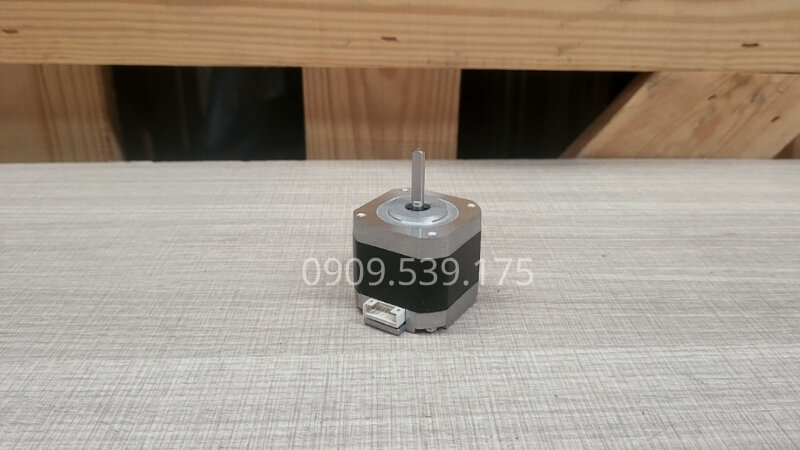
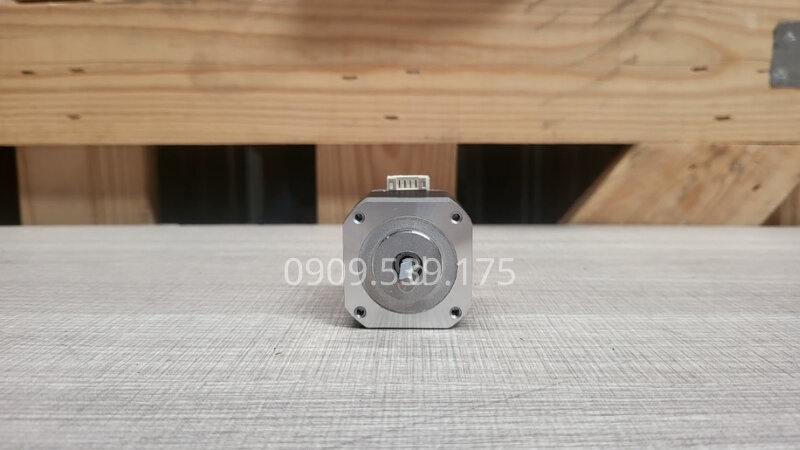
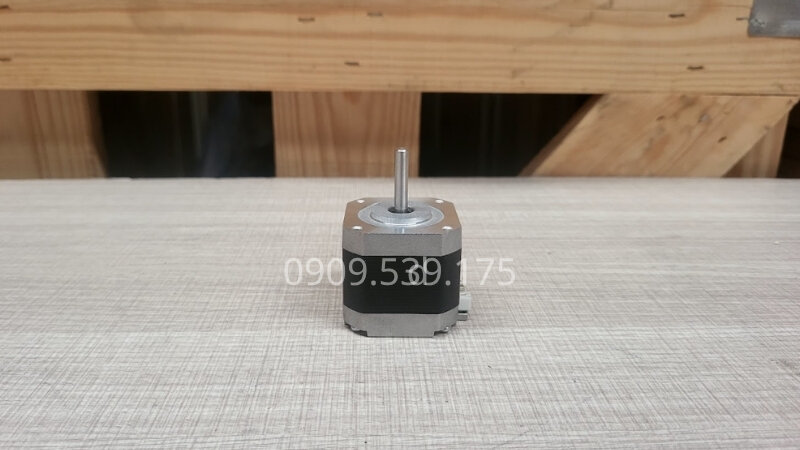
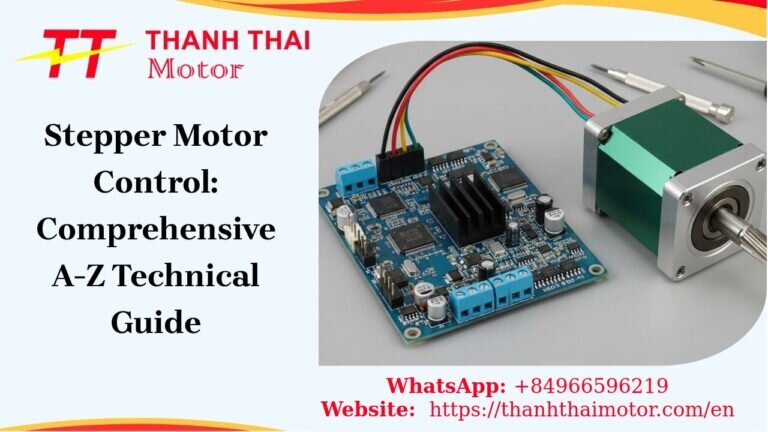
Welcome to Thanh Thai Motor Stepper Motor Warehouse – The leading reputable distributor of imported precision control equipment in the market. Here, we provide a full range of 100% new models, diverse from stepper motors size 57, size 42, 86 to heavy-duty series such as stepper motors size 110, 130, specifically for CNC machines, 3D printers.
Commitment: 100% new products – Wholesale prices from the warehouse – Long-term warranty. Contact us immediately at 0909.539.175 to receive the latest preferential price list
What are stepper motors?
A stepper motor is an electric motor that operates in small rotational steps. By receiving control commands via electrical pulses, it can stop precisely at the desired position without the need for feedback sensors. Unlike conventional continuous rotation motors, a stepper motor moves in fixed rotational angles, making it easy to control and highly accurate in operation.
In Vietnam, stepper motors are an important component in many high-precision automation systems such as CNC machines, 3D printers, laser engraving machines, automatic robots, and product packaging lines.
What are stepper motors
Structure of stepper motors
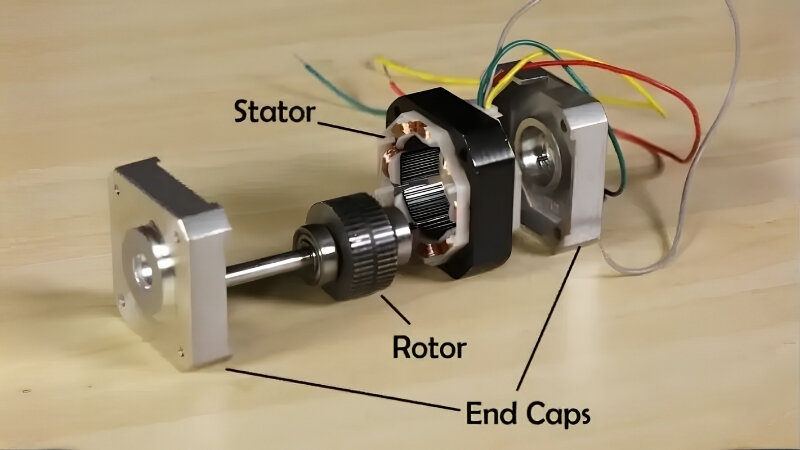
A stepper motor consists of two main components: the rotor and the stator, which work together to create precise step-by-step rotational movement.
Rotor: Is the rotating part of the motor, typically made of permanent magnets arranged into multiple symmetrical magnetic poles. When the stator generates a magnetic field, the rotor rotates in fixed steps based on the attraction and repulsion between the magnetic poles.
Stator: Is the stationary part, made of ferromagnetic material with multiple coils arranged inside. When electricity is supplied in cycles, the coils create a magnetic field to control the rotor’s rotation to the desired angle.
Thanks to this structure, stepper motors can control position and speed with high precision, making them suitable for automation systems and precision control machinery.
Structure of stepper motors
Operating Principle of stepper motors
Stepper motors operate based on the interaction between the stator’s magnetic field and the magnetic poles on the rotor. When current is supplied to the stator coils, a magnetic field will be generated, pulling the rotor to the corresponding position.
This process is controlled by a dedicated control circuit, which is responsible for supplying electrical pulses in the correct sequence and frequency. Each electrical pulse causes the rotor to rotate by one fixed step, thereby allowing the motor to move precisely to the desired rotational angle.
Thanks to their ability to control in individual steps, stepper motors can effectively control position, speed, and direction of rotation, making them particularly suitable for high-precision automation systems.
Criteria for Choosing stepper motors
To select the appropriate stepper motor, ensuring stable operation and high precision, users need to consider some important technical criteria below:
Torque and Working Load: It is necessary to determine the appropriate torque for the actual system load to ensure the motor does not lose steps during operation.
Speed and Accuracy: Choose a motor with appropriate response speed and a small step angle if high-precision position control is required, such as for CNC, robots, or 3D printers.
Electrical Specifications and Control Driver: Check the rated current, rated voltage, and compatibility with the driver to ensure the motor operates stably without overheating.
Size and Practical Application: Select based on installation space (NEMA 17, 23, 34…) and intended use to ensure easy integration into the system.
Criteria for Choosing stepper motors
Guide to Choosing Drivers for stepper motors
Stepper motors cannot run directly from the power supply; they must have a controller (Driver). To ensure the system operates durably, please note the following:
Select Current: The Driver must withstand a current equal to or greater than the motor’s rated current. For example: For a 4A motor, a Driver of 5.6A or higher should be chosen (such as DM556).
Select Microstep: Modern drivers allow for subdividing steps (1/2, 1/4, 1/8…) helping the motor run smoother and reducing noise.
Brand: Thanh Thai Motor provides high-quality synchronized Driver series with overcurrent and overvoltage protection features, ensuring maximum motor protection.
You can refer to the summary video in the stepper motors video category for a better understanding of the structure, principle, and how to choose each product series suitable for actual needs.
Guide to Choosing Drivers for stepper motors
Stepper motors Price List updated for 10/2026 at Thanh Thai Motor
Below is the stepper motors price list compiled by common power ranges and sizes, helping you easily refer to and choose according to application needs.
Stepper motors have high accuracy because each step rotation is fixed by design. However, if overloaded or if control pulses are lost, positional deviation may occur.
How do stepper motors differ from servo motors?
Stepper motors operate in fixed steps and do not require position feedback, while servo motors use encoders for continuous feedback and adjustment, providing higher accuracy and speed in complex applications.
Are stepper motors durable?
Stepper motors have high durability if operated under correct load and with a good cooling system. However, if run overloaded or incorrectly controlled, it can reduce their lifespan faster than normal.