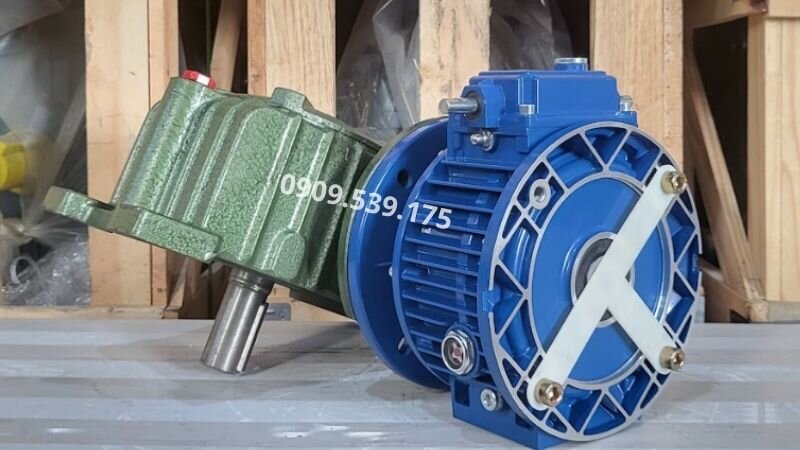
The 2-stage worm gearbox is designed with a worm and worm gear drive mechanism combined with a mechanical speed variator (UDL), allowing a large gear ratio in a compact installation space. Thanks to characteristic drive properties, the gearbox operates smoothly, reduces noise, and has good self-locking capability, contributing to safety during work. With a sturdy structure and high stability, the worm gearbox with two transmission stages is suitable for drive systems requiring deep speed reduction and continuous operation.
2-stage worm gearbox at Thanh Thai Motor.
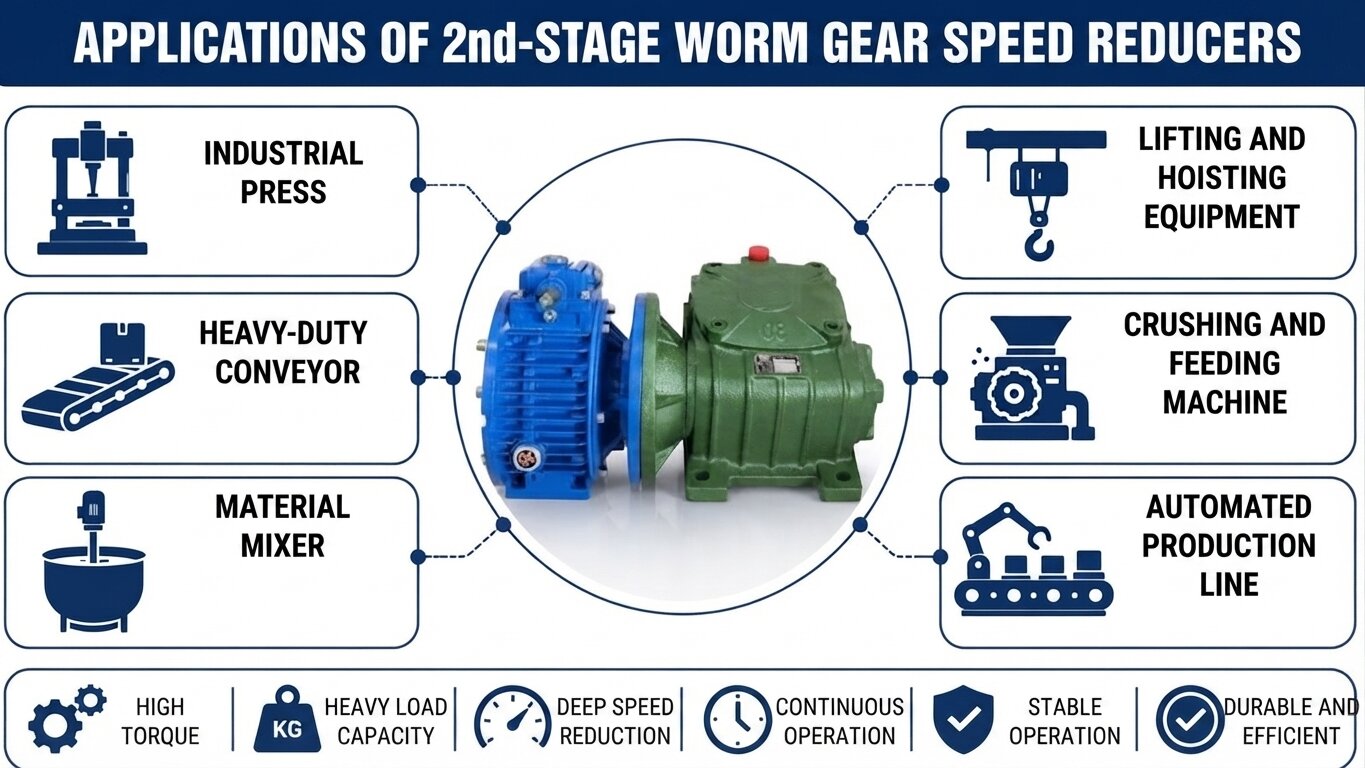
Applications of 2-Stage Worm Gearbox
Industrial presses: The 2-stage worm gearbox helps generate high torque for material pressing, plastic pressing, or scrap metal pressing mechanisms during production.
Heavy-duty conveyors: The 2-stage gearbox is suitable for long conveyor systems or transporting heavy loads that require continuous operation.
Material mixers: Applied in the animal feed, building materials, and food industries to maintain a stable mixing speed.
Lifting and winch equipment: Thanks to the large gear ratio, the gearbox helps generate strong pulling force for material lifting and handling mechanisms.
Crushers and feeders: Installed in production lines that require low output speed and high load-bearing capacity.
Automated production lines: Meets positions requiring deep speed reduction, stable operation, and maintaining large output torque over a long period.
Applications of 2-stage worm gearbox.
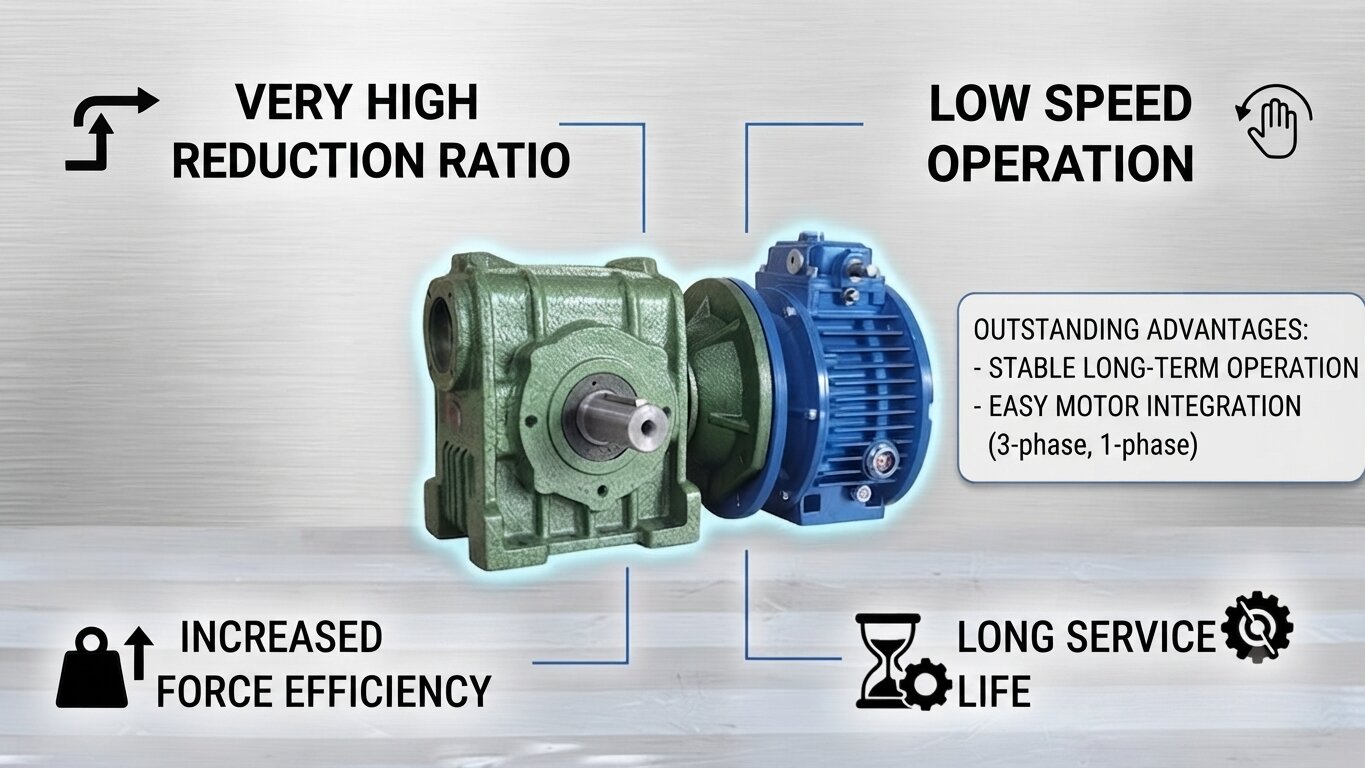
Key Advantages of 2-Stage Worm Gearbox
Larger gear ratio than 1-stagegearboxes: By using two consecutive reduction stages, the device can produce a very low output speed, suitable for various specialized applications.
Effective pulling force increase: The ability to generate high torque helps the gearbox well-suit systems working under heavy loads or continuously changing loads.
Stable operation over a long period: Synchronously designed transmission stages help the system work durably and minimize vibrations.
Low-speed working capability: Suitable for equipment requiring slow rotation speed while still maintaining large driving force.
High service life: When choosing the correct load and performing periodic maintenance, the gearbox can operate stably for many years.
Key advantages of 2-stage worm gearbox.
Notable 2-Stage Worm Gearbox Price List at Thanh Thai Motor
Below is the price list of notable 2-stage worm gearbox models at Thanh Thai Motor. Customers can refer to popular products by gear ratio, load capacity, and appropriate motor power to select a driving solution that meets actual usage needs.
Motor power for gearbox selection: In many cases, the motor is only 1HP or 2HP but the starting load is very heavy; if the selected gearbox is too small, it will quickly heat up and wear out the worm gear.
Speed check: The 2-stage gearbox has a relatively large gear ratio; choosing the wrong gear ratio can cause the machine to run slower than desired and affect work productivity.
Carefully check the load: For systems running continuously for 8-12 hours or 24/7, it is advisable to choose a slightly oversized gearbox to increase durability and minimize damage during use.
Prioritize cast iron housing for heavy-duty applications: In practice, stirring systems, conveyors, or presses often generate heavy vibrations; cast iron housings are more rigid and bear loads better than lightweight series.
Choose a supplier with clear technical support and warranty: When issues occur such as oil leakage, loud noise, or the need to replace worm gears and bearings, having available spare parts and a technical team will save a lot of time and repair costs.
If you need to learn more about the product, customers can watch compilation videos at Thanh Thai Motor. The content within the gearbox videos focuses on internal structure, transmission principles, gear ratio selection experience, and precautions when installing gearboxes into machinery systems.
Frequently Asked Questions
I am using a 1.5kW 4P motor (1400 rpm), wanting an output of about 20 rpm, which gear ratio should I choose?
Usually, a gear ratio of about 1/70 is chosen. However, in practice, common gear ratios for gearboxes are typically 1/60, 1/80, or 1/100. If the system is a conveyor or feeder, technicians usually prioritize the 1/80 gear ratio to reserve load capacity when goods suddenly increase.
Should a 1,000-liter tank mixer use a 1-stage or 2-stage gearbox?
If the required mixing speed is from 30-60 rpm, a 1-stage gearbox can usually meet the requirement. However, chemical, adhesive, or high-viscosity solution mixing tanks often use 2-stage gearboxes to achieve lower speeds and generate higher torque upon starting.
I am using a 1/50 gear ratio; if I switch to 1/100, will the pulling force double?
Under constant motor power conditions, increasing the gear ratio will significantly increase the output torque. However, in reality, it cannot be considered an exact doubling because it also depends on transmission efficiency and internal losses within the gearbox.
Does vertical installation of the gearbox affect its lifespan?
If the gearbox is designed for both horizontal and vertical installation styles, the lifespan remains almost unchanged. The important thing is to fill the correct amount of oil according to instructions, as this is a fairly common mistake that causes worm gears or bearings to fail quickly.