Two-Stage NMRV Gearboxes are a line of gearboxes formed by two consecutive worm and worm gear transmission stages, helping to reduce rotational speed to a very low level while significantly increasing output torque. Compared to 1-stage gearboxes, the 2-stage line can achieve a larger gear ratio, making it suitable for systems requiring high traction force and slow, stable operating speeds.
In terms of structure, NMRV 2-Stage Gearboxes typically consist of two NMRV gear unit assemblies synchronously coupled together. The internal components include the worm, bronze worm gear, output shaft, bearings, oil seals, housing, and lubrication system. Thanks to the reduction process taking place through two transmission stages, the gearbox can generate higher torque while maintaining smooth operation, low vibration, and high durability.
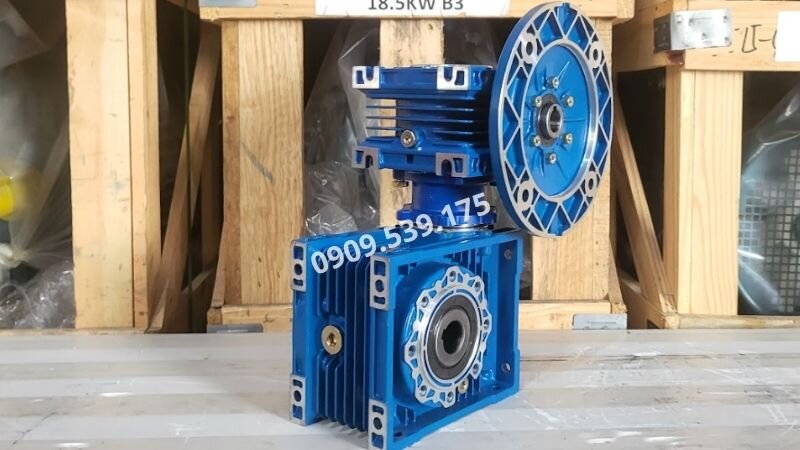
2-stage NMRV gearbox at Thanh Thai Motor.
Applications of Two-Stage NMRV Gearboxes
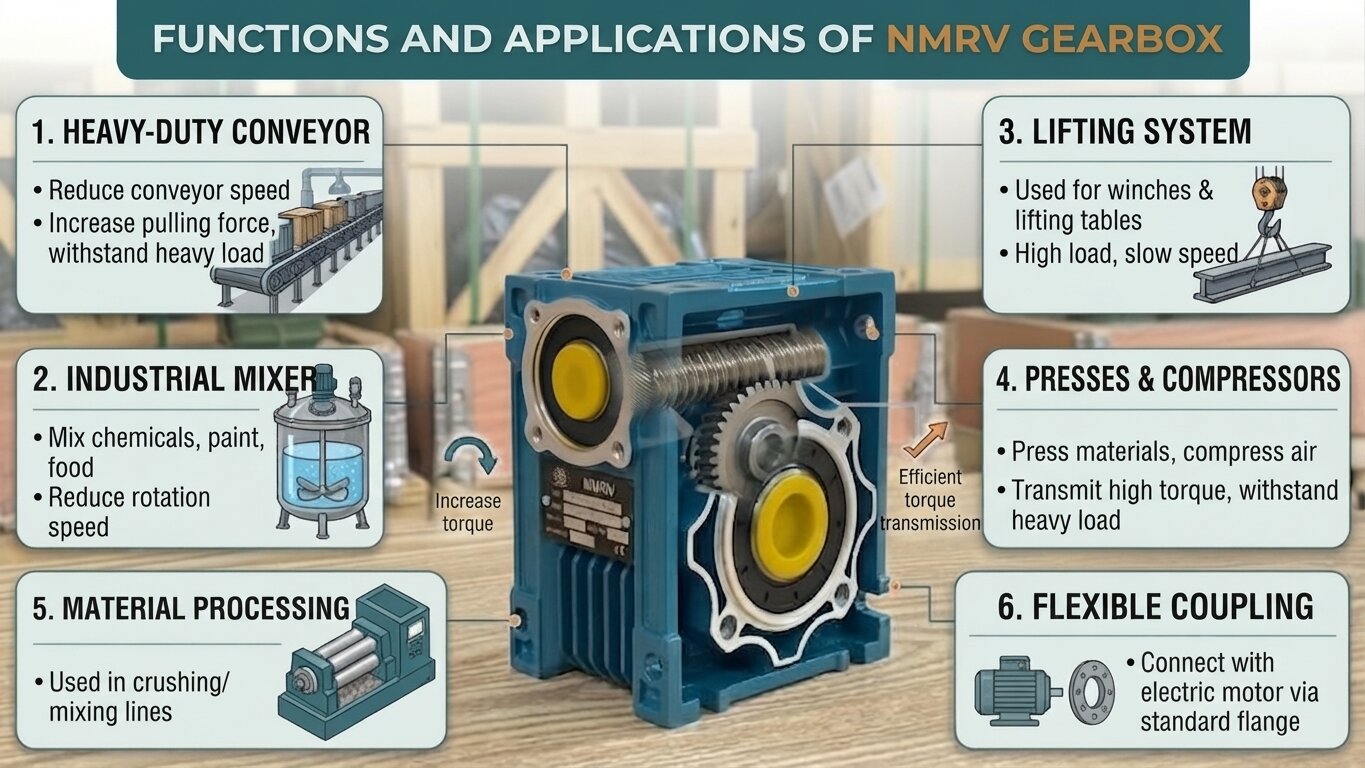
Heavy-duty conveyors: Two-Stage NMRV Gearboxes help reduce speed and increase traction force, making them suitable for heavy-load material handling systems operating continuously.
Industrial agitators: Used for chemical, paint, food, or wastewater mixing tanks requiring low rotational speed and high torque.
Presses and compressors: The gearbox supports transmitting high torque to the working mechanism, helping equipment operate stably under heavy loads.
Lifting systems: Suitable for winches, lifting tables, or material lifting equipment requiring slow speed but high pulling force.
Material processing machinery: Commonly used in crushing, mixing, or feeding systems that require high torque and continuous operation.
Applications of 2-stage NMRV gearbox.
Outstanding advantages of NMRV 2-Stage Gearboxes
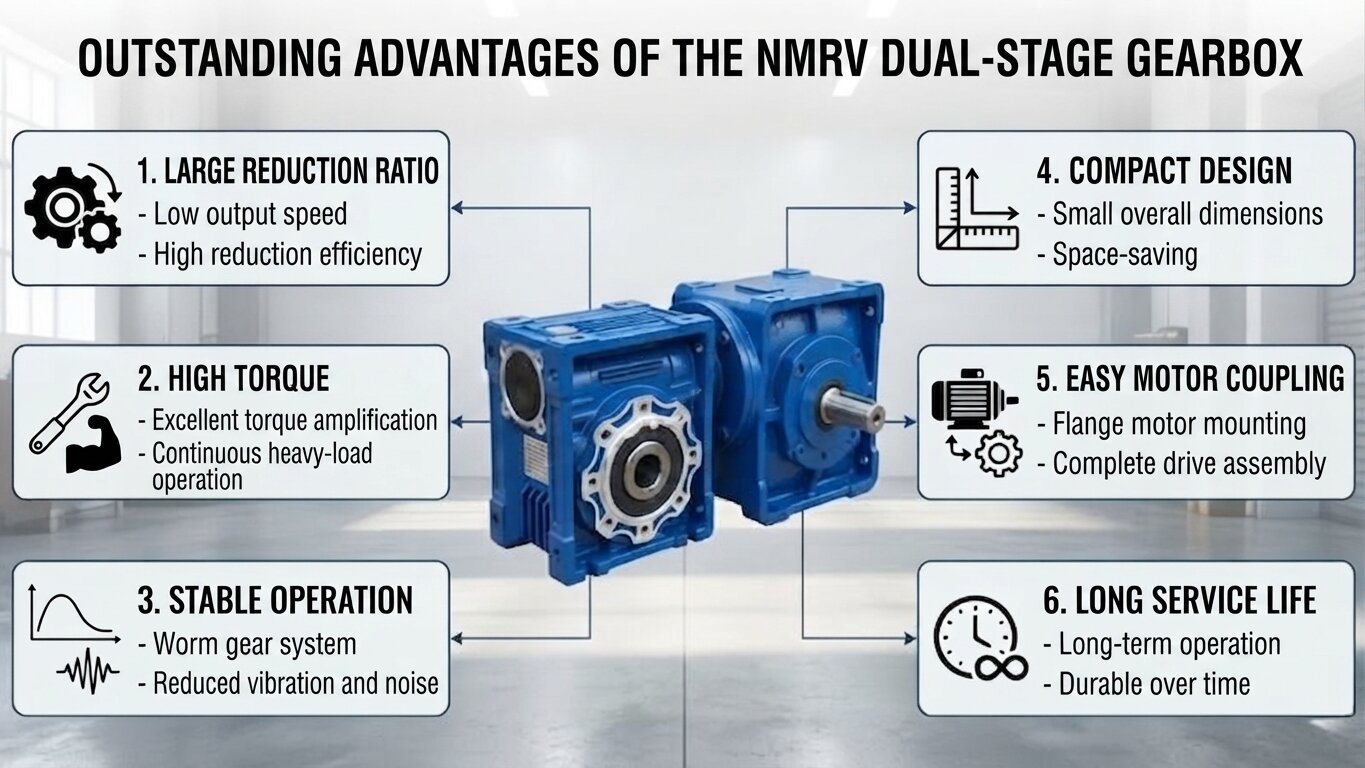
Large gear ratio: Two consecutive reduction stages help achieve significantly lower output speeds compared to 1-stage gearboxes.
High output torque: Excellent traction amplification capability, meeting heavy-duty and continuous-duty applications.
Stable operation: The worm and worm gear mechanism helps reduce vibration and limit noise during operation.
Compact design: Despite having a large gear ratio, the size remains relatively compact compared to many other industrial gearbox lines.
Easy integration with electric motors: Can be coupled with various flange-mounted or foot-mounted motor lines to form a complete drive system.
High durability: When properly lubricated and operated according to technical standards, the gearbox can work stably for a long time.
Outstanding advantages of 2-stage NMRV gearbox.
Price list of prominent Two-Stage NMRV Gearboxes at Thanh Thai Motor
Below is the price list of prominent NMRV 2-Stage Gearboxes at Thanh Thai Motor. You can refer to the dimensions, gear ratios, and actual load requirements to select the suitable product for your drive system.
Accurately determine the gear ratio: Two-Stage NMRV Gearboxes typically have very large gear ratios, so actual output speed must be calculated to avoid the machine running too slowly or failing to meet operational requirements.
Check the output torque of the gearbox: Do not rely solely on motor power; actual load torque must be cross-referenced to ensure the gearbox operates stably and is not overloaded.
Choose housing materials: For heavy-duty applications, continuous operation, or high-vibration environments, cast iron housing gearboxes should be prioritized to increase rigidity and durability.
Check output shaft dimensions, flanges, and mounting styles: Cross-referencing mechanical parameters before purchasing will make the assembly process with motors and machinery smoother, limiting modification costs.
Maintainability and product origin: Products with full technical specifications, replacement parts, and clear warranty policies should be chosen for convenient repairs during use.
In addition, you can refer to additional gearbox videos at Thanh Thai Motor. The video content compiles many practical experiences on how to select gear ratios, calculate output torque, installation instructions, periodic maintenance, and common errors during the operation of NMRV 2-Stage Gearboxes.
Frequently Asked Questions
Why do NMRV 2-Stage Gearboxes experience abnormal heating at the second reduction stage even though the load does not exceed the rated limit?
This phenomenon is usually related to wear on the second-stage worm gear, changes in meshing clearance, or lubricating oil no longer ensuring the necessary viscosity. If prolonged, elevated temperatures can reduce the lifespan of the worm gear and bearings.
Why does the gearbox continuously leak oil at the output shaft despite replacing the oil seal multiple times?
If oil leaks persist after seal replacement, journal wear must be checked. During long-term operation, the contact position with the seal often forms a groove, preventing the new seal from providing a complete seal.
Why is the NMRV 2-Stage Gearbox still hotter than before repairs even after replacing with a new bronze worm gear?
In reality, many cases are caused not by the worm gear, but by uneven wear on the worm over a long period. When installing a new worm gear onto an old worm, the contact surfaces no longer match completely, leading to increased friction and abnormal gearbox temperature increases.