Proper installation of a water pump (water pump motor) is a decisive factor in the performance and lifespan of the equipment. Many users encounter difficulties during this process, leading to unstable operation, high power consumption, or premature failure. This article provides a detailed guide on how to install a high head water pump with proper technical standards, helping you install and maintain your equipment most effectively.
Instructions on how to install a high head water pump properly
This is the most crucial part, determining 80% of the efficiency and durability of the machine. Implementing the correct water pump installation process will help you avoid many annoying issues. When you purchase a high head water pump, pay close attention to the following steps.
Site Survey and Preparation of the Installation Area
Before starting, select an ideal installation location. The placement area for the water pump motor should meet the following criteria:
Flat, solid, and dry. Avoid placing the machine in damp or flood-prone areas.
As close to the water source as possible to reduce the length of the suction pipe, helping the machine operate more efficiently.
Sufficiently spacious and well-ventilated to allow easy installation, maintenance, and proper operation of the motor cooling fan.
Determine Total Head and Water Source Depth
This is a key technical specification. You need to determine:
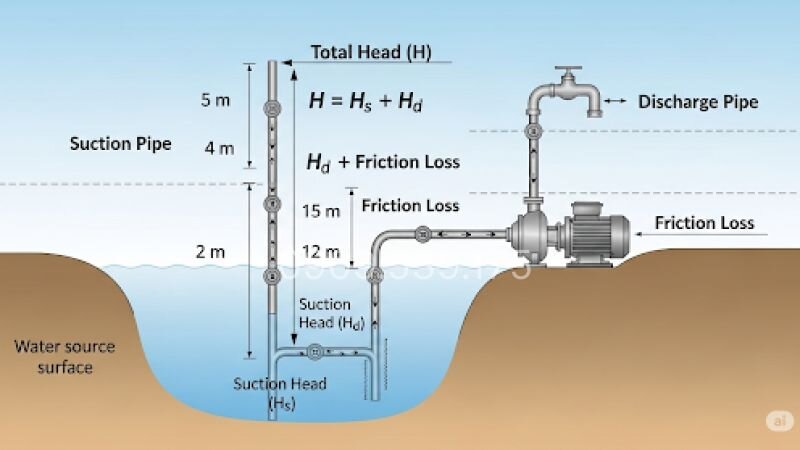
Suction Lift (Hs): The vertical distance from the water surface of the source to the centerline of the pump.
Discharge Head (Hd): The vertical distance from the pump centerline to the highest point of the discharge pipe (e.g., the inlet of a rooftop water tank).
Total Head (H): H = Hs + Hd + friction loss in the piping. Choose a water pump with a total head rating that is approximately 1.2 to 1.5 times the calculated H value.
Measuring total head and water source depth
Map Out the Piping and Electrical Schematic
Drawing a simple schematic helps you better visualize the path of the water pipes and electrical wiring. This minimizes unnecessary joints, elbows, and fittings, reducing pressure losses and preventing installation errors.
Detailed Installation Steps
Follow this procedure on how to install a high head water pump step-by-step:
Securing the Pump: Place the water pump on a solid concrete base or metal frame. Bolt down the pump feet securely to minimize vibration during operation. This is especially critical for heavy-duty or high-capacity water pumps.
Piping Connections:
Suction Pipe: Must be completely airtight with zero air leaks. The diameter of the suction pipe should be equal to or larger than the pump’s suction inlet. Install a one-way foot valve (strainer check valve) at the bottom end of the suction pipe to maintain priming water.
Discharge Pipe: Connect the discharge pipe to the pump’s outlet. A gate or ball valve can be added to easily adjust the flow rate or facilitate repairs.
Electrical Wiring: Ensure the power source voltage matches the pump specifications. Use power cables with a sufficient cross-sectional area. Connect the wires inside the terminal box of the water pump motor, and do not forget to connect the grounding wire to ensure safety.
Cleaning and Test Running the Pump
Before starting, perform the final checks:
Priming: Fill the pump casing and suction pipe completely with water. This is a mandatory step for most centrifugal pump systems.
Inspect Joints/Couplings: Tighten all connections to ensure zero leakage.
Check Voltage: Use a multimeter to ensure the voltage supply is stable.
Test Run: Switch on the power and observe. The machine should run smoothly without unusual noise, and the water flow should be steady and strong. If any issues arise, cut the power immediately and re-inspect the entire system.
Technical procedure on how to install a high head water pump properly
Selecting and Maintaining High Head Water Pumps
To ensure your high head water pump operates durably over time, selecting the correct model and carrying out regular maintenance are indispensable.
How to Choose the Right Capacity and Pump Type
When buying a water pump, do not just look for cheap water pumps. Select the machine based on your actual demands:
Power Rating (HP, kW): Based on the required head and flow rate calculated above. Choosing a motor capacity that is too high wastes electricity, while a capacity too small will fail to lift the water to the desired height.
Flow Rate (liters/minute or m³/hour): Determine the volume of water you need within a specific timeframe.
Pump Type: A centrifugal pump is ideal for high-head delivery, whereas a vacuum pump has better deep-suction capabilities. A typical household water pump is usually a centrifugal type.
Important Usage Notes to Ensure Machine Longevity
Never run the pump dry (without water), as this will quickly damage the mechanical seal and impeller.
Install a suction strainer at the inlet of the suction pipe if the water source contains sediment or debris.
Provide a protective cover for the water pump to shield it from direct sunlight and rain, protecting the motor and electrical components.
Basic Maintenance, Cleaning, and Troubleshooting Guide
Periodic maintenance helps extend the lifespan of your water pumping equipment. Whether it is an industrial water pump or a residential household water pump, this maintenance is essential.
Routine Inspections (every 3-6 months): Examine the high head water pump components, pipe joints, electrical wiring, vibration, and noise levels.
Clean the Foot Valve/Strainer: Regularly clean the filter screen at the foot valve to ensure proper suction.
Lubrication: For certain industrial pump models, grease the bearings periodically according to the manufacturer’s guidelines.
Important considerations when purchasing a water pump based on actual needs
Price List for High Head Water Pumps in 10/2026 at Thanh Thai Motor
If you are looking for a reputable supplier to purchase a high head water pump, below is the detailed water pump price list, specifically for high head water pumps in 10/2026 at Thanh Thai Motor, to help you make the best choice.
Warranty, Shipping, and Commitment Policy when purchasing water pumps at Thanh Thai Motor
Up to 24-month warranty for water pumps
All water pump lines supplied by Thanh Thai Motor come with an official warranty of up to 24 months. We are committed to providing fast, transparent, and professional warranty support – ensuring complete peace of mind for customers during use.
Nationwide Delivery – Fast and Secure
We offer nationwide delivery, ensuring that pumps are carefully transported and delivered on schedule to customers in all provinces and cities across the country. From Hanoi, Da Nang to Ho Chi Minh City or industrial zones – Thanh Thai Motor is always ready to serve.
Advanced Technology – European Standard
All water pump lines at Thanh Thai Motor are manufactured with German technology, meeting European standards, ensuring high durability, stable operation, power saving, and suitability for many demanding environments such as construction sites, agriculture, manufacturing plants, etc.
Competitive Prices – Attractive Offers for Dealers, Wholesale Customers
We offer reasonable and the most competitive prices in the market. We also have a high discount policy for bulk purchasers, project customers, and long-term distribution partners.
Quality Commitment – Powerful Pump, Energy Saving
All pumps are constructed with 100% copper windings, ensuring powerful operation – low power consumption – minimal vibration – less heating, smooth and durable performance over time. Thanh Thai Motor only sells genuine products – we say no to counterfeit and low-quality goods.
Full CO, CQ Certificates
Each product comes with a Certificate of Origin (CO) and a Certificate of Quality (CQ) – fully meeting the requirements for construction projects, acceptance documents, and engineering projects.
Contact for Consultation & Water Pump Orders
Do you need consultation on choosing the right water pump for your home, construction project, or factory?
Frequently Asked Questions on How to Install a High Head Water Pump
Can a high head water pump be used for dirty water sources?
Most high head water pumps are designed for clean water. If your water source contains sediment, sand, or debris, you must install a suction strainer at the inlet and select a specialized pump for wastewater or fluid with impurities to prevent impeller wear and clogging.
How to calculate the appropriate power and total head?
As guided above, you need to measure the actual suction lift and discharge head. The required total head will equal the sum of these two heights plus approximately 2-3 meters of piping friction loss. Based on these parameters and your desired flow rate, you can consult the manufacturer’s performance curve to select a water pump with the appropriate power rating.
How to troubleshoot when the pump fails to draw or discharge water?
This is a common issue. Potential causes include:
Incomplete priming or a leaking foot valve (strainer check valve) causing priming water loss.
Air leaks in the suction pipe.
Depleted water source.
Impeller jammed by debris or sediment.
Reverse motor rotation (often due to incorrect wiring of a 3-Phase pump motor).
Disconnect the power supply and systematically inspect these potential causes.
How often should the water pump be maintained?
For residential water pumps, a comprehensive inspection should be done every 6 months. For industrial water pump systems operating continuously, the maintenance cycle should be every 3 months to ensure safety and optimal performance.
Conclusion
Mastering how to install a high head water pump not only empowers you to operate the equipment confidently but is also key to optimizing performance, saving energy, and extending product longevity. A high head water pump selected with the correct power capacity and installed to precise technical standards will serve as a reliable asset in securing your water supply.
If you require further advice on purchasing a water pump, do not hesitate to contact us to receive our latest water pump price list so you can select the perfect model for your needs.