


Pulley dimension standards & precise pulley selection guide
A pulley is a crucial mechanical drive component, and selecting the correct size is the core factor to ensure system performance and longevity. Pulley dimension standards are a set of predefined technical specifications regarding diameter, width, depth, and groove angle, helping the pulley remain perfectly compatible with standard belt types (such as sections A, B, C, and D). Complying with these standards not only optimizes transmission capacity but also minimizes wear and unnecessary incidents.
Key points about Pulley dimension standards to grasp:
- Compatibility is paramount: Pulley dimensions must match the belt type (e.g., a section B pulley for a section B V-belt) for efficient transmission.
- Core parameters: Always check 3 factors: outside diameter, bore diameter (shaft hole), and most importantly, the pulley groove dimensions.
- International standards: Common standards such as JIS (Japan) and DIN (Germany) shape these parameters, making replacement and selection easier.
- Wrong selection consequences: Using a pulley that does not meet the standard will quickly damage the belt, cause noise, and reduce machinery efficiency.
Mastering these parameters will help you be more confident when selecting products for your application. Let’s dive into the details of each standard below.
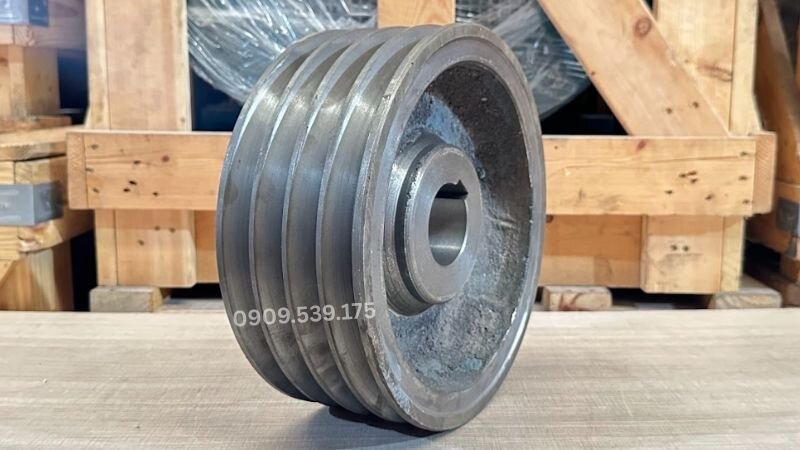
What is a pulley and why comply with standard dimensions?
Basic concept of pulleys in drive systems
A pulley is a circular machine part used to transmit rotational motion between shafts via a belt. It operates based on the principle of friction between the pulley groove surface and the belt. This configuration allows for flexible changes in speed and torque.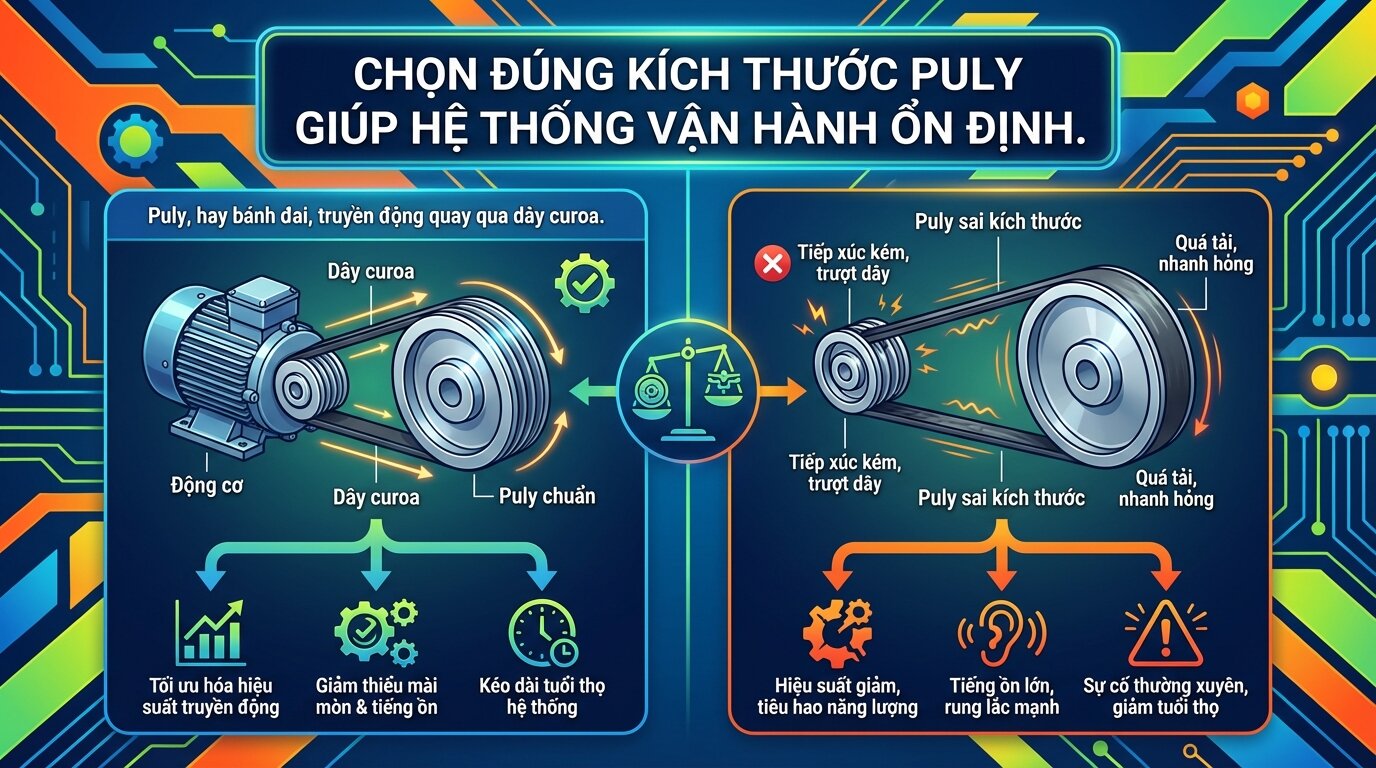
Importance of complying with standard pulley dimensions
Strict compliance with Pulley dimension standards is a mandatory requirement for stable system operation. A standard pulley ensures perfect contact between the belt and the groove surface, maximizing friction and effectively transmitting power. Conversely, dimensional deviations will cause belt slippage, abnormal wear, vibration, and loud noise, reducing the lifespan of both the belt and related components like bearings.
Key technical parameters in a standard pulley
Outside Diameter (OD) and Pitch Diameter (PD)
Outside Diameter (OD) is the largest diameter of the pulley, measured from the outermost edge. Pitch Diameter (PD) is the effective working diameter of the pulley where the belt contacts and transmits force. The PD parameter is a critical factor for accurately calculating the transmission ratio of the drive system.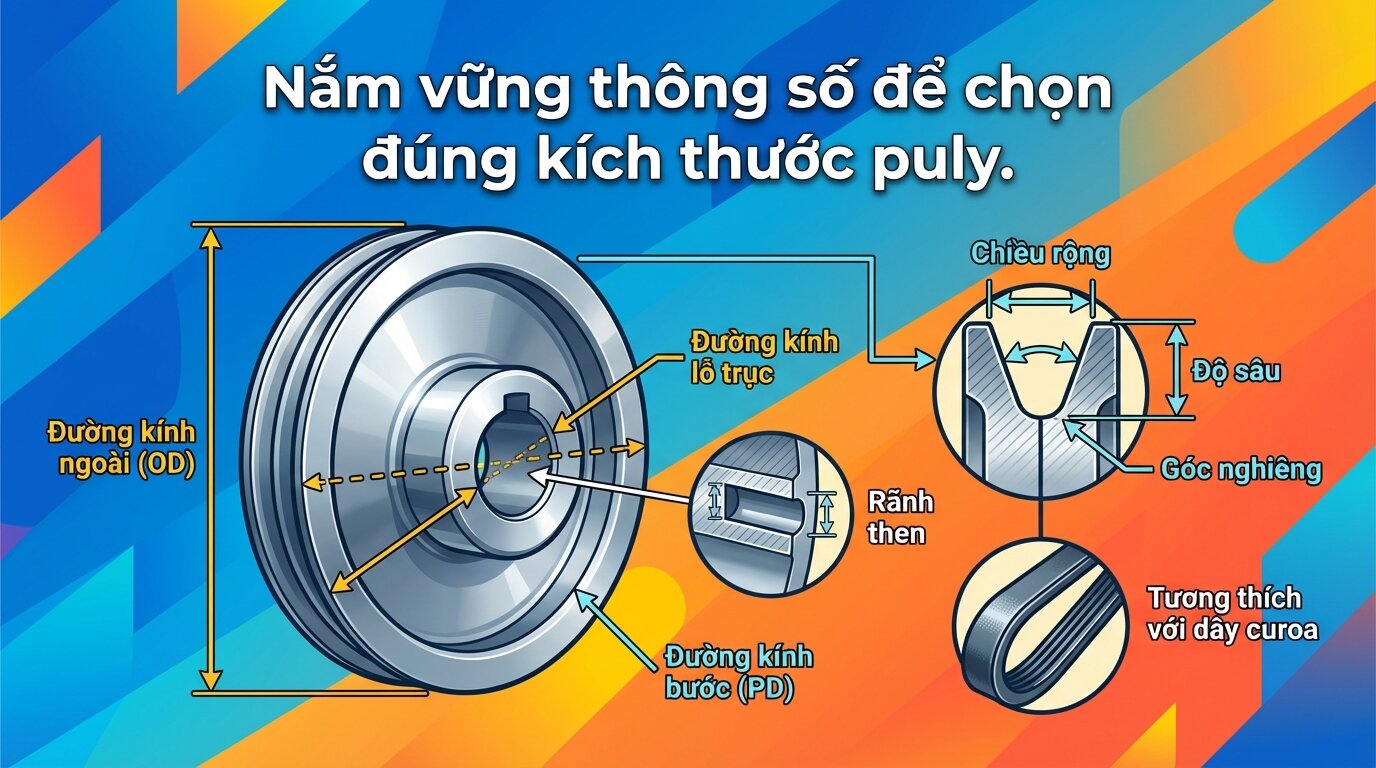
Bore Diameter and Keyway
Bore Diameter is the diameter of the hole at the center of the pulley, used to mount the pulley onto the motor shaft or machine shaft. This size must precisely match the shaft diameter to ensure concentricity. A Keyway is a small slot cut inside the bore, used to install a key and lock the pulley tightly to the shaft, preventing the pulley from spinning or slipping.
Groove Profile and Angle
This is the most important pulley technical specification, determining compatibility with the belt. It includes the width, depth, and especially the groove angle of the two side walls. Each belt type (Section A, B, C…) has a corresponding groove profile to ensure the belt “grips” the pulley firmly.
Engineer’s advice: The pulley groove angle is an extremely important parameter but is often overlooked. If this angle does not meet the standard, the belt will not seat fully in the groove, leading to poor contact, causing slippage and very rapid belt wear. This is a small detail but has a huge impact on the entire system.
Pulley dimension standards lookup table for common belt types
Below is a basic pulley dimension lookup table, helping you quickly identify the appropriate parameters for the type of belt you are using.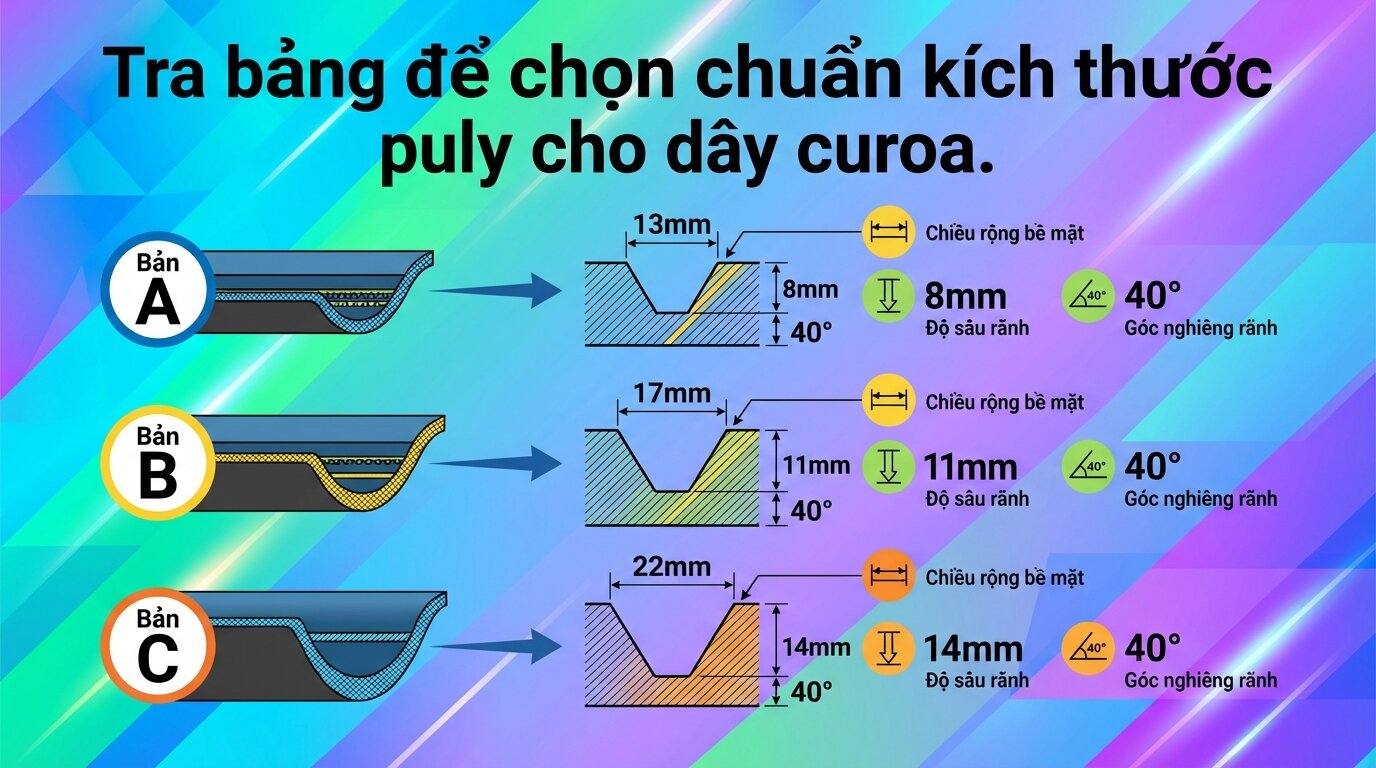
Pulley standards for Section A V-belts (13mm)
This type of pulley is specifically designed to work with Section A V-belts, commonly used in light to medium load applications.
Pulley standards for Section B V-belts (17mm)
Section B V-belt pulleys are the most common type in industry, suitable for motors with small to large power capacities, offering a good balance between transmission capacity and compact size.
Pulley standards for Section C V-belts (22mm)
Used for systems requiring high power transmission capacity and heavy load resistance.
Other pulley types (Section D, E, SPZ, SPA…)
In addition to the above types, there are many other Pulley dimension standards such as Section D and E for extra-heavy applications, or timing pulleys and wedge pulleys (SPA, SPB, SPC, SPZ) for applications requiring higher precision. Selection must be based on the machine design.
If you have difficulty looking up or are unsure about the type of pulley you need, do not hesitate. The engineering team at Thanh Thai Motor is always ready to support you. Call the Hotline: 0909.539.175 for free and most accurate consultation.
How to choose the correct pulley size for a motor?
Choosing a pulley for a motor requires precision to ensure the desired transmission ratio and performance. Follow these steps.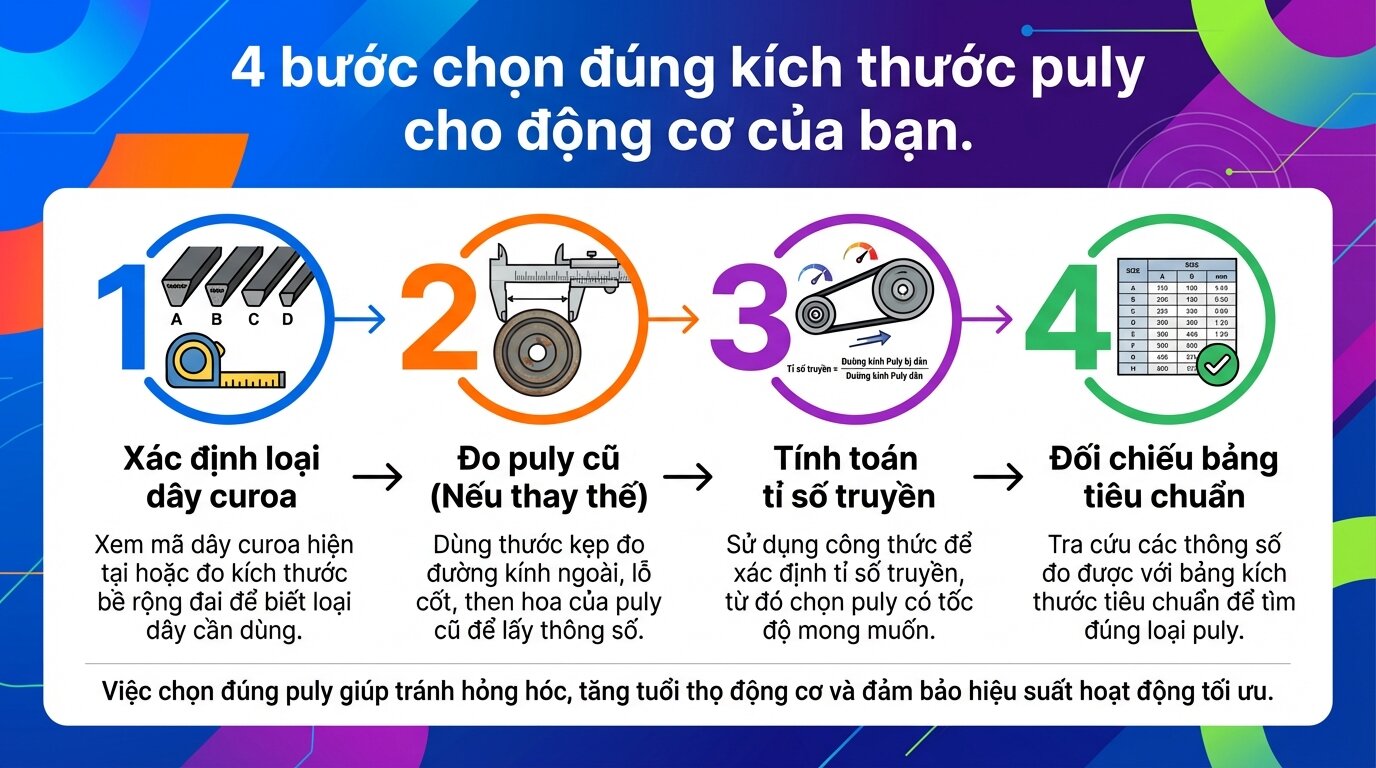
Step 1: Determine the belt type and motor power
First, check the belt type the system is using or that is recommended (e.g., Section B). Then, determine the motor’s power to select the pulley material (cast iron, steel) and the number of grooves suitable for the load.
Step 2: Measure existing pulley dimensions (if replacing)
In the case of replacing an old pulley, use a caliper to measure the outside diameter, bore diameter, and groove width of the pulley. This is the fastest and most reliable way to measure pulley dimensions to find an equivalent product.
Step 3: Calculate the required transmission ratio
The transmission ratio determines the output speed of the machine. You can calculate it based on the pulley diameter or the desired rotational speed using the following formula:
i = D2 / D1 = n1 / n2
i: Transmission ratioD1,D2: Diameters of the driving pulley (motor pulley) and driven pulley (machine pulley)n1,n2: Rotational speed of the driving and driven pulleys
Example: If the motor has a speed of 1450 rpm (n1) and you need the equipment to operate at ~725 rpm (n2), the transmission ratio i will be 1450/725 = 2. If the motor pulley (D1) is 100mm, then the equipment pulley (D2) should be 100mm * 2 = 200mm.
Step 4: Cross-reference parameters with the standard lookup table
Once you have all the necessary parameters (belt type, pulley diameter, bore diameter), cross-reference them with the Pulley dimension standards lookup table from the supplier to select the exact product.
Warning: Absolutely do not attempt to re-machine or turn down old, worn pulley grooves for reuse. This will completely deviate from the standard groove angle and contact surface, causing a newly installed belt to be destroyed in a short time. The cost of continuously replacing belts will be much higher than investing in a new, standard-compliant pulley.
Conclusion
Understanding and applying the correct Pulley dimension standards is not just a technical requirement but also a smart investment for the stability and durability of machinery. From the diameter and bore to the groove angle, every parameter plays a vital role in ensuring the drive system operates smoothly and efficiently. Making the wrong choice can lead to unnecessary repair and replacement costs, directly affecting productivity.
At Thanh Thai Motor, we understand that not everyone has the time to deeply research complex technical lookup tables. With years of experience in the industry, our engineering team is ready to listen and provide the most suitable pulley solution for each of your specific applications. If you have any questions, please do not hesitate to contact us via Hotline 0909.539.175 for professional and dedicated advice.