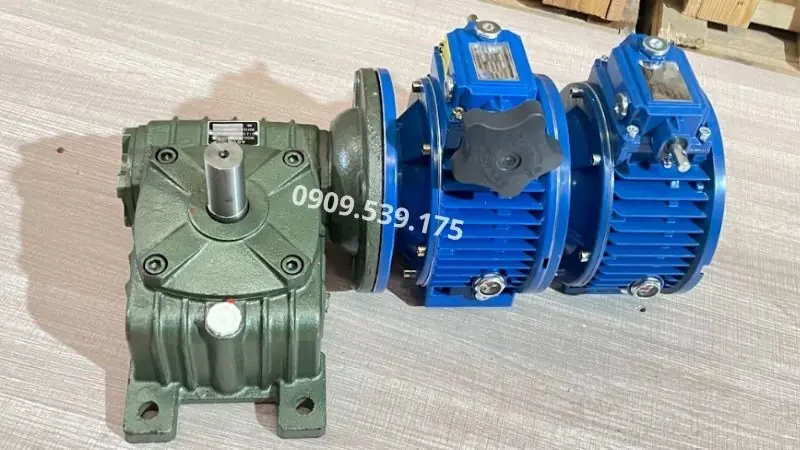
3-stage worm gearboxes are a line of gearboxes designed with a worm gear drive mechanism combined with a mechanical speed variator (UDL), helping to achieve a high transmission ratio in a compact installation space. Thanks to their characteristic structure, these gearboxes offer smooth operation, low noise, and good self-locking capability, ensuring safety during operation. With a sturdy structure and high durability, the 3-stage worm gearbox is suitable for drive systems requiring deep speed reduction, stable loads, and continuous operation in industrial environments.
3-stage worm gearbox operates durably at Thanh Thai Motor.
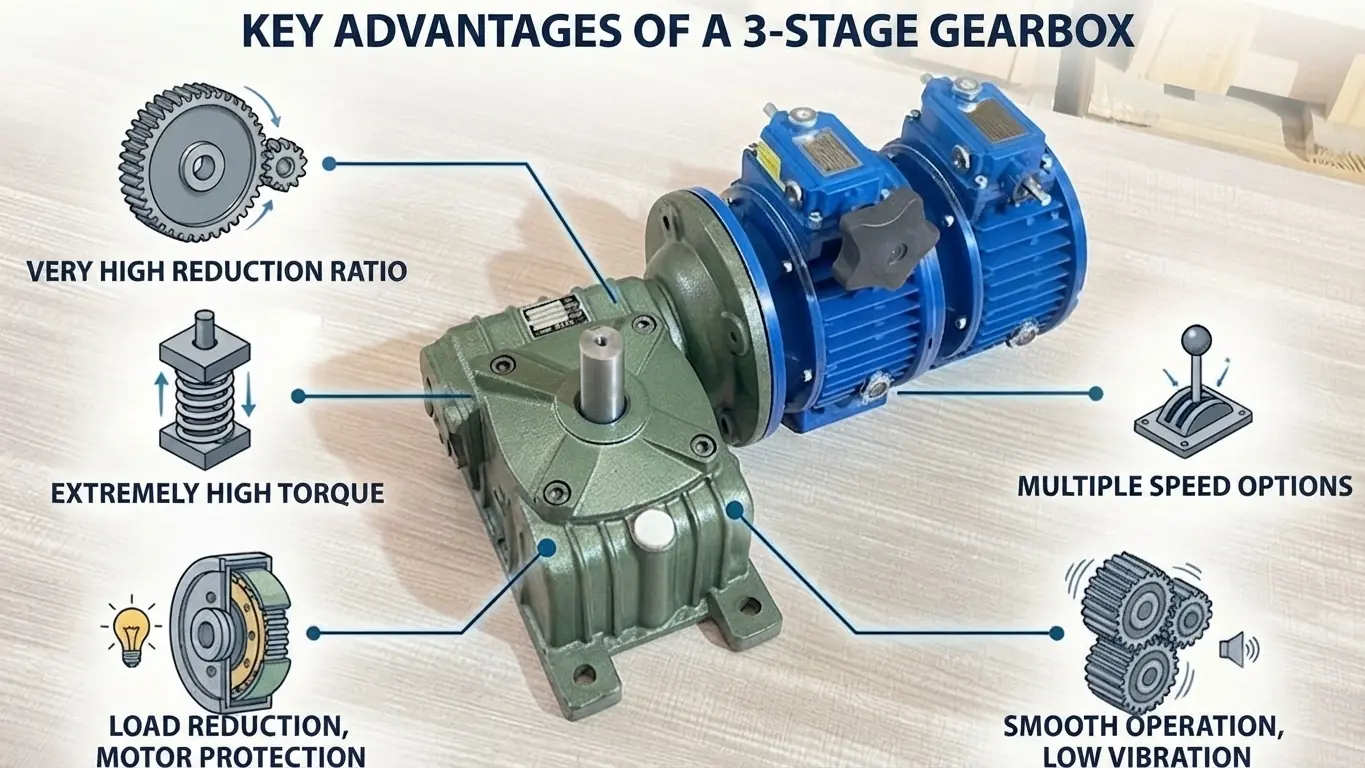
Advantages of the 3-stage worm gearbox
Very high transmission ratio: Thanks to the combination of 3 consecutive reduction stages, the gearbox can bring the output speed down to a very low level, suitable for applications requiring only a few revolutions to dozens of revolutions per minute.
High output torque: After the reduction process, the output pulling force increases significantly compared to the initial motor, helping the equipment operate stably when working with heavy loads or starting under load.
Load reduction for the electric motor: When choosing the correct transmission ratio, the motor will not have to work overloaded to pull the load, thereby limiting overcurrent and overheating phenomena and improving equipment lifespan.
Multiple choices for transmission ratios: Users can easily choose different output speed levels depending on actual operational needs without changing the machinery structure.
Stable operation and low vibration: The worm gear drive mechanism helps the machine run smoother than many other types of drives, especially in low-speed applications.
Advantages of the 3-stage worm gearbox.
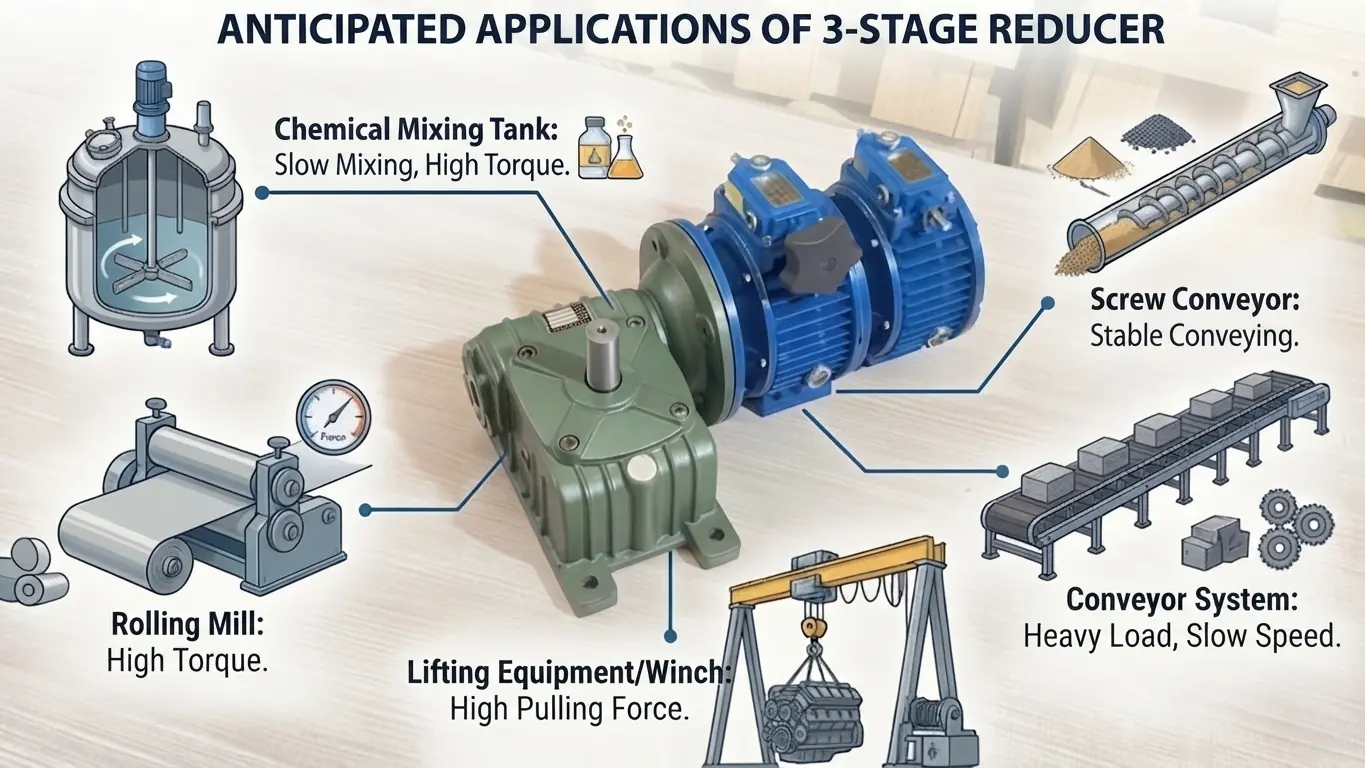
Applications of the 3-stage worm gearbox
Chemical and industrial adhesive mixing tanks: 3-stage gearboxes are often used when very slow mixing speeds are required while still ensuring sufficient mixing force to thoroughly blend materials.
Material conveying screw conveyors: Suitable for screw conveyor systems for cement, stone powder, bran, or granular materials that need stable transportation over long periods.
Industrial presses and rolling mills: Installed on equipment requiring large torque during operation.
Heavy-duty conveyor systems: Used for conveyors transporting heavy materials or production lines requiring slow movement speeds.
Lifting equipment and winches: Supports generating large pulling force for material lifting and handling applications in factories and workshops.
Low-speed production lines: Suitable for systems requiring deep speed reduction that 1-stage or 2-stage gearboxes cannot meet.
Applications of the 3-stage worm gearbox.
Price list of outstanding 3-stage worm gearboxes at Thanh Thai Motor
Below is the latest price list for 3-stage worm gearboxes at Thanh Thai Motor. Customers can refer to each size and transmission ratio to select the model that matches the actual needs of their machinery.
Criteria for choosing to buy a 3-stage worm gearbox
Determine the actual output speed of the machine: Before choosing the gearbox, it is necessary to know the exact desired revolution count to select the appropriate transmission ratio.
Check the working load of the equipment: Viscous mixers, long screw conveyors, or heavy-duty conveyors typically require a gearbox with higher load capacity than standard calculations.
Select the power capacity suitable for the motor: Motor power and gearbox load capacity must be synchronously calculated to avoid overloading during use.
Compare installation dimensions: Carefully check shaft diameters, flanges, mounting bases, and installation space before purchasing to minimize modification costs.
Consider actual operating conditions: For continuous working systems or dusty, high-humidity environments, prioritize gearboxes with sturdy structures and high durability.
Choose a supplier with technical support: Receiving proper advice on transmission ratios, power capacity, and replacement parts support will ensure smoother long-term operation.
If you need to learn more about the product, you can refer to the compiled videos from Thanh Thai Motor. These gearbox videos will help viewers better understand the internal structure, transmission principles, ratio selection methods, and detailed installation instructions.
Frequently asked questions
I am using a 4kW motor with a speed of 1450 rpm and want an output of about 8-10 rpm. Is a 3-stage worm gearbox suitable?
With such low-speed requirements, a 3-stage worm gearbox is a quite popular choice because it can achieve a large transmission ratio without using many additional auxiliary drives. However, it is still necessary to check the actual load torque to determine the correct gearbox size.
Do 2,000-liter adhesive mixers typically use a 2-stage or 3-stage gearbox?
This depends on the viscosity of the material and the required mixing speed. For thick adhesives or high-viscosity chemicals, a 3-stage gearbox is usually chosen to create greater mixing force during startup and operation.
If replacing a gearbox with a 1/200 transmission ratio with a 1/300 ratio, how will the machine change?
When increasing the transmission ratio, the output speed will decrease while the output pulling force will increase. Before making changes, check the machine’s required working speed to avoid affecting productivity or production processes.
Can a 3-stage worm gearbox be directly installed with an inverter motor?
Absolutely. This is a widely used practical option because it takes advantage of the gearbox’s large transmission ratio while allowing flexible speed adjustment through the inverter when needed.