When researching industrial fans, many customers often wonder whether to choose an axial fan or a centrifugal fan. These are two common types of air blowers, each with a distinct design and operating principle, leading to differences in air pressure, airflow, noise level, and operational efficiency. So, which type of fan-axial or centrifugal-should you use for your factory, ventilation system, or project? Thanh Thai Motor will help you compare axial fans and centrifugal fans so you can make the most optimal choice.
Classification of Centrifugal and Axial Fans
Currently, air blowers are broadly divided into 2 common types: centrifugal fans and axial fans.
Axial Fans: typically have a simple design, generating high airflow and low pressure, suitable for applications requiring rapid ventilation.
Centrifugal Fans: have a more complex structure, operating based on the centrifugal principle, generating higher pressure and stable airflow, suitable for conveying air over long distances or within systems.
The choice of which fan type is better depends on the specific needs of each application, such as pressure requirements, airflow, as well as installation and maintenance conditions.
Distinguish between Axial and Centrifugal Fans to Choose the Right Type for Your Needs
Comparing Axial and Centrifugal Fans
Here’s how axial and centrifugal fans compare in terms of similarities and differences:
Similarities Between Axial and Centrifugal Fans
Comparing axial and centrifugal fans reveals that they both have the ability to generate airflow and extract hot air, effectively changing pressure and circulating air. Both fan types play an important role in balancing air between two environments, specifically inside and outside the factory. Through this function, they contribute to improving air quality, reducing temperature and enhancing comfort for workers in industrial spaces.
Differences Between Centrifugal and Axial Fans
While comparing axial and centrifugal fans reveals some similarities, they also have clear differences, such as:
Fan and Blade Shape
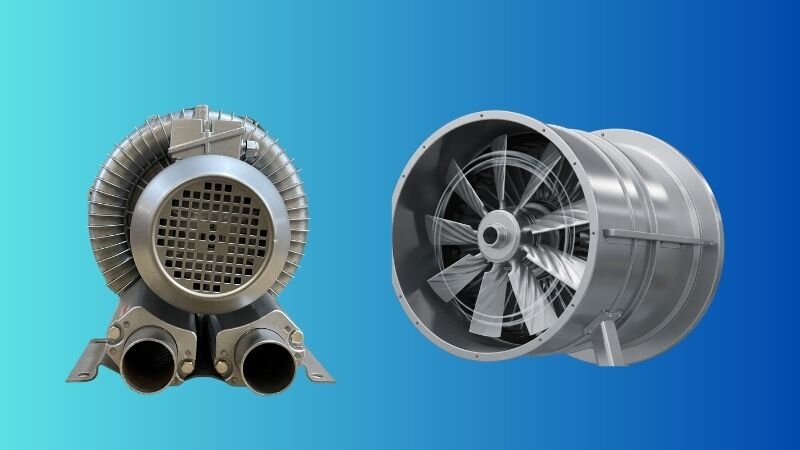
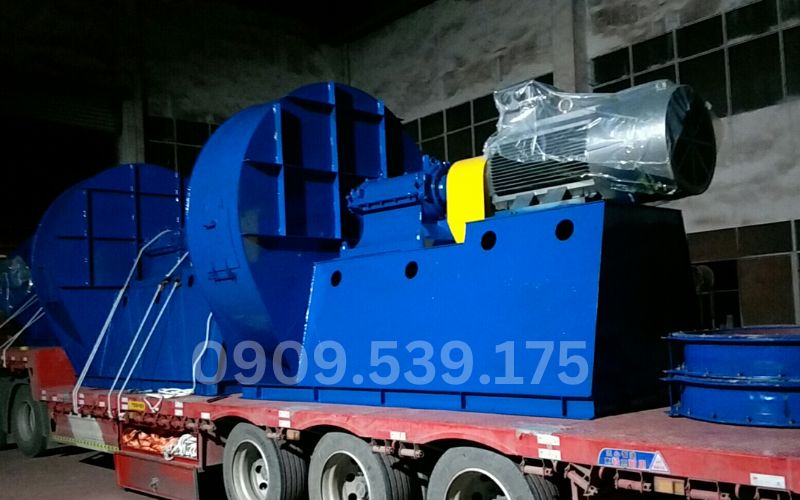
Centrifugal fans, also known as snail-shell fans, have a distinctive design with a spiral or snail-shell shaped casing. The internal impellers are typically numerous and designed as curved or straight blades to efficiently compress air. The structure of a centrifugal fan allows it to generate very high air pressure. Thanks to this design, centrifugal fans can transport air containing dust and impurities without significantly affecting the motor. A high-quality centrifugal fan always has this optimal design. Industrial hot air blowers often have a similar structure to centrifugal fans.
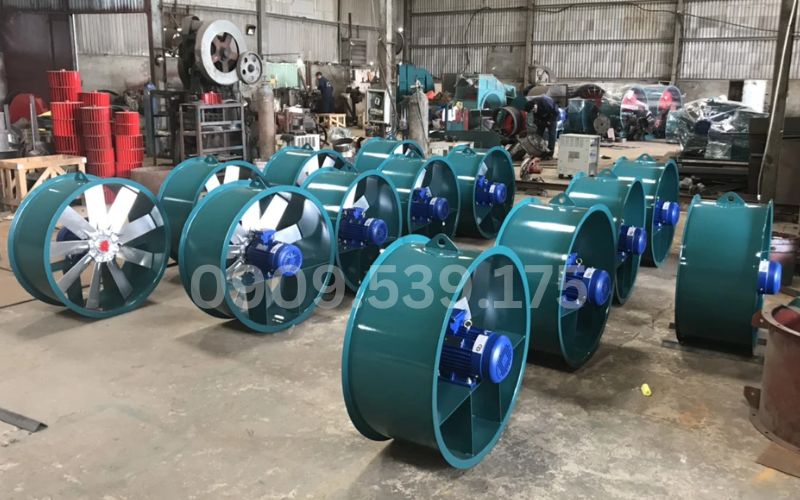
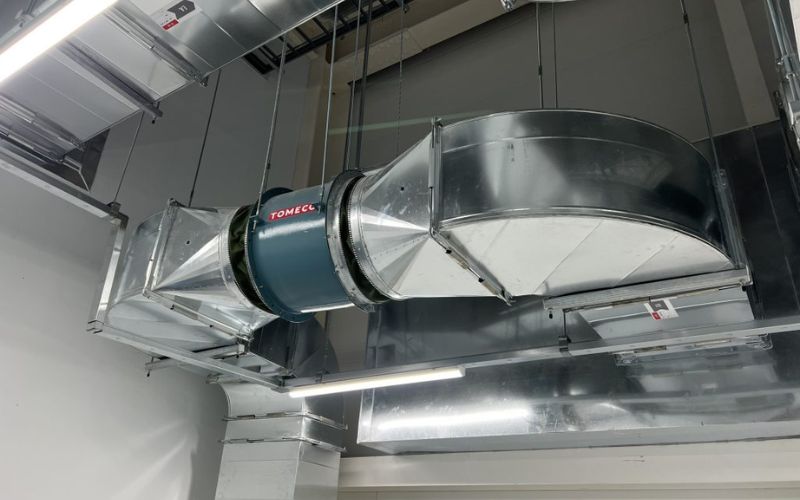
Axial fans have a simpler design, usually cylindrical or square. The number of blades is significantly fewer than centrifugal fans, and the blades are designed like airplane wings to create a large airflow in a specific direction. This design is ideal for ventilating large spaces but less effective when needing to push air through long ducts. This is the most basic type of air blower.
Motor Position and Impact on Performance, Lifespan
In centrifugal fans (snail-shell fans), the motor is typically placed outside the airflow. This protects the motor from dust, hot air, and corrosive chemicals in the air, helping to increase its lifespan and stability. This is why industrial hot air blowers and centrifugal fans are very durable. A good industrial air blower system always prioritizes motor protection.
In axial fans, the motor is located directly on the rotating shaft and within the airflow. This makes the motor susceptible to dust accumulation, overheating, corrosion, and rapid reduction in lifespan if operated in harsh environments. Maintenance for this type of air blower needs to be more frequent.
Noise Level and Vibration
Due to their blade structure and high-speed operation, axial fans typically generate less noise and vibration, especially in residential or light ventilation models.
Centrifugal fans, because they require strong centrifugal force to create pressure, usually produce more noise, particularly in high-power models. However, this can be mitigated by adding sound attenuators, soundproof casings, or anti-vibration pads.
Differences Between Axial and Centrifugal Fans
Advantages and Disadvantages of Centrifugal and Axial Fans
What are the advantages and disadvantages of centrifugal and axial fans?
Advantages of Centrifugal and Axial Fans
Below are the advantages regarding the differences between centrifugal and axial fans:
Advantages of Axial Fans:
High Airflow and Low Pressure: Axial fans can generate large airflow, suitable for ventilation applications.
Stable Air Quality: Air is circulated evenly.
Quiet Operation: Produces less significant noise during use.
Cost and Energy Efficient: Low initial investment cost, reduced power consumption, and low maintenance.
Long Lifespan: Simple design helps increase equipment durability.
Advantages of Centrifugal Fans:
Powerful Suction and Long-Distance Discharge: Centrifugal fans can generate high pressure, enabling air transmission through ducts over long distances.
Avoids Direct Dust Exposure: The design helps limit dust from entering the airflow, protecting the system and improving air quality.
What are the Advantages of Axial and Centrifugal Fans?
Disadvantages of Centrifugal and Axial Fans
Some disadvantages to note when using axial and centrifugal fans:
Disadvantages of Axial Fans: They are prone to dust accumulation on the fan blades and easily collect dirt, leading to rapid corrosion due to friction.
Disadvantages of Centrifugal Fans: High-pressure centrifugal fans can experience overload if not connected to a system, requiring an inlet damper or stable load systems.
Notes on Using Axial and Centrifugal Fans
Notes Before Using Axial Fans
Ensure Proper Installation: Check the fan’s rotation direction and ensure correct installation to optimize operational performance.
Regular Maintenance: Frequently inspect and clean the fan blades to reduce dust, prevent corrosion, and extend lifespan.
Load Control: Ensure the fan does not operate under overload, which can reduce efficiency and cause damage.
Notes When Using Centrifugal Fans
Precise Installation: Ensure the fan is installed aligned and perpendicular to the ducting system to avoid pressure loss.
Use a Damper: If the fan is not connected to a system, use an inlet damper to prevent motor overload.
Periodic Inspection: Conduct regular inspections and maintenance to ensure all components, especially the motor and fan blades, operate efficiently.
Comparing axial and centrifugal fans will help us avoid issues that may arise during use.
Notes on Using Axial and Centrifugal Fans
Air Blower Price List for 10/2026 at Thanh Thai Motor
After comparing axial and centrifugal fans, it’s clear that each type is suitable for different needs and operating environments. To help customers easily choose the right product, Thanh Thai Motor presents the latest air blower price list for 10/2026. The price list is clearly updated for each product line, assisting you in weighing investment costs against operational efficiency.
All models of air blowers (blower machines) supplied by Thanh Thai Motor come with an official warranty of up to 24 months. We are committed to providing transparent, fast, and professional warranty support, ensuring absolute peace of mind during use – whether you install it in a factory, construction site, production workshop, or residential area.
Nationwide Delivery – Fast and Safe
Thanh Thai Motor offers nationwide delivery, carefully transporting products – on schedule – to the correct address, reaching customers across the country. Heavy equipment will be carefully packaged and accompanied by installation instructions for customer peace of mind.
Advanced Technology – European Standard Compliant
Air blower models, especially centrifugal blowers and industrial hot air blowers, are all manufactured using German technology, meeting CE – European standards. As a result, the products offer high performance, durable operation, and power saving, making them suitable for factories, agricultural areas, warehouses, mines, and demanding work environments.
Competitive Prices – Attractive Offers for Dealers and Wholesale Customers
We always strive to offer the most reasonable prices. In addition, Thanh Thai Motor has a high discount policy for dealers, contractors, and wholesale customers who purchase large quantities or cooperate long-term. We are committed to mutual benefits – providing on-site technical support if needed.
Full CO, CQ Certification
Each product at Thanh Thai Motor comes with full:
CO (Certificate of Origin): Certificate of Origin
CQ (Certificate of Quality): Certificate of Quality
Meeting all standards for acceptance documentation, bidding, or supplying to government projects, industrial zones, and manufacturing plants.
Contact for Consultation & Ordering
Do you need advice on choosing the right air blower for your construction project, factory, or ventilation system? Thanh Thai Motor is ready to assist you 24/7:
Comparing axial and centrifugal fans requires careful consideration of technical requirements, operating environment, and investment capital to ensure optimal performance and durability throughout the operational process.